Section 318 BNS: Cheating, Bail & High Court Quashing
 Authored by: Advocate Kishan Kumar (Advocate & Legal Consultant)
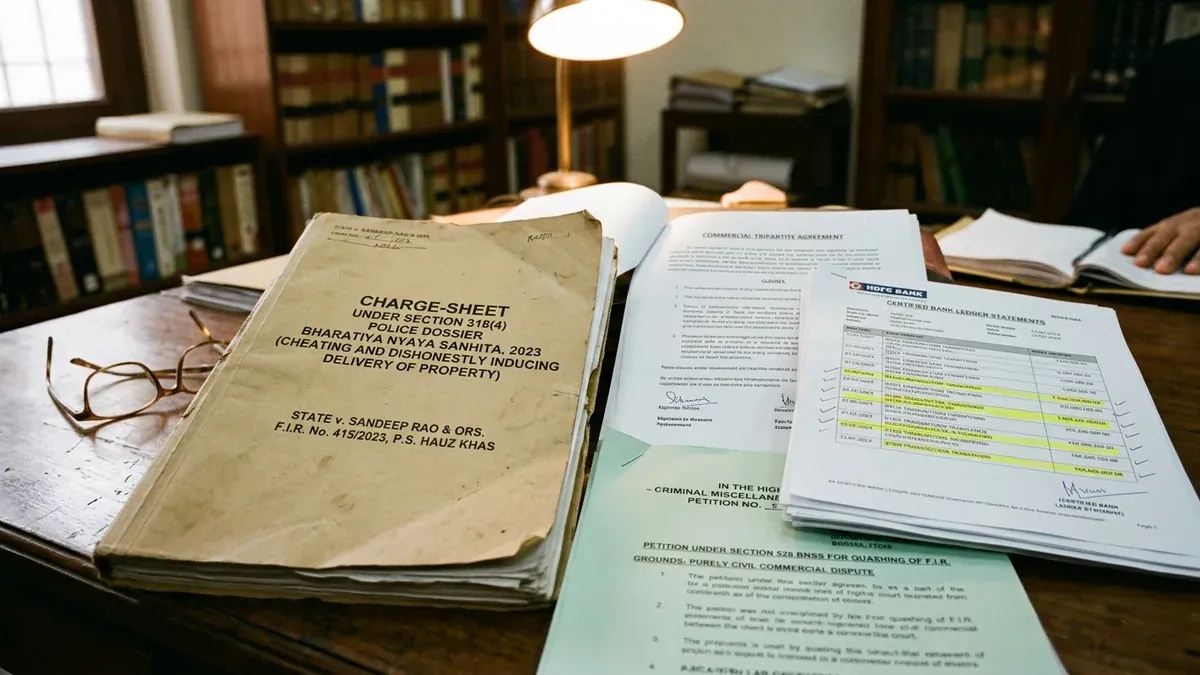
Quick Legal Takeaways
- Core Statutory Base: Exhaustive legal coverage under the latest 2024–2026 statutes and landmark judicial precedents.
- Practical Procedure: Detailed step-by-step litigation roadmap before District Courts, High Courts, and specialized tribunals.
- Evidence & Remedies: How to build watertight documentary trails and protect civil and personal liberties.
1. Essential Statutory Ingredients of Cheating under Section 318 BNS
Under the Bharatiya Nyaya Sanhita, which repealed and replaced the Indian Penal Code, 1860, the law governing fraud, deception, and property deprivation is consolidated primarily in Section 318 BNS (incorporating former Sections 415, 417, and 420 IPC). Section 318 defines cheating as deceitfully inducing any person to deliver property or to consent to the retention of property, or intentionally inducing a person to do or omit to do anything which causes harm to their body, mind, reputation, or property.
To sustain a criminal charge under Section 318(4) BNS (formerly Section 420 IPC — cheating and dishonestly inducing delivery of property), the prosecution or complainant must establish three foundational ingredients:
- Deception: The accused made a false representation, promise, or statement knowing it to be false at the time it was made.
- Dishonest Inducement: The fraudulent representation directly induced the victim to part with money, execute a document, or transfer property.
- Mens Rea from Inception: The fraudulent or dishonest intention must have existed at the very inception of the transaction, and not arisen merely as a subsequent commercial default.
2. The Critical Legal Distinction: Civil Breach of Contract vs. Criminal Cheating
A recurring challenge in Indian criminal litigation is the malicious practice of converting ordinary commercial contract defaults, partnership fallouts, or unpaid loans into criminal cheating FIRs under Section 318 BNS. The Supreme Court of India has repeatedly held that every breach of contract does not give rise to criminal cheating.
In Hridaya Ranjan Prasad Verma v. State of Bihar (2000) 4 SCC 168, the Supreme Court established the classic distinction: "The distinction between mere breach of contract and the offence of cheating depends on the intention of the accused at the time of inducement. Subsequent inability to perform a promise does not constitute cheating unless fraudulent intention existed from the very beginning."
If an individual or business entity enters into an agreement in good faith, makes initial payments or partial deliveries, and subsequently suffers financial insolvency or market disruption, such failure constitutes a civil breach of contract remediable through a civil suit for damages or summary suit under Order 37 CPC, rather than a criminal offence under Section 318 BNS.
3. Comprehensive Statutory Analysis under BNS 2023 & Related Provisions
The criminal framework under BNS 2023 groups economic and property offences with enhanced statutory penalties and streamlined procedural compliance:
- Section 318(2) BNS (Simple Cheating): Punishable with imprisonment up to 3 years, or fine, or both (formerly Section 417 IPC).
- Section 318(4) BNS (Cheating & Delivery of Property): Where cheating dishonestly induces delivery of property, valuable security, or signed documents, the offence carries imprisonment up to 7 years and mandatory fine (formerly Section 420 IPC).
- Section 316 BNS (Criminal Breach of Trust): Punishes dishonest misappropriation or conversion of property entrusted to a person, carrying imprisonment up to 5 years (or up to 7 years for bankers, merchants, or agents under Section 316(5) BNS).
- Section 336 BNS (Forgery for Purpose of Cheating): Fabricating false documents, digital signatures, or forged contracts with intent to deceive, punishable with up to 7 years imprisonment (formerly Section 468 IPC).
- Section 35(3) BNSS Notice (formerly Section 41A CrPC): For offences punishable with 7 years or less, police cannot make arbitrary arrests without serving a mandatory notice of appearance.
4. Landmark Supreme Court & High Court Precedents
The Supreme Court held that where the dispute is essentially of a civil nature arising out of a financial transaction, filing a criminal complaint under cheating sections is an abuse of judicial process. The High Court must exercise its inherent quashing powers to prevent harassment of bona fide business partners.
The Supreme Court reiterated that a mere failure to keep a promise cannot be presumed as culpable cheating unless there is clear documentary evidence showing fraudulent representation right from the commencement of the agreement.
Established the foundational 7 categories for quashing criminal proceedings under Section 528 BNSS (formerly 482 CrPC), explicitly including instances where criminal allegations are manifestly attended with mala fide motives or lack essential ingredients of cognizable crime.
5. Complete Procedural Roadmap: Defense, Bail & Quashing Strategy
When an individual or corporate director is falsely implicated or investigated under Section 318 BNS, our senior criminal defense advocates recommend the following systematic strategy:
- Compliance with Section 35(3) BNSS Notice: If police issue a notice of appearance, attend the inquiry with an advocate, submit complete documentary evidence (contracts, bank statements, email correspondences), and secure written acknowledgment.
- Anticipatory Bail under Section 482 BNSS: If there is an imminent threat of arrest in a non-bailable Section 318(4) FIR, immediately move an Anticipatory Bail Application before the Sessions Judge (Faridabad/Delhi) demonstrating that the dispute is civil and documentary in nature.
- Petition for Quashing under Section 528 BNSS (High Court): File a petition before the High Court of Punjab & Haryana or Delhi High Court demonstrating that the FIR lacks initial mens rea and represents a criminalized civil dispute.
- Interim Stay on Arrest & Coercive Proceedings: Pray for urgent interim protection from the High Court while the quashing petition is adjudicated.
6. Comparative Assessment Table: Civil Recovery vs. Section 318 Criminal Complaint
| Parameter | Civil Suit for Money Recovery | Section 318 BNS Criminal FIR | Summary Suit (Order 37 CPC) |
|---|---|---|---|
| Primary Objective | Financial recovery with interest | Penal punishment & deterrence | Fast-track recovery of debt |
| Standard of Proof | Preponderance of probabilities | Beyond reasonable doubt | Written admission of debt |
| Essential Requirement | Valid contract & default | Dishonest intent at inception | Liquidated debt / Negotiable instrument |
| Limitation Period | 3 Years (Limitation Act) | 3 Years under Section 514 BNSS (for ≤3 yrs offences) | 3 Years from debt due date |
| Court Fees | Ad-valorem state court fees | Nil (State prosecution) | Ad-valorem state court fees |
7. Strategic Legal Advisory for Businesses in Faridabad & Delhi NCR
- Draft Clear Written Agreements: Always execute stamped and registered agreements with precise termination clauses, force majeure provisions, and dispute resolution mechanisms to prevent civil defaults from being painted as fraud.
- Preserve Contemporaneous Communication: Maintain complete records of WhatsApp chats, emails, and bank receipts under Section 63 BSA 2023 certification to prove bona fide intent throughout the contract lifecycle.
- Act Swiftly Upon Police Station Summons: Never ignore informal calls or Section 35(3) notices. Immediate legal representation ensures that investigative officers record defense exhibits on the official case diary.
Statutory Authorities & Legal References
- Bharatiya Nyaya Sanhita & Bharatiya Nagarik Suraksha Sanhita, 2023
- Bharatiya Sakshya Adhiniyam, 2023 (Section 63 Electronic Evidence Certificate)
- Landmark rulings of the Supreme Court of India and Punjab & Haryana High Court
- Case precedents reported in Supreme Court Cases (SCC), All India Reporter (AIR), and Punjab Law Reporter (PLR).
- e-Courts Services & National Judicial Data Grid (NJDG) procedural tracking guidelines.
Disclaimer: This article is published for educational and informational purposes only under the Advocates Act, 1961. It does not constitute formal legal advice or create an attorney-client relationship. For case-specific legal strategy, consult a qualified advocate.
Actionable Next Steps & Critical Legal Checklist
If you are facing an active legal dilemma regarding Criminal Trial Defence & Evidence Checklist, execute these immediate procedural steps to protect your statutory rights:
- Establish Civil Nature of Dispute: Demonstrate through contracts, account ledgers, and bank trails that the matter involves commercial breach rather than penal fraud.
- Preserve Digital Communications: Archive all WhatsApp chats, SMS threads, emails, and audio recordings certified under Section 63 of Bharatiya Sakshya Adhiniyam 2023.
- Explore Section 359 BNSS Compounding: If parties resolve differences, prepare a formal Compromise Deed for compounding or mutual quashing before the High Court.
Frequently Asked Questions
Key statutory answers and procedural guidance curated by Senior Advocates in Faridabad & Delhi NCR.
What is the punishment for cheating under Section 318 BNS (formerly Section 420 IPC)?
Under Section 318(4) BNS 2023, cheating coupled with dishonest inducement to deliver property or alter valuable securities carries rigorous imprisonment for up to 7 years and a mandatory fine. Simple cheating under Section 318(2) BNS carries imprisonment for up to 3 years, or fine, or both.
Can an FIR for cheating under Section 318 BNS be quashed if parties settle the dispute?
Yes. Under the landmark Supreme Court ruling in Gian Singh v. State of Punjab, commercial cheating cases that do not involve heinous offences or public corruption can be quashed by the High Court under Section 528 BNSSbased on a mutual settlement deed and compromise agreement.
How can an accused obtain Anticipatory Bail in a Section 318 BNS cheating case?
The accused must file an application under Section 482 BNSSbefore the Sessions Court or High Court, highlighting: (a) absence of criminal intent at inception, (b) purely civil/commercial nature of transaction, (c) availability of documentary trail, and (d) willingness to join police investigation without flight risk.
Is Section 318(4) BNS bailable or non-bailable?
Section 318(4) BNS is a cognizable and non-bailable offence, triable by a Magistrate of the First Class. However, under Section 35(3) BNSS, police cannot make automatic arrests without recording specific statutory grounds in writing.
What is the difference between Section 318 BNS (Cheating) and Section 316 BNS (Criminal Breach of Trust)?
In cheating (Section 318), the dishonest intention exists from the very beginning to induce delivery of property. In criminal breach of trust (Section 316), property is initially entrusted lawfully, and the dishonest misappropriation or conversion occurs subsequently.