 Authored by: Advocate Kishan Kumar (Advocate & Legal Consultant)
Cheque Bounce Legal Notice: Checklist & Mistakes
Quick Legal Takeaways
- Core Statutory Base: Exhaustive legal coverage under the latest 2024–2026 statutes and landmark judicial precedents.
- Practical Procedure: Detailed step-by-step litigation roadmap before District Courts, High Courts, and specialized tribunals.
- Evidence & Remedies: How to build watertight documentary trails and protect civil and personal liberties.
1. Statutory Criticality of the Section 138(b) Demand Notice
Proceedings under Section 138 of the Negotiable Instruments Act (NI Act) offer one of the most potent criminal remedies for recovering commercial dues and loan defaults in India. However, unlike regular civil suits, Section 138 is a strictly construed penal enactment where cause of action does NOT arise upon cheque dishonour alone; it arises only when the drawer fails to make payment within 15 days of receiving a valid statutory demand notice.
- Adhere to 30-Day Notice Window: Issue a formal advocate legal demand notice under Section 138 Proviso (b) within exactly 30 days of receiving the bank memo.
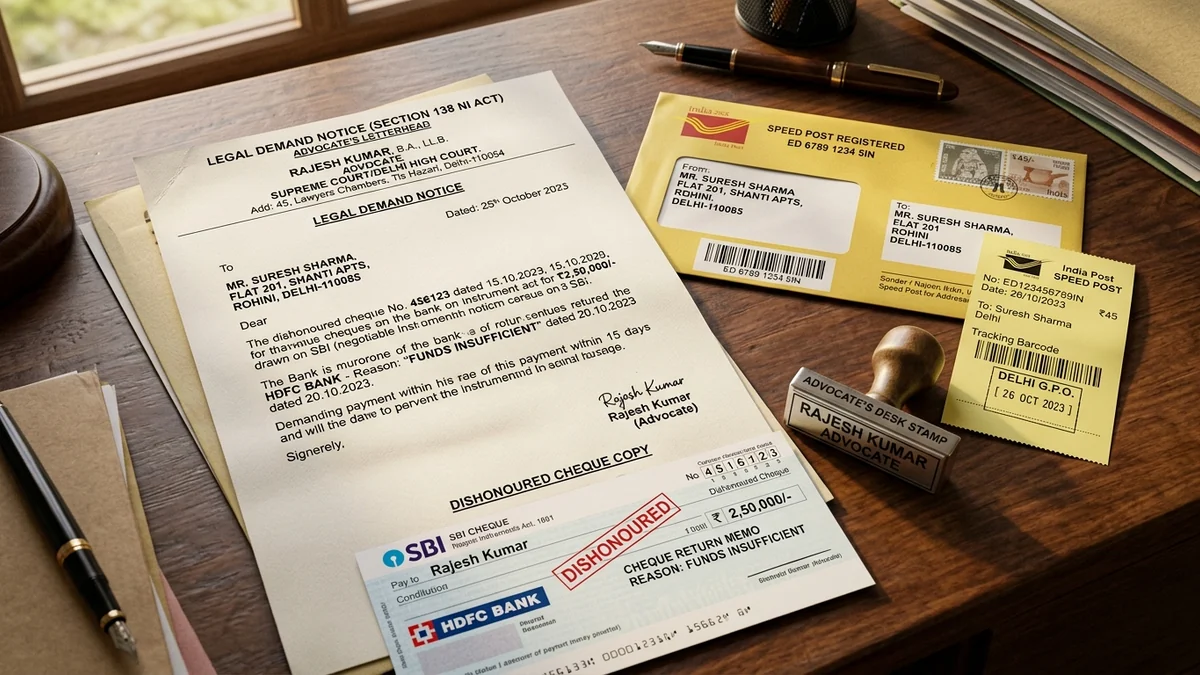
- Preserve Original Records: Safeguard the original cheque, return memo with bank seal, postal speed post receipts, and online tracking delivery reports.
- Calculate 15-Day Cure Period: Allow exactly 15 days for payment after notice delivery before filing the complaint within 30 days under Section 142 NI Act.
2. Fatal Mistake #1: Missing the Mandatory 30-Day Notice Window
The 30-day period begins from the exact date the complainant or their bank receives the official Bank Return Memo (not the date of cheque issuance or deposit). Even a single day's delay beyond 30 days extinguishes the cause of action under Section 138:
- Bank Memo Date vs. Receipt Date: In Subodh S. Salaskar v. Jayprakash M. Shah (2008) 13 SCC 689, the Supreme Court held that the 30-day limitation runs from the date the return memo is actually delivered or made available to the payee.
- Evidence Required: Always preserve the bank acknowledgment slip or online banking return timestamp as primary documentary evidence.
3. Fatal Mistake #2: Premature Filing before 15-Day Cure Period Expires
Under Section 138, Proviso (c), the drawer is granted an inviolable 15-day cure period from the date of receipt of notice to arrange funds and pay the demanded amount. The cause of action arises only on the 16th day:
The Supreme Court affirmed that a complaint filed before the expiry of 15 days from the date of notice service is premature and non-est in the eyes of law. Magistrates cannot take cognizance of a premature complaint, and the defect cannot be cured by subsequent passage of time during trial.
4. Fatal Mistake #3: Combining Cheque Amount with Unspecified Damages / Interest
A fatal drafting error occurs when the advocate demands an omnibus, unsegregated sum (e.g. "Pay Rs. 15 Lakhs towards cheque amount, interest, damages, and legal fees within 15 days"):
- The Rule of Severability (*Suman Sethi v. Ajay K. Churiwal (2000) 2 SCC 380*): The demand notice must make a specific, unambiguous demand for the exact cheque amount. While interest or legal costs can be mentioned separately, failure to clearly sever the principal cheque amount invalidates the statutory demand.
- Drafting Best Practice: State: "We hereby demand payment of Rs. 10,00,000/- (Ten Lakhs only), being the exact dishonoured cheque amount, failing which criminal proceedings under Section 138 shall be initiated. You are separately called upon to pay interest at 18% p.a. and Rs. 11,000/- towards notice charges."
5. Fatal Mistake #4: Failure to Serve Notice on Company & Active Directors
Where a cheque is issued on the bank account of a Private Limited Company, LLP, or Partnership Firm, serving notice solely on an individual director is fatal to prosecution:
A 3-Judge Bench of the Supreme Court held that maintaining a prosecution under Section 141 NI Act against directors is impermissible without arraigning the company as a primary accused. The demand notice MUST be addressed and served independently on: (1) The Corporate Entity at its registered office, and (2) Specific Whole-Time Directors / Managing Directors / Authorized Signatories detailing their active operational roles.
6. Fatal Mistake #5: Defective Postal Service & Presumption of Delivery
To avoid false defenses that "notice was never received", complainants must strictly comply with the landmark Supreme Court ruling in C.C. Alavi Haji v. Palapetty Muhammed (2007) 6 SCC 555:
- Section 27 General Clauses Act Presumption: When a notice is correctly addressed, prepaid, and dispatched via Registered Post AD / Speed Post, service is legally presumed to have been effected on the date it would normally be delivered.
- Unclaimed / Refused Endorsement: Postal remarks like "Refused", "Unclaimed", or "Addressee Left without Intimation" are deemed valid service in law.
- Post-Summons 15-Day Safe Harbour: If the drawer claims in court that they did not receive notice, they must pay the cheque amount within 15 days of receiving court summons. Failing to pay at the summons stage bars them from raising non-receipt of notice as a defence.
7. Essential 7-Point Drafting Checklist for Section 138 Legal Notice
Before dispatching a Section 138 demand notice, ensure every parameter is strictly satisfied:
- Full Particulars of Underlying Debt: Date, invoice number, contract agreement, or loan sanction details establishing legally enforceable consideration.
- Complete Cheque Particulars: Cheque number, date, drawn bank, branch, and exact amount in words and figures.
- Bank Memo Details: Presentation date, clearing memo date, exact bank return code and remark (e.g. "Funds Insufficient").
- Clear 15-Day Unconditional Demand: Explicit instruction demanding payment of the principal cheque amount within 15 calendar days of receipt.
- Mode of Payment Specification: Designating payee bank details (RTGS/NEFT/Demand Draft) for remittance.
- Clear Penal Warning: Notice of intention to initiate criminal prosecution under Section 138 NI Act and Section 318 BNS (Cheating) upon default.
- Multiple Dispatch Channels: Dispatching via Speed Post with Tracking, Registered Post AD, and backed by a Section 63 BSA certified email/WhatsApp message.
8. Strategic Advisory for Answering / Defending False 138 Notices
If you have received an unjustified Section 138 demand notice for a lost, stolen, or expired security cheque:
- Issue a Detailed Counter-Reply within 15 Days: Explicitly state the defence (e.g. security cheque misused post-loan clearance, breach of contract, lack of consideration) to establish contemporaneous rebuttal before trial commences.
- Demand Account Statements & Ledger Proof: Call upon the sender to produce audited ledgers and invoices verifying the alleged liability.
- File Police Complaint for Misappropriation: If a signed blank security cheque was stolen or filled fraudulently, lodge an immediate police report under Section 316 BNS (Criminal Breach of Trust) to create an unbroken evidentiary defense.
9. Comparative Assessment: Flawed Notice vs. Watertight Notice
| Parameter | Flawed / Defective Legal Notice | Watertight Compliant Legal Notice |
|---|---|---|
| Dispatch Date | Dispatched on Day 31+ post-memo (Fatal) | Dispatched within 1 to 10 days of memo |
| Amount Demanded | Lump-sum interest & damages mixed | Cheque amount severed from damages |
| Corporate Drawee | Sent only to individual director | Served on company registered office & directors |
| Postal Proof | Unverified courier receipt without tracking | Speed Post consignment report with tracking |
8. Frequently Asked Questions (FAQ)
Answer: Yes. Indian courts, including the Supreme Court in the Suo Motu Cognizance case (2020), have recognized electronic service via Email and WhatsApp as valid statutory notice, provided delivery is proven by read receipts (blue ticks) and accompanied by an electronic certificate under Section 63 BSA 2023 (old 65B). However, sending via Speed Post is still mandatory as primary mode.
Answer: If notice returns with 'Address Incomplete', verify the address registered on the drawer's GST portal, MCA company master data, or Aadhaar records. Re-dispatch immediately within the 30-day window or present documentary proof that the drawer intentionally provided a false address.
Answer: While not strictly mandatory, failing to reply allows the court to draw an adverse inference that the drawer had no defense to offer. Issuing a prompt reply within 15 days sets up your defense (e.g., security cheque misuse, payment already made, lack of consideration) early in the record.
Answer: Yes. Under Supreme Court rulings, a single composite legal demand notice can cover multiple dishonoured cheques issued by the same drawer to the same payee within the statutory 30-day window from the bank return memo.
Answer: Filing a complaint on or before the 15th day is premature and invalid in law. Under the Supreme Court ruling in Kamlesh Kumar (2014), the cause of action only arises on the 16th day, and premature complaints are liable to be dismissed.
Statutory Authorities & Legal References
- Negotiable Instruments Act (Sections 138, 139, 141, 142 & 143A)
- Bharatiya Nagarik Suraksha Sanhita, 2023 (Summary Trial Procedure)
- Supreme Court precedents reported in Supreme Court Cases (SCC) and All India Reporter (AIR)
- Case precedents reported in Supreme Court Cases (SCC), All India Reporter (AIR), and Punjab Law Reporter (PLR).
- e-Courts Services & National Judicial Data Grid (NJDG) procedural tracking guidelines.
Disclaimer: This article is published for educational and informational purposes only under the Advocates Act, 1961. It does not constitute formal legal advice or create an attorney-client relationship. For case-specific legal strategy, consult a qualified advocate.
Actionable Next Steps & Critical Legal Checklist
If you are facing an active legal dilemma regarding Cheque Dishonour Statutory Action Checklist, execute these immediate procedural steps to protect your statutory rights:
- Adhere to 30-Day Notice Window: Issue a formal advocate legal demand notice under Section 138 Proviso (b) within exactly 30 days of receiving the bank memo.
- Preserve Original Records: Safeguard the original cheque, return memo with bank seal, postal speed post receipts, and online tracking delivery reports.
- Calculate 15-Day Cure Period: Allow exactly 15 days for payment after notice delivery before filing the complaint within 30 days under Section 142 NI Act.