Section 138 NI Act: Cheque Bounce Complete Guide
 Authored by: Advocate Kishan Kumar (Advocate & Legal Consultant)
Quick Legal Takeaways
- Core Statutory Base: Exhaustive legal coverage under the latest 2024–2026 statutes and landmark judicial precedents.
- Practical Procedure: Detailed step-by-step litigation roadmap before District Courts, High Courts, and specialized tribunals.
- Evidence & Remedies: How to build watertight documentary trails and protect civil and personal liberties.
1. Statutory Framework of Section 138 NI Act
The dishonour of a cheque issued towards the discharge, in whole or in part, of any legally enforceable debt or other liability constitutes a criminal offence under Section 138 of the Negotiable Instruments Act (NI Act). The primary legislative objective is to infuse credibility into commercial transactions and banking operations. Section 138 creates strict statutory criminal liability punishable with imprisonment up to two (2) years, or with a fine which may extend to twice the amount of the cheque, or both.
- Adhere to 30-Day Notice Window: Issue a formal advocate legal demand notice under Section 138 Proviso (b) within exactly 30 days of receiving the bank memo.
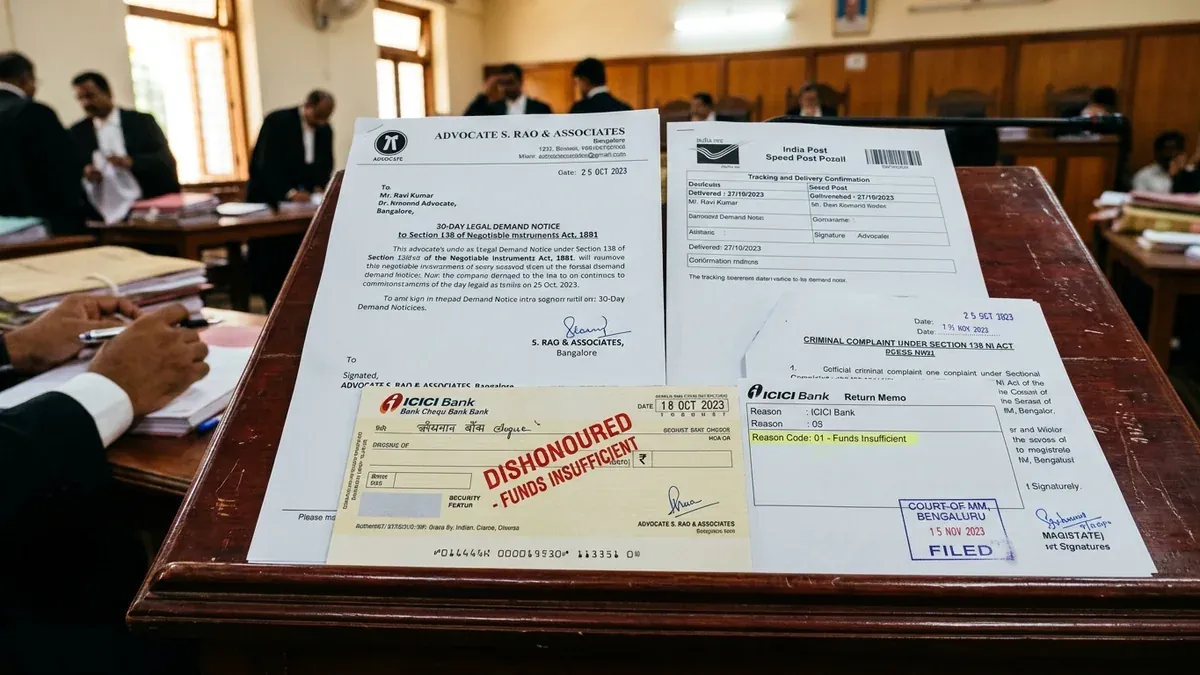
- Preserve Original Records: Safeguard the original cheque, return memo with bank seal, postal speed post receipts, and online tracking delivery reports.
- Calculate 15-Day Cure Period: Allow exactly 15 days for payment after notice delivery before filing the complaint within 30 days under Section 142 NI Act.
2. The Mandatory 4-Stage Statutory Timeline
To establish a valid cause of action under Section 138, the complainant must execute four consecutive statutory steps without procedural deviation:
- Cheque Presentation within 3 Months: The cheque must be presented to the bank within its validity period of three (3) months from the date inscribed on the instrument.
- Bank Return Memo: The cheque is returned unpaid with reasons such as "Funds Insufficient", "Account Closed", "Stop Payment", "Refer to Drawer", or "Exceeds Arrangement".
- Statutory Demand Notice within 30 Days: Within 30 days of receiving the bank return memo, the payee must issue a formal written demand notice to the drawer demanding payment of the cheque amount.
- 15-Day Cure Period & 30-Day Filing Window: The drawer is granted 15 days from receipt of notice to make payment. If payment is not made, the cause of action arises on the 16th day, and the complaint must be filed before the Judicial Magistrate within 30 days thereafter.
3. Statutory Presumptions under Sections 118 & 139 NI Act
Section 138 is bolstered by formidable legal presumptions in favor of the holder in due course:
Under Section 118(a) and Section 139 of the NI Act, the court shall presume that the cheque was drawn for consideration and received for the discharge of a legally enforceable debt. In Bir Singh v. Mukesh Kumar (2019) 4 SCC 197 and Triyambak S. Hegde v. Sripad (2022) 1 SCC 742, the Supreme Court held that once the signature on a cheque is admitted, the presumption of debt arises automatically, and the burden shifts entirely to the accused to rebut the presumption on a preponderance of probabilities.
4. Interim Compensation (Section 143A) & Appellate Deposit (Section 148)
To eliminate dilatory trial tactics by dishonest drawers, Parliament enacted major statutory amendments:
- Section 143A Interim Compensation: In a summary trial or summons case, the trial court may order the drawer to deposit up to 20% of the cheque amount as interim compensation to the complainant within 60 days of framing notice.
- Section 148 Appellate Deposit: In an appeal against conviction by the drawer, the Appellate Court (Sessions Court) shall order the appellant to deposit a minimum of 20% of the fine or compensation awarded by the trial court (*Surinder Singh Deswal v. Virender Gandhi (2019) 11 SCC 341*).
5. Vicarious Liability of Directors & Partners (Section 141 NI Act)
Where a dishonoured cheque is issued by a Private Limited Company, LLP, or Partnership Firm, criminal liability extends beyond the company itself:
Under Section 141 NI Act, every person who was in charge of and responsible to the company for the conduct of its business at the time of the offence is deemed guilty. However, specific averments detailing the active operational role of each director must be explicitly pleaded in the complaint; merely naming non-executive or independent directors without specific roles warrants High Court quashing under Section 528 BNSS (*Sunita Palita v. Panchami Stone Quarry (2022)*).
6. Legal Status of Security Cheques & Stop Payment Instructions
- Security Cheques: In APS Forex Services Pvt. Ltd. v. Shakti International Fashion Linkers (2020) 12 SCC 724 and Sripati Singh v. State of Jharkhand (2021), the Supreme Court held that a cheque issued as security matures into a legally enforceable instrument the moment a commercial loan or contractual debt becomes overdue and unpaid.
- Stop Payment Instructions: In Modi Cements Ltd. v. Kuchil Kumar Nandi (1998) 3 SCC 249, the Apex Court affirmed that issuing 'Stop Payment' instructions does not evade Section 138 liability unless the drawer proves sufficient funds existed in the account and payment was stopped for a valid extraneous reason.
7. Territorial Jurisdiction Rules (Section 142(2) NI Act)
Following the Negotiable Instruments (Amendment) Act 2015, the jurisdictional rules for filing cheque bounce complaints were simplified:
- Where Cheque is Delivered for Collection through Account: The complaint must be instituted strictly before the court within whose local jurisdiction the branch of the bank where the payee maintains their account is situated.
- Where Cheque is Presented for Payment over the Counter: The complaint is filed where the drawer's bank branch maintaining the account is located.
8. Summary Trial Procedure before Judicial Magistrate First Class (JMFC)
The standard lifecycle of a Section 138 trial follows these systematic stages:
- Filing Complaint & Verification (Sec 142 NI Act): Institution of complaint with original cheque, return memo, postal receipt, tracking report, and pre-summoning evidence affidavit under Section 145 NI Act.
- Issuance of Summons / Bailable Warrants: Magistrate issues summons to the accused drawer. If unserved or ignored, bailable/non-bailable warrants are issued.
- Notice Framing & Bail (Sec 274 BNSS / old 251 CrPC): Accused appears, secures bail, and court frames notice asking if accused pleads guilty.
- Application under Section 143A: Complainant moves application for 20% interim compensation.
- Cross-Examination of Complainant (CW-1): Defence counsel cross-examines complainant on financial capacity, ITR non-disclosure, or lack of consideration.
- Statement of Accused (Sec 351 BNSS / old 313 CrPC) & Defence Evidence: Accused explains defence and introduces bank records, handwriting expert reports, or counter-receipts.
- Final Arguments & Judgment: Court pronounces conviction (imprisonment up to 2 years, double compensation) or acquittal.
9. Comparative Assessment: Cheque Bounce vs. Summary Suit vs. BNS Cheating
| Parameter | Section 138 NI Act | Order 37 CPC Summary Suit | Section 318 BNS Cheating (IPC 420) |
|---|---|---|---|
| Nature of Remedy | Quasi-criminal with financial recovery | Pure civil recovery decree | Pure criminal prosecution |
| Limitation Period | 30 days post 15-day notice period | 3 years from cause of action | 3 years from occurrence |
| Court Fees | Nominal court fee (~Rs. 50 - 1,000) | Full ad-valorem court fee (~5% - 7.5%) | Nil (State prosecution / Police FIR) |
| Interim Relief | Up to 20% under Section 143A NI Act | Conditional leave to defend deposit | No interim compensation |
10. Practical Evidentiary Checklist for Payees in Delhi NCR
- Always Dispatch Notices via Speed Post with Tracking: Preserve the India Post consignment tracking receipt showing 'Item Delivered' or 'Refused' (deemed service under Section 27 General Clauses Act as held in C.C. Alavi Haji).
- Comply with Section 269SS Income Tax Act: If advancing commercial or friendly loans exceeding Rs. 20,000, always transfer via banking channels (RTGS/NEFT/Cheque) to prevent the accused from alleging unaccounted cash transactions.
- Execute Underlying Loan Agreements / Promissory Notes: Back all cheques with stamped loan agreements, invoices, or delivery challans to establish watertight debt enforceability.
Statutory Authorities & Legal References
- Negotiable Instruments Act (Sections 138, 139, 141, 142 & 143A)
- Bharatiya Nagarik Suraksha Sanhita, 2023 (Summary Trial Procedure)
- Supreme Court precedents reported in Supreme Court Cases (SCC) and All India Reporter (AIR)
- Case precedents reported in Supreme Court Cases (SCC), All India Reporter (AIR), and Punjab Law Reporter (PLR).
- e-Courts Services & National Judicial Data Grid (NJDG) procedural tracking guidelines.
Actionable Next Steps & Critical Legal Checklist
If you are facing an active legal dilemma regarding Cheque Dishonour Statutory Action Checklist, execute these immediate procedural steps to protect your statutory rights:
- Adhere to 30-Day Notice Window: Issue a formal advocate legal demand notice under Section 138 Proviso (b) within exactly 30 days of receiving the bank memo.
- Preserve Original Records: Safeguard the original cheque, return memo with bank seal, postal speed post receipts, and online tracking delivery reports.
- Calculate 15-Day Cure Period: Allow exactly 15 days for payment after notice delivery before filing the complaint within 30 days under Section 142 NI Act.
Frequently Asked Questions
Key statutory answers and procedural guidance curated by Senior Advocates in Faridabad & Delhi NCR.
Can a company director be prosecuted for a cheque issued by the company?
Yes. Under Section 141 of the NI Act, every director who was in charge of and responsible to the company for the conduct of its business at the time of the offence is vicariously liable, provided specific averments detailing their active role are made in the complaint.
What happens if the drawer issues a 'Stop Payment' instruction to the bank?
Under the Supreme Court ruling in Modi Cements v. Kuchil Kumar Nandi, a cheque returned with 'Stop Payment' instructions is fully actionable under Section 138 NI Actunless the drawer proves sufficient funds existed and payment was stopped for a valid extraneous dispute.
Is an unsigned or undated security cheque actionable under Section 138?
Under Section 20 of the NI Act and the Supreme Court ruling in Bir Singh v. Mukesh Kumar (2019), when a person signs and delivers a blank or security cheque, they authorize the holder to fill in remaining particulars. The cheque is fully actionable upon dishonour for an overdue debt.
Can a complainant claim interim compensation during a Section 138 trial?
Yes. Under Section 143A of the NI Act, the trial court has discretionary power to order the accused drawer to deposit up to 20% of the cheque amount as interim compensation to the complainant within 60 days of framing notice.
Where should a cheque bounce complaint be filed after the 2015 amendment?
Under Section 142(2) of the NI Act, the complaint must be filed before the Magistrate court having territorial jurisdiction over the bank branch where the payee maintains their account and deposits the cheque for clearance.