Consumer Court Remedies for Insurance Claim Rejection
 Authored by: Advocate Kishan Kumar (Advocate & Legal Consultant)
Quick Legal Takeaways
- Deficiency of Service (Sec 2(11) CPA 2019): Arbitrary rejection of health, life, or motor insurance claims constitutes actionable deficiency of service.
- Pecuniary Commission Jurisdiction: District Forum handles claims up to Rs. 50 Lakhs (e.g., District Consumer Commission Sector-12 Faridabad).
- Pre-Existing Disease Rule (Manmohan Nanda): Insurers cannot reject claims by alleging unrelated pre-existing ailments after accepting proposals.
- No Hyper-Technical Delays (Gurmel Singh): Claims cannot be denied for minor paperwork delay.
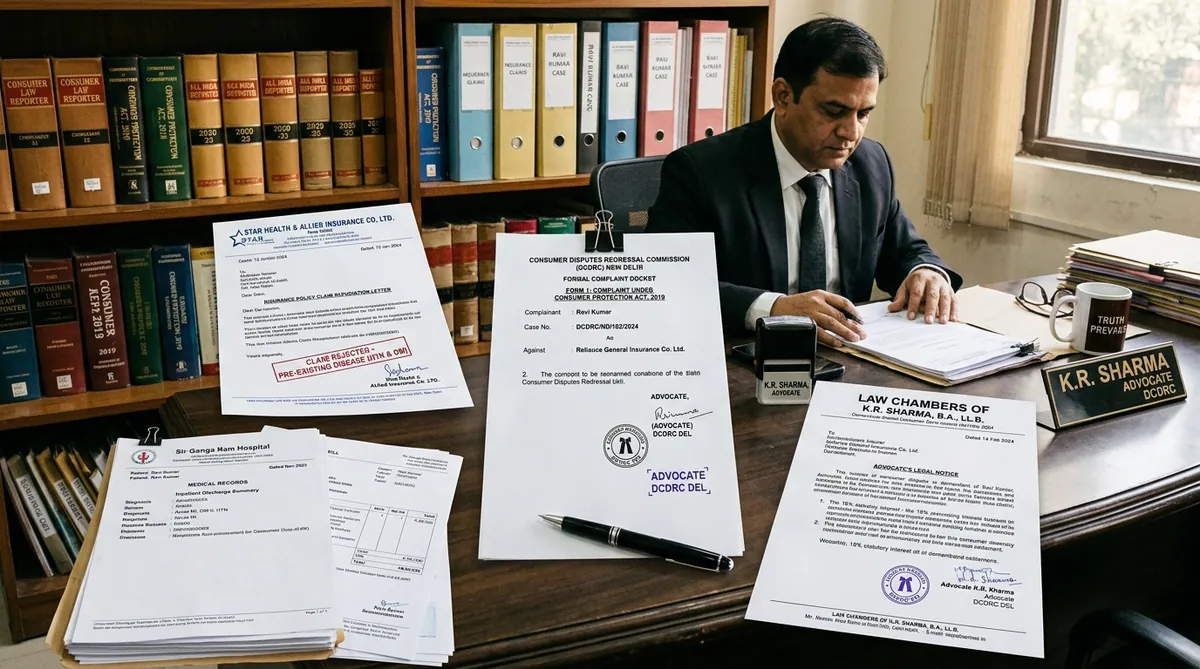
Policyholders who pay regular premiums frequently face sudden financial distress when insurance companies arbitrarily reject health insurance, life insurance, or motor accident claims relying on technical exclusion clauses. Rejecting a valid claim without justification constitutes a Deficiency of Service under Section 2(11) of the Consumer Protection Act.
- Calculate Ad Valorem Court Fees & Interest: Compute statutory interest under HRERA Rules or Section 7(iv) Court Fees Act before filing claims.
- Observe 2-Year Consumer Limitation Window: File consumer forum complaints within 2 years from the date of cause of action under Section 69 Consumer Protection Act.
- Execute Court Decrees Under Order 21 CPC: If opponent defaults on judicial orders, initiate execution proceedings or contempt under Order 39 Rule 2A CPC.
1. Common Arbitrary Grounds Used by Insurance Insurers
- Non-disclosure of pre-existing diseases (PED) for unrelated ailments.
- Hyper-technical delay in intimating motor accident or hospitalization.
- Unfair interpretation of "cashless treatment" exclusions.
The Supreme Court held that insurance contracts are governed by the principle of uberrimae fidei (utmost good faith). Once an insurer accepts a proposal after medical examination, they.
The Apex Court ruled that insurance companies must not adopt a hyper-technical approach to deny genuine claims based on minor delay in submitting claim documents or surveyor reports.
2. Step-by-Step Legal Procedure to Recover Rejected Claims
- Issue a formal Grievance Complaint to IRDAI Ombudsperson and the insurer's Nodal Officer.
- Serve a 15-day Legal Notice for Deficiency of Service demanding full claim amount plus 12% interest.
- File a Complaint before the District Consumer Disputes Redressal Commission claiming full insurance claim amount, 12% to 18% p.a. interest, litigation costs, and mental agony compensation.
3. Comprehensive Legal Framework & Statutory Rights
Commercial compliance, corporate governance, employment disputes, cyber offences, and consumer remedies in India are governed by specialized central statutes including the Companies Act, the Information Technology Act, the Consumer Protection Act, the Bharatiya.
Key statutory mechanisms governing these legal domains include:
- Consumer Protection Act: Empowers consumers to file complaints before District, State, and National Consumer Disputes Redressal Commissions (NCDRC) for deficiency of service, product liability, and unfair trade practices with statutory mediation provisions.
- Cyber Crime & Digital Defamation (IT Act & BNS): Offences involving identity theft (Section 66C IT Act), morphing/privacy violation (Section 66E IT Act), publishing obscene material (Section 67 IT Act), and digital stalking (Section 78 BNS 2023) carry rigorous criminal liability and emergency takedown procedures under Rule 3 of IT Intermediary Rules.
- POSH Act 2013 (Workplace Safety): Mandates that every enterprise with 10+ employees constitute an Internal Committee (IC) to investigate workplace sexual harassment within strict 90-day statutory timeframes.
- Employment Contracts & Non-Compete Clauses: Section 27 of the Indian Contract Act strictly renders post-employment non-compete covenants void as restraint of trade, while confidentiality and trade secret protections remain fully enforceable.
4. Landmark Supreme Court & High Court Precedents
The Supreme Court struck down Section 66A IT Act while establishing clear parameters for intermediary liability and court-directed removal of offensive digital content under Section 79 IT Act.
The Supreme Court confirmed that the doctrine of restraint of trade under Section 27 Contract Act applies strictly to post-employment restrictions. Employers cannot restrain ex-employees from joining competitors or pursuing their lawful profession.
Laid down strict guidelines for medical negligence prosecution, establishing that criminal charges against doctors require a prima facie opinion from an independent medical board establishing gross negligence.
5. Complete Procedural Roadmap & Litigation Strategy
The systematic lifecycle of prosecuting commercial, consumer, and cyber claims before appropriate courts and tribunals follows this roadmap:
- Pre-Litigation Statutory Legal Notice: Serving a 15 or 30-day demand notice detailing facts, statutory breaches, quantified financial damages, and litigation consequences.
- Filing Consumer / Civil / NCLT Petition: Institution of formal petition before the District Consumer Commission, Commercial Court, or National Company Law Tribunal (NCLT) with complete supporting exhibits.
- Filing Cyber Crime Report (NCRB / Cyber Cell): Submitting complaint on cybercrime.gov.in and before the local Cyber Police Station accompanied by hash-verified screenshots, URLs, and Section 63 BSA 2023 certificate.
- Emergency Interim Injunctions & Takedown Orders: Moving urgent interim applications to restrain unlawful termination, trademark infringement, or online distribution of defamatory content.
- Trial & Evidence Stage: Filing affidavits of evidence, producing expert witnesses, and conducting cross-examination on technical records.
- Final Award / Decree & Execution: Securing final decree and enforcing recovery through execution warrants under Order XXI CPC or Section 71/72 Consumer Protection Act.
6. Comparative Assessment Table: Forums & Reliefs
| Parameter | District Consumer Commission | Commercial Court (Commercial Courts Act) | Cyber Crime & Criminal Court |
|---|---|---|---|
| Pecuniary Jurisdiction | Up to ₹50 Lakhs (District) | Specified value above ₹3 Lakhs | Criminal trial (no financial limit) |
| Court Fees | Nil to nominal (₹100 - ₹500) | Ad-valorem state court fee | Nil (State prosecution) |
| PMM (Pre-Institution Mediation) | Voluntary under CPA 2019 | Mandatory Section 12A PMM | Not applicable (Criminal trial) |
| Standard Disposal Time | 6 to 18 Months | 12 to 24 Months | 12 to 36 Months |
7. Strategic Legal Advisory for Businesses & Individuals in Delhi NCR
To safeguard personal liberty, corporate reputation, and contractual rights, our senior advocates recommend:
- Draft Watertight Service Agreements: Incorporate unambiguous dispute resolution clauses specifying sole arbitration seated in Delhi/Faridabad, alongside precise IP assignment and confidentiality definitions.
- Preserve Digital Evidence Instantly: In cyber offences, take full-page screen recordings showing URLs, system clock, and send immediate legal notices to platform grievance officers under IT Intermediary Rules.
- Adhere to Pre-Institution Mediation under Section 12A: Commercial suits must undergo mandatory pre-institution mediation through the District Legal Services Authority (DLSA) unless urgent interim relief is claimed.
9. Complete Checklist for Challenging Unfair Insurance Claim Repudiation
- Insurance Policy Schedule & Terms: Full policy document showing coverage, sum insured, and specific exclusions.
- Original Proposal Form: Proving accurate and bona fide disclosure of pre-existing health and material facts at inception.
- Repudiation / Rejection Letter: Detailed rejection memo issued by the insurer or Third-Party Administrator.
- Treating Doctor's Clarification Certificate: Medical certificate stating that current hospitalization was unrelated to past conditions.
- Ombudsman / Legal Notice Record: Copy of representation before Insurance Ombudsman and formal advocate legal notice.
Essential consumer filing records include: (1) Original purchase invoice/policy document; (2) Formal written legal notice served upon the opposite party; (3) Proof of monetary payment; and (4) Verified affidavit in support of complaint.
Statutory Authorities & Legal References
- Real Estate (Regulation and Development) Act, 2016 (RERA & Haryana HRERA Rules)
- Consumer Protection Act (Sections 34, 35, 47, 58 - District Commission & NCDRC)
- Haryana Real Estate Regulatory Authority (Panchkula & Gurugram Benches) Precedents
- Case precedents reported in Supreme Court Cases (SCC), All India Reporter (AIR), and Punjab Law Reporter (PLR).
- e-Courts Services & National Judicial Data Grid (NJDG) procedural tracking guidelines.
Disclaimer: This article is published for educational and informational purposes only under the Advocates Act, 1961. It does not constitute formal legal advice or create an attorney-client relationship. For case-specific legal strategy, consult a qualified advocate.
Actionable Next Steps & Critical Legal Checklist
If you are facing an active legal dilemma regarding Regulatory & Statutory Remedy Action Checklist, execute these immediate procedural steps to protect your statutory rights:
- Calculate Ad Valorem Court Fees & Interest: Compute statutory interest under HRERA Rules or Section 7(iv) Court Fees Act before filing claims.
- Observe 2-Year Consumer Limitation Window: File consumer forum complaints within 2 years from the date of cause of action under Section 69 Consumer Protection Act.
- Execute Court Decrees Under Order 21 CPC: If opponent defaults on judicial orders, initiate execution proceedings or contempt under Order 39 Rule 2A CPC.
Frequently Asked Questions
Key statutory answers and procedural guidance curated by Senior Advocates in Faridabad & Delhi NCR.
What is the time limit for filing a consumer complaint against an insurance company?
Under Section 69 of the Consumer Protection Act, complaints must be filed within2 yearsfrom the date of cause of action (i.e., the date of claim rejection or the date the deficiency in service was first discovered). The Consumer Commission may condone delay if sufficient cause is shown.
Can the Insurance Ombudsman resolve claim disputes without going to court?
Yes. The Insurance Ombudsman (under the Insurance Ombudsman Rules, 2017) provides a free, paperless alternative for disputes up to Rs. 30 lakhs. The Ombudsman's recommendation is binding on the insurer if accepted by the complainant. This is often faster than Consumer Court proceedings.
What types of insurance claim rejections can be challenged?
Rejections based on hyper-technical exclusions, undisclosed pre-existing conditions where the insurer failed to conduct pre-policy medical examination, delayed intimation where the delay was justified, third-party liability disputes, and cashless claim denials can all be challenged. The Supreme Court in Manmohan Nanda v. United India Insuranceheld that insurers cannot deny bona fide claims when disclosures were made in good faith.
What is the statutory limitation period for filing proceedings related to consumer court remedies for insurance claim rejection?
Under the Limitation Act, 1963, limitation varies depending on the specific cause of action (e.g. 3 years for civil suits/contracts, 30 days for Section 138 NI Act notices, 90 days for statutory appeals). You can verify exact limitation windows using our interactive Limitation Calculator.
How can I consult an experienced advocate in Delhi NCR or Haryana for consumer court remedies for insurance claim rejection?
You can schedule a confidential legal consultation with Advocate Kishan Kumar at Urban Rights Legal Consultants (Chamber No. 343, District & Sessions Court Complex, Faridabad) by phone or WhatsApp at +91-92120-22119 to review case documents and structure an effective litigation strategy.
What documents are required to initiate legal action regarding consumer court remedies for insurance claim rejection?
Essential documentation includes: (1) Primary agreement, notice, or FIR records; (2) Certified communication logs (WhatsApp, emails, speed post receipts); (3) Government/revenue identity documents; and (4) Chronological statement of facts signed by the client.
Can proceedings regarding consumer court remedies for insurance claim rejection be settled out of court through mediation?
Yes. Under Section 89 CPC and statutory dispute resolution mechanisms, parties can resolve civil, matrimonial, and compoundable criminal disputes through court-annexed mediation, Lok Adalats, or private settlement agreements.