Enforcing Stay Orders: Order 39 Rule 2A CPC Contempt
 Authored by: Advocate Kishan Kumar (Advocate & Legal Consultant)
Quick Legal Takeaways
- Order 39 Rule 2A Enforcement: Sanctions passed against persons disobeying or breaching civil court temporary stay orders / injunctions.
- Dual Penalties: 1. Attachment of the guilty party's property (up to 1 year, leading to auction), AND 2. Detention in civil prison for up to 3 months.
- Samee Khan Precedent: Supreme Court confirmed that property attachment and civil prison detention are independent and cumulative.
- Proof Requirements: Must establish operative stay order, actual knowledge/notice by violator, and deliberate willful breach.
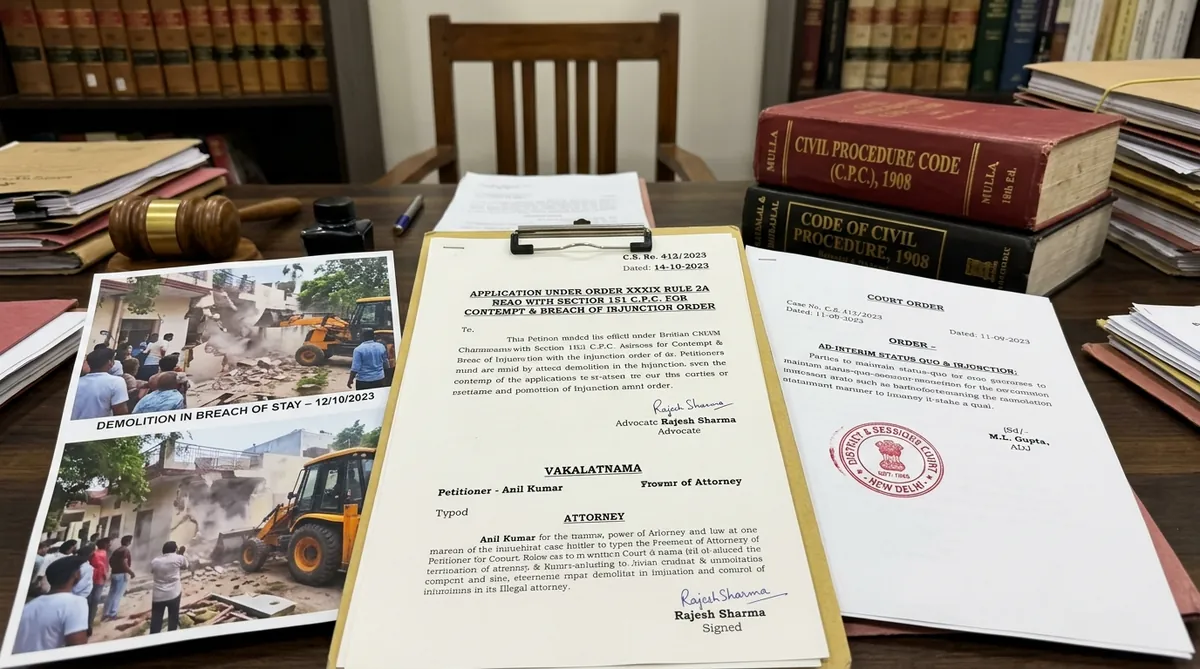
When a Civil Court issues a temporary injunction or stay order under Order 39 Rules 1 & 2 of the Code of Civil Procedure in property or contract disputes, parties are legally bound to respect the court mandate.
👉 In Plain Terms: An immediate court restraining order prohibiting the opponent from altering, constructing, or demolishing the property while trial proceeds. If an opponent willfully disobeys or violates a stay order (e.g., carrying out unauthorized construction or alienating property), the aggrieved party can initiate enforcement proceedings under Order 39 Rule 2A CPC.
- Calculate Ad Valorem Court Fees & Interest: Compute statutory interest under HRERA Rules or Section 7(iv) Court Fees Act before filing claims.
- Observe 2-Year Consumer Limitation Window: File consumer forum complaints within 2 years from the date of cause of action under Section 69 Consumer Protection Act.
- Execute Court Decrees Under Order 21 CPC: If opponent defaults on judicial orders, initiate execution proceedings or contempt under Order 39 Rule 2A CPC.
1. Two Dual Penalties Prescribed Under Order 39 Rule 2A CPC
- Attachment of Guilty Party's Property: The court can attach the violator's real estate or bank accounts for up to 1 year. If the disobedience continues beyond 1 year, the attached property may be sold in public auction to pay damages to the aggrieved plaintiff.
- Civil Prison Detention: Directing the guilty party to be arrested and detained in civil prison for up to 3 months to compel compliance and punish court defiance.
The Supreme Court held that the two remedies provided under Order 39 Rule 2A CPC—attachment of property and detention in civil prison—are independent and cumulative. The court can order civil prison detention even without attaching property if the breach is willful and blatant.
The Apex Court affirmed that court stay orders must be obeyed implicitly. Anyone who deliberately violates an injunction order undermines the majestic authority of judicial proceedings and must face strict punitive consequences.
2. Mandatory Requirements to Win an Order 39 Rule 2A Application
- Prove that a clear, operative stay/injunction order was passed by the Civil Court.
- Establish that the guilty party had actual knowledge or notice of the court order (via process server, advocate notice, or WhatsApp service).
- Produce concrete evidence (photographs, police complaint, Local Commissioner report) proving deliberate, willful breach after notice.
3. Statutory Framework: Order 39 Rule 2A CPC & Contempt of Courts Act
The enforcement of stay orders in India is primarily governed by the Code of Civil Procedure and the Contempt of Courts Act, 1971. A breach of an injunction fundamentally undermines the authority of the court.
- Order 39 Rule 1 & 2 CPC: Empowers civil courts to grant temporary injunctions to prevent property from being wasted, damaged, or alienated during the pendency of a suit.
- Order 39 Rule 2A CPC: Specifies the consequences of disobedience or breach of an injunction. It allows for the attachment of the contemnor's property or civil imprisonment for up to three months.
- Contempt of Courts Act, 1971 (Section 2(b)): Defines "civil contempt" as willful disobedience to any judgment, decree, direction, order, writ, or other process of a court, or willful breach of an undertaking given to a court.
4. Landmark Judicial Precedents on Wilful Disobedience
The Supreme Court clarified that for a court to punish a person under Order 39 Rule 2A, the disobedience must be "willful." Mere unintentional failure or a bona fide mistake does not attract the stringent penalties of civil imprisonment or property attachment.
The Supreme Court held that punishing a person for contempt of court is a drastic step and should not be used lightly. However, if a party blatantly violates an injunction order, the court must act firmly to uphold the majesty of law.
5. Procedural Roadmap for Enforcing Stay Orders
- Filing the Application: File an application under Order 39 Rule 2A CPC in the same court that passed the injunction order, detailing the specific acts of disobedience.
- Issuance of Show Cause Notice: The court will issue a notice to the alleged contemnor, asking them to explain why action should not be taken for breach of the order.
- Evidence and Hearing: Both parties present evidence. The burden of proof lies heavily on the applicant to prove "willful" disobedience beyond reasonable doubt.
- Order of Penalty: If found guilty, the court may order attachment of property or civil imprisonment. The attachment can last up to one year, after which the property may be sold if disobedience continues.
6. Comparative Assessment: Civil Imprisonment vs. Property Attachment
| Parameter | Civil Imprisonment | Property Attachment |
|---|---|---|
| Nature of Relief | Detention in civil prison for up to 3 months. | Seizure of the contemnor's assets by the court. |
| Primary Objective | Coercive action to force immediate compliance. | Securing financial compensation or preventing alienation. |
| Duration | Maximum 3 months. | Up to 1 year; property can be sold thereafter if breach persists. |
| Judicial Preference | Used as a last resort for severe, blatant violations. | Often preferred as an initial coercive step before imprisonment. |
7. Strategic Legal Advisory for Enforcing Injunctions
When dealing with a breach of an injunction, time is of the essence. Document the violation meticulously—use photographs, timestamped videos, and witness statements. Before rushing to file under Order 39 Rule 2A, consider whether a police complaint (under relevant BNS 2023 provisions for criminal trespass or mischief) can run concurrently to exert immediate pressure, depending on the nature of the breach.
Statutory Authorities & Legal References
- Transfer of Property Act (Sections 53A, 54 Sale, Section 106 Tenancy)
- Registration Act, Indian Stamp Act & Haryana Stamp Rules
- Specific Relief Act (Section 16(c) Readiness and Willingness & Injunctions)
- Code of Civil Procedure (Order 39 Rules 1 & 2 Temporary Injunctions)
- Case precedents reported in Supreme Court Cases (SCC), All India Reporter (AIR), and Punjab Law Reporter (PLR).
- e-Courts Services & National Judicial Data Grid (NJDG) procedural tracking guidelines.
Disclaimer: This article is published for educational and informational purposes only under the Advocates Act, 1961. It does not constitute formal legal advice or create an attorney-client relationship. For case-specific legal strategy, consult a qualified advocate.
Actionable Next Steps & Critical Legal Checklist
If you are facing an active legal dilemma regarding Regulatory & Statutory Remedy Action Checklist, execute these immediate procedural steps to protect your statutory rights:
- Calculate Ad Valorem Court Fees & Interest: Compute statutory interest under HRERA Rules or Section 7(iv) Court Fees Act before filing claims.
- Observe 2-Year Consumer Limitation Window: File consumer forum complaints within 2 years from the date of cause of action under Section 69 Consumer Protection Act.
- Execute Court Decrees Under Order 21 CPC: If opponent defaults on judicial orders, initiate execution proceedings or contempt under Order 39 Rule 2A CPC.
Frequently Asked Questions
Key statutory answers and procedural guidance curated by Senior Advocates in Faridabad & Delhi NCR.
What is the punishment for disobeying a court injunction order?
UnderOrder 39 Rule 2A CPC, willful disobedience of an injunction or stay order attractscivil imprisonment for up to 3 monthsand/orattachment of propertybelonging to the disobedient party. The court may also award costs and damages to the aggrieved party.
Can contempt proceedings be initiated if the opposing party violates a status quo order?
Yes. A status quo order is equivalent to an injunction, and its willful breach constitutes contempt. The aggrieved party must file an application under Order 39 Rule 2A CPCdemonstrating that the respondent had knowledge of the order and deliberately violated its terms.
Is it necessary to prove 'willful' disobedience for contempt under Order 39 Rule 2A?
Yes. The Supreme Court in Shiv Shankar v. State of Rajasthanheld that mere non-compliance is insufficient; the applicant must prove that the disobedience wasdeliberate, conscious, and willful. Accidental or inadvertent breach without knowledge of the order does not attract contempt.
What is the statutory limitation period for filing proceedings related to enforcing stay orders: order 39 rule 2a cpc contempt?
Under the Limitation Act, 1963, limitation varies depending on the specific cause of action (e.g. 3 years for civil suits/contracts, 30 days for Section 138 NI Act notices, 90 days for statutory appeals). You can verify exact limitation windows using our interactive Limitation Calculator.
How can I consult an experienced advocate in Delhi NCR or Haryana for enforcing stay orders: order 39 rule 2a cpc contempt?
You can schedule a confidential legal consultation with Advocate Kishan Kumar at Urban Rights Legal Consultants (Chamber No. 343, District & Sessions Court Complex, Faridabad) by phone or WhatsApp at +91-92120-22119 to review case documents and structure an effective litigation strategy.
What documents are required to initiate legal action regarding enforcing stay orders: order 39 rule 2a cpc contempt?
Essential documentation includes: (1) Primary agreement, notice, or FIR records; (2) Certified communication logs (WhatsApp, emails, speed post receipts); (3) Government/revenue identity documents; and (4) Chronological statement of facts signed by the client.
Can proceedings regarding enforcing stay orders: order 39 rule 2a cpc contempt be settled out of court through mediation?
Yes. Under Section 89 CPC and statutory dispute resolution mechanisms, parties can resolve civil, matrimonial, and compoundable criminal disputes through court-annexed mediation, Lok Adalats, or private settlement agreements.