Court Fees & Stamp Duty in Haryana Civil Suits
 Authored by: Advocate Kishan Kumar (Advocate & Legal Consultant)
Quick Legal Takeaways
- Court Fees Act (Haryana): Mandates correct court fee payment prior to instituting civil property, recovery, or cancellation suits.
- Ad-Valorem vs Fixed Scale: Ad-valorem applies to money recovery & Sale Deed cancellation; fixed nominal fee applies to injunctions & partition in joint possession.
- Suhrid Singh Precedent (2010): Executants seeking deed cancellation pay ad-valorem fee; non-executants seeking declaration in possession pay fixed nominal court fee.
- Order 7 Rule 11(c) Rejection: Failure to make up deficient court fees within fixed time leads to automatic Plaint rejection.
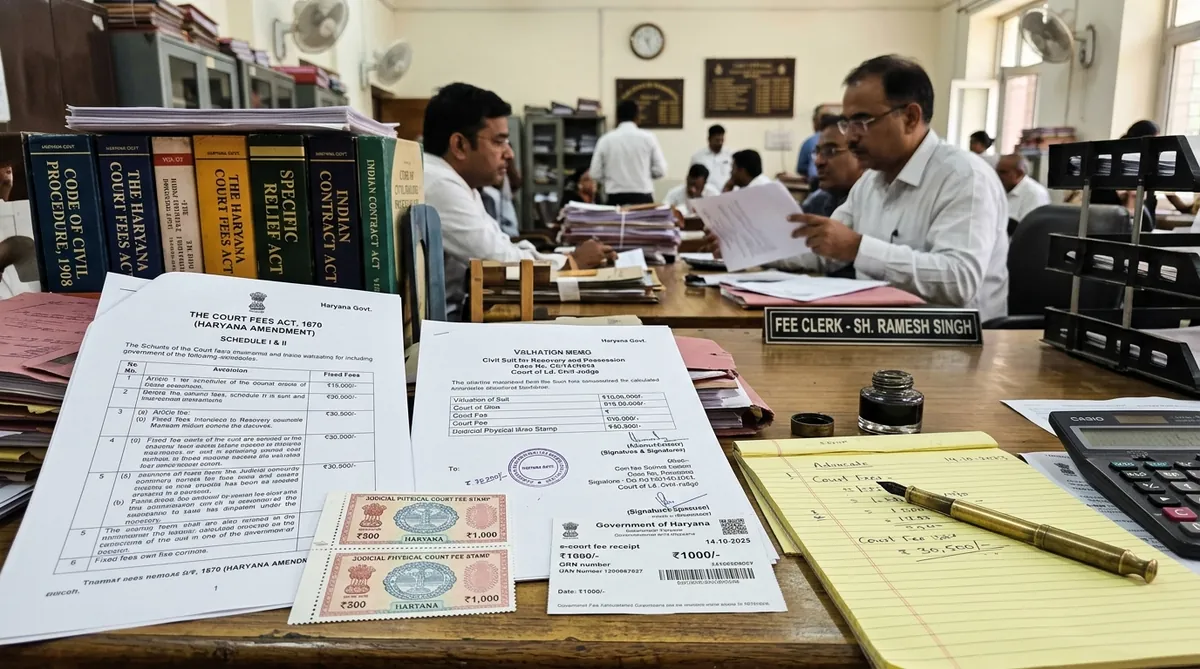
The Supreme Court clarified that the State Government has the executive prerogative to regulate court fees and stamp duty schedules, provided statutory classification conforms to Article 14 of the Constitution.
The High Court of Punjab and Haryana laid down mandatory procedural norms governing the adjudication and refund of excess court fees deposited in civil and revenue proceedings.
5. Complete Procedural Roadmap & Litigation Strategy
- Valuation of Suit: Determine the value of the subject matter of the suit under the Suit Valuation Act.
- Calculation of Fee: Ascertain whether the suit requires a fixed court fee (e.g., injunctions) or ad-valorem court fee (e.g., recovery of money) based on the Haryana Court Fee schedules.
- Procurement of Stamps: Purchase judicial stamp papers or utilize e-stamping facilities as mandated by the state government.
- Filing of Plaint: Affix the requisite court fees to the plaint before filing it in the competent civil court.
- Scrutiny by Ahlmad: The court clerk (Ahlmad) will verify the court fees; any deficiency must be made good within the time granted by the court under Order VII Rule 11 CPC.
- Refund Claim (If Applicable): If the matter is settled via Lok Adalat, file an application for a refund certificate for the court fees paid.
6. Comparative Assessment Table: Fixed vs. Ad-Valorem Fees
| Nature of Suit | Type of Court Fee | Basis of Calculation |
|---|---|---|
| Recovery of Money | Ad-Valorem | Based on the total amount claimed. |
| Suit for Permanent Injunction | Fixed | Nominal fixed fee as per Schedule II. |
| Suit for Possession | Ad-Valorem | Based on the market value of the property. |
| Suit for Declaration | Fixed | Nominal fixed fee, unless consequential relief is claimed. |
7. Strategic Legal Advisory for Businesses & Individuals
Ensuring correct valuation and payment of court fees is crucial to avoid rejection of the plaint under Order VII Rule 11 of the CPC. Litigants should properly assess whether their claims fall under fixed or ad-valorem categories to optimize litigation costs. Additionally, leveraging alternate dispute resolution (ADR) mechanisms can facilitate the refund of court fees, offering significant financial relief in protracted disputes.
9. Step-by-Step Court Fee Calculation & Refund Procedure in Haryana
- Ad-Valorem Schedule Inspection: Calculating exact slab-based court fee under Court Fees (Haryana Amendment) Act.
- E-Challan Generation (e-GRAS Portal): Generating official treasury payment challan for Haryana Judiciary.
- Court Fee Refund upon Lok Adalat Settlement: Moving application under Section 16 of Court Fees Act for 100% refund upon settlement.
- Indigent Person Exemption (Order 33 CPC): Filing application to sue as pauper where applicant lacks property worth ₹1,000.
- Verification by Nazir: Obtaining formal court nazir report confirming exact fee calculation before regular suit registration.
Under Section 13 and Section 19 of the Court Fees Act, plaintiffs who settle disputes through mediation, Lok Adalats, or compromise before framing of issues are entitled to 100% refund of institution court fees upon issuance of a judicial certificate.
Statutory Authorities & Legal References
- Transfer of Property Act (Sections 53A, 54 Sale, Section 106 Tenancy)
- Registration Act, Indian Stamp Act & Haryana Stamp Rules
- Specific Relief Act (Section 16(c) Readiness and Willingness & Injunctions)
- Code of Civil Procedure (Order 39 Rules 1 & 2 Temporary Injunctions)
- Case precedents reported in Supreme Court Cases (SCC), All India Reporter (AIR), and Punjab Law Reporter (PLR).
- e-Courts Services & National Judicial Data Grid (NJDG) procedural tracking guidelines.
Disclaimer: This article is published for educational and informational purposes only under the Advocates Act, 1961. It does not constitute formal legal advice or create an attorney-client relationship. For case-specific legal strategy, consult a qualified advocate.
Practical Checklist: Computing Court Fees in Civil Recovery & Injunction Suits
Under the Court Fees Act, 1870 as amended by Haryana state notifications, calculating correct ad-valorem fees prevents rejection of plainer under Order VII Rule 11 CPC:
1. Suits for Money Recovery: Court fee is payable ad-valorem on the total principal sum plus pre-suit interest claimed up to the date of institution. Use our Court Fee Calculator for exact slabs.
2. Suits for Permanent Injunction: Fixed court fee under Section 7(iv)(d) of the Court Fees Act where title is not in dispute.
3. Suits for Declaration with Consequential Relief: Valued under Section 7(iv)(c) based on the value of the relief sought (Suhrid Singh v. Randhir Singh).
4. Suits for Possession under Specific Relief Act: Calculated on the market value or revenue assessment of the land.
The Supreme Court ruled that an executant of a sale deed must seek cancellation and pay ad-valorem court fee, while a non-executant stranger can seek a mere declaration of invalidity without paying full ad-valorem fee on the transaction value.
Actionable Next Steps & Critical Legal Checklist
If you are facing an active legal dilemma regarding Regulatory & Statutory Remedy Action Checklist, execute these immediate procedural steps to protect your statutory rights:
- Calculate Ad Valorem Court Fees & Interest: Compute statutory interest under HRERA Rules or Section 7(iv) Court Fees Act before filing claims.
- Observe 2-Year Consumer Limitation Window: File consumer forum complaints within 2 years from the date of cause of action under Section 69 Consumer Protection Act.
- Execute Court Decrees Under Order 21 CPC: If opponent defaults on judicial orders, initiate execution proceedings or contempt under Order 39 Rule 2A CPC.
Frequently Asked Questions
Key statutory answers and procedural guidance curated by Senior Advocates in Faridabad & Delhi NCR.
What is the difference between ad-valorem and fixed court fees in Haryana?
Ad-valorem court fees are calculated as a percentage of the suit valuation (e.g., property value or claim amount), while fixed court fees are flat amounts prescribed for specific types of applications like interim injunctions, appeals, or miscellaneous petitions. Most money suits and property disputes in Haryana attract ad-valorem fees under the Court Fees Act read with Haryana amendments.
Can court fees be refunded if the case is settled through mediation or Lok Adalat?
Yes. Under Section 16 of the Court Fees Act, if a suit is settled through compromise, mediation, or Lok Adalat before the final hearing stage, the plaintiff is entitled to a refund of up to 50-75% of the court fee paid, depending on the stage of settlement.
How is court fee calculated for a partition suit involving ancestral property?
In partition suits, court fee is payable on the market value of the plaintiff's share (not the entire property). Under the Haryana Court Fees rules, the plaintiff must obtain a certified valuation report and pay ad-valorem fee on their claimed share.
What is the statutory limitation period for filing proceedings related to court fees & stamp duty in haryana civil suits?
Under the Limitation Act, 1963, limitation varies depending on the specific cause of action (e.g. 3 years for civil suits/contracts, 30 days for Section 138 NI Act notices, 90 days for statutory appeals). You can verify exact limitation windows using our interactive Limitation Calculator.
How can I consult an experienced advocate in Delhi NCR or Haryana for court fees & stamp duty in haryana civil suits?
You can schedule a confidential legal consultation with Advocate Kishan Kumar at Urban Rights Legal Consultants (Chamber No. 343, District & Sessions Court Complex, Faridabad) by phone or WhatsApp at +91-92120-22119 to review case documents and structure an effective litigation strategy.
What documents are required to initiate legal action regarding court fees & stamp duty in haryana civil suits?
Essential documentation includes: (1) Primary agreement, notice, or FIR records; (2) Certified communication logs (WhatsApp, emails, speed post receipts); (3) Government/revenue identity documents; and (4) Chronological statement of facts signed by the client.
Can proceedings regarding court fees & stamp duty in haryana civil suits be settled out of court through mediation?
Yes. Under Section 89 CPC and statutory dispute resolution mechanisms, parties can resolve civil, matrimonial, and compoundable criminal disputes through court-annexed mediation, Lok Adalats, or private settlement agreements.