 Authored by: Advocate Kishan Kumar (Advocate & Legal Consultant)
Employment Termination: Severance & Dismissal Rights
Quick Legal Takeaways
- Section 30 Haryana Shops Act: Employees with 3+ months service are entitled to 30 days written notice or notice pay in lieu.
- Retrenchment Compensation (Sec 25F ID Act): Employees completing 1 year service receive 15 days' wages per year of service plus gratuity & leave encashment.
- Unlawful Dismissal: Terminating without inquiry, natural justice, or in retaliation for POSH complaints is illegal.
- Reinstatement Rule (Deepali Gundu Surwase): Unlawful termination entitles employees to reinstatement with full back wages.
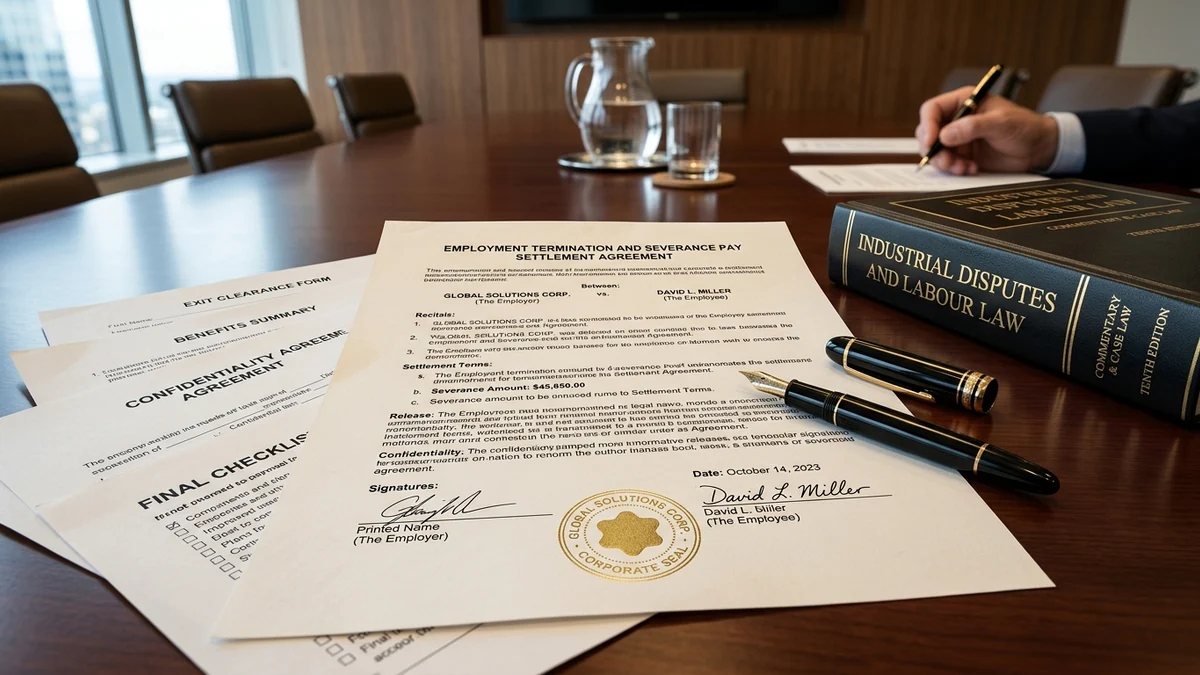
When an employer terminates an employment contract unexpectedly, employees are protected by state labor statutes (such as the Haryana Shops and Commercial Establishments Act, 1973), the Industrial Disputes Act, 1947, and Section 73 of the Indian Contract Act.
1. Mandatory Statutory Notice Period & Pay
- Review Dispute Resolution & Notice Clauses: Examine contractual cure periods, limitation provisions, and mandatory pre-institution mediation requirements.
- Serve Detailed Advocate Legal Notice: Detail specific contractual breaches, calculation of liquidated damages, and compliance timelines before litigation.
- Adhere to POSH & Employment Directives: Ensure Internal Committee (IC) inquiry procedures strictly comply with natural justice and statutory 90-day inquiry timelines.
2. Retrenchment Severance Pay Rules
Under Section 25F of the Industrial Disputes Act, 1947, an employee who has completed 1 year of continuous service is entitled to Retrenchment Compensation calculated at 15 days' average pay for every completed year of continuous service alongside encashment of accrued leaves and gratuity.
3. What Constitutes Unlawful / Wrongful Dismissal?
- Termination without serving mandatory 30-day notice or notice pay.
- Firing on alleged misconduct without issuing a Show Cause Notice or conducting a domestic inquiry following natural justice.
- Retaliatory termination against employees who raised internal grievances or POSH harassment complaints.
The Supreme Court held that in cases of wrongful or unlawful termination of service, reinstatement with full back wages is the normal rule, unless special circumstances warrant monetary compensation in lieu of reinstatement.
4. Comprehensive Legal Framework Governing Employment Termination
The substantive law for protecting workmen against arbitrary dismissal and ensuring fair retrenchment compensation is primarily found in the Industrial Disputes Act, 1947 and various State Shops and Establishments Acts.
- Industrial Disputes Act, 1947 (Section 25F): Mandates conditions precedent to retrenchment of workmen, including one month's notice (or wages in lieu) and retrenchment compensation equivalent to 15 days' average pay for every completed year of service.
- Section 25G & 25H (ID Act): Establishes the "Last come, first go" principle for retrenchment, and mandates priority re-employment for retrenched workmen if the employer later needs to hire.
- Industrial Employment (Standing Orders) Act, 1946: Requires employers in industrial establishments to formally define conditions of employment, including precise procedures for disciplinary action and termination.
- State Shops & Establishments Acts: For non-workmen or managerial employees, state-specific acts govern notice periods and severance requirements. (e.g., Delhi Shops Act mandates a month's notice or pay for employees working for over three months).
5. Landmark Judicial Precedents on Unlawful Dismissal
The Supreme Court established the principle that in cases of wrongful termination, reinstatement with full back wages is the normal rule. The employer bears the burden to prove the employee was gainfully employed elsewhere to deny back wages.
A landmark judgment clarifying the powers of Labour Courts/Tribunals under Section 11A of the ID Act, allowing them to reappraise evidence and substitute the penalty of dismissal if it is found disproportionate to the misconduct.
The court held that for managerial employees, courts may award lumpsum compensation instead of reinstatement if the relationship of trust has completely broken down.
6. Procedural Roadmap: Challenging Wrongful Dismissal
Upon unlawful termination, an aggrieved employee should follow this legal roadmap to seek reinstatement or severance pay:
- Pre-Litigation Legal Notice: Issue a formal demand notice highlighting the statutory violations (e.g., non-payment of retrenchment compensation under Section 25F) and demanding reinstatement or severance.
- Conciliation Proceedings: Raise an industrial dispute by filing a complaint before the Assistant Labour Commissioner. The ALC will attempt conciliation between the employer and employee.
- Failure Report & Reference: If conciliation fails, the ALC submits a failure report, and the appropriate government refers the dispute to the Labour Court or Industrial Tribunal.
- Labour Court Adjudication: File a Statement of Claim. The employer files a Written Statement, followed by evidence and cross-examination.
- Award & Execution: The Labour Court passes an Award for reinstatement and/or back wages. If the employer appeals in the High Court, the employee can claim interim wages under Section 17B of the ID Act.
7. Comparative Assessment: Remedies for Unlawful Dismissal
| Parameter | Labour Court (ID Act) | Civil Court Suit | High Court Writ Petition |
|---|---|---|---|
| Applicability | "Workmen" under ID Act | Managers / Executives | Govt. / PSU Employees (State) |
| Primary Relief | Reinstatement & Back Wages | Damages for breach of contract | Quashing of termination order |
| Cost & Speed | Low cost, moderate speed | High court fees, slow speed | Moderate cost, faster relief |
| Limitation Period | Ideally 3 years (Sec 2A) | 3 years from breach | Reasonable time (no strict limit) |
8. Strategic Legal Advisory for Severance & Dismissal
To navigate employment termination safely, both employees and employers must adhere to these guidelines:
- Proper Domestic Enquiry: Employers must never terminate an employee for misconduct without conducting a fair domestic enquiry adhering to the principles of natural justice. Failure to do so renders the dismissal void.
- Strict Compliance with Section 25F: Retrenchment compensation and notice pay must be paid simultaneously with the termination order. Delaying payment even by a day can invalidate the termination.
- Resignation vs. Constructive Dismissal: Employees forced to resign under duress should clearly state the coercion in their resignation email. This preserves the right to claim constructive dismissal and seek compensation.
9. Frequently Asked Questions (FAQ)
Answer: The employer can only recover notice pay in lieu of the agreed notice period as quantified in the employment contract. Employers cannot arbitrarily withhold relieving letters, experience certificates, or accrued salaries without legal justification.
Answer: Termination is wrongful if it violates mandatory provisions of the Industrial Disputes Act, 1947 (such as not obtaining government permission for retrenchment in establishments with 100+ workers), breaches the employment contract terms, or is carried out without following principles of natural justice (notice, hearing, opportunity to respond).
Answer: Yes. Under Section 25F of the Industrial Disputes Act, retrenched workmen are entitled to retrenchment compensation at 15 days' average pay for every completed year of service. Additionally, courts may award back wages if the termination is declared illegal, and the employee can claim damages for mental harassment in appropriate cases.
10. Mandatory Pre-Litigation Checklist for Unlawful Termination Claims
- Original Employment Contract & Offer Letter: Stating the agreed notice period, severance compensation, and termination clause.
- Performance Appraisal & KPI Records: Disproving alleged 'performance failure' used as a pretext for mala fide dismissal.
- Formal Communications Trail: All emails, Slack messages, and termination letters exchanged with HR and Management.
- Salary Slips & Bank Statements: 6 months of pay slips establishing unpaid gratuity, leave encashment, and variable bonuses.
- Statutory Demand Notice: Advocate-drafted legal notice demanding reinstatement or full severance settlement within 15 days.
- Review Dispute Resolution & Notice Clauses: Examine contractual cure periods, limitation provisions, and mandatory pre-institution mediation requirements.
- Serve Detailed Advocate Legal Notice: Detail specific contractual breaches, calculation of liquidated damages, and compliance timelines before litigation.
- Adhere to POSH & Employment Directives: Ensure Internal Committee (IC) inquiry procedures strictly comply with natural justice and statutory 90-day inquiry timelines.
Statutory Authorities & Legal References
- Transfer of Property Act (Sections 53A, 54 Sale, Section 106 Tenancy)
- Registration Act, Indian Stamp Act & Haryana Stamp Rules
- Specific Relief Act (Section 16(c) Readiness and Willingness & Injunctions)
- Code of Civil Procedure (Order 39 Rules 1 & 2 Temporary Injunctions)
- Case precedents reported in Supreme Court Cases (SCC), All India Reporter (AIR), and Punjab Law Reporter (PLR).
- e-Courts Services & National Judicial Data Grid (NJDG) procedural tracking guidelines.
Disclaimer: This article is published for educational and informational purposes only under the Advocates Act, 1961. It does not constitute formal legal advice or create an attorney-client relationship. For case-specific legal strategy, consult a qualified advocate.
Actionable Next Steps & Critical Legal Checklist
If you are facing an active legal dilemma regarding Commercial Contracts & Corporate Compliance Checklist, execute these immediate procedural steps to protect your statutory rights:
- Review Dispute Resolution & Notice Clauses: Examine contractual cure periods, limitation provisions, and mandatory pre-institution mediation requirements.
- Serve Detailed Advocate Legal Notice: Detail specific contractual breaches, calculation of liquidated damages, and compliance timelines before litigation.
- Adhere to POSH & Employment Directives: Ensure Internal Committee (IC) inquiry procedures strictly comply with natural justice and statutory 90-day inquiry timelines.