False POCSO & Harassment Defence: Bail & Legal Rights
 Authored by: Advocate Kishan Kumar (Advocate & Legal Consultant)
Quick Legal Takeaways
- Core Statutory Base: Exhaustive legal coverage under the latest 2024–2026 statutes and landmark judicial precedents.
- Practical Procedure: Detailed step-by-step litigation roadmap before District Courts, High Courts, and specialized tribunals.
- Evidence & Remedies: How to build watertight documentary trails and protect civil and personal liberties.
1. Statutory Presumption & Gravity under POCSO & BNS 2023
Allegations of sexual offences under the Protection of Children from Sexual Offences (POCSO) Act, 2012 and the Bharatiya Nyaya Sanhita (Sections 74, 75, 76 & 79 BNS—formerly Sections 354, 376, 509 IPC) represent the most severe category of criminal litigation in India. These statutes are uniquely designed with reverse burdens of proof to safeguard victims. However, when these non-bailable provisions are falsely weaponized in the context of matrimonial disputes, property rivalries, extortion, or consensual teenage relationships, the falsely accused faces immediate reputational ruin and threat of long-term incarceration.
Under Section 29 of the POCSO Act, where a person is prosecuted for committing an offence under Sections 3, 5, 7, or 9, the Special Court shall presume that such person has committed the offence, until the contrary is proved by the accused. Furthermore, under Section 30 POCSO, the court presumes the existence of culpable mental state (mens rea). To secure an acquittal or bail, the defence must actively dismantle this presumption through contemporaneous digital evidence and forensic discrepancies.
2. Immediate Emergency Action Plan: The First 48 Hours
When a false complaint or FIR is lodged, the accused and their family must act with extreme precision within the first 48 hours:
- Preserve Contemporaneous Digital Evidence: Immediately extract and notarize CCTV footage, Google Timeline locations, Call Detail Records (CDR), Toll plaza Fastag records, WhatsApp chats, and audio recordings demonstrating an absolute alibi or establishing prior monetary extortion/threats from the complainant.
- Obtain Section 63 BSA 2023 Certificate: All electronic evidence must be backed by a signed electronic evidence certificate under Section 63 of Bharatiya Sakshya Adhiniyam, 2023 (replacing Section 65B Evidence Act) to ensure admissibility in court.
- File Urgent Anticipatory Bail (Section 482 BNSS): Approach the Sessions Court (Special POCSO Court) or High Court for pre-arrest protection under Section 482 BNSS before police can effect custodial arrest.
- Refrain from Contacting the Complainant: Never attempt private settlements or send messages directly to the complainant or victim, as this will be characterized as witness intimidation under Section 195A IPC / Section 232 BNS, defeating bail applications.
3. Rebutting the Section 29 POCSO Presumption of Guilt
While Section 29 creates a statutory presumption of guilt, the Supreme Court of India in P. Yuvaprakash v. State (2023) SCC OnLine SC 849 and State of Kerala v. Babu (2020) 9 SCC 649 clarified the constitutional limits of this presumption:
The Supreme Court held that the prosecution must first establish the foundational facts beyond reasonable doubt (e.g. proof of the victim being a minor and prima facie commission of an overt act). Once foundational facts are proved, the accused is NOT required to prove innocence beyond reasonable doubt; the accused needs only to establish a defence on a preponderance of probabilities through cross-examination, digital alibis, or medical contradictions.
4. Forensic, Medical & Age Determination Defense
The cornerstone of defending false POCSO and sexual harassment charges lies in challenging four scientific pillars:
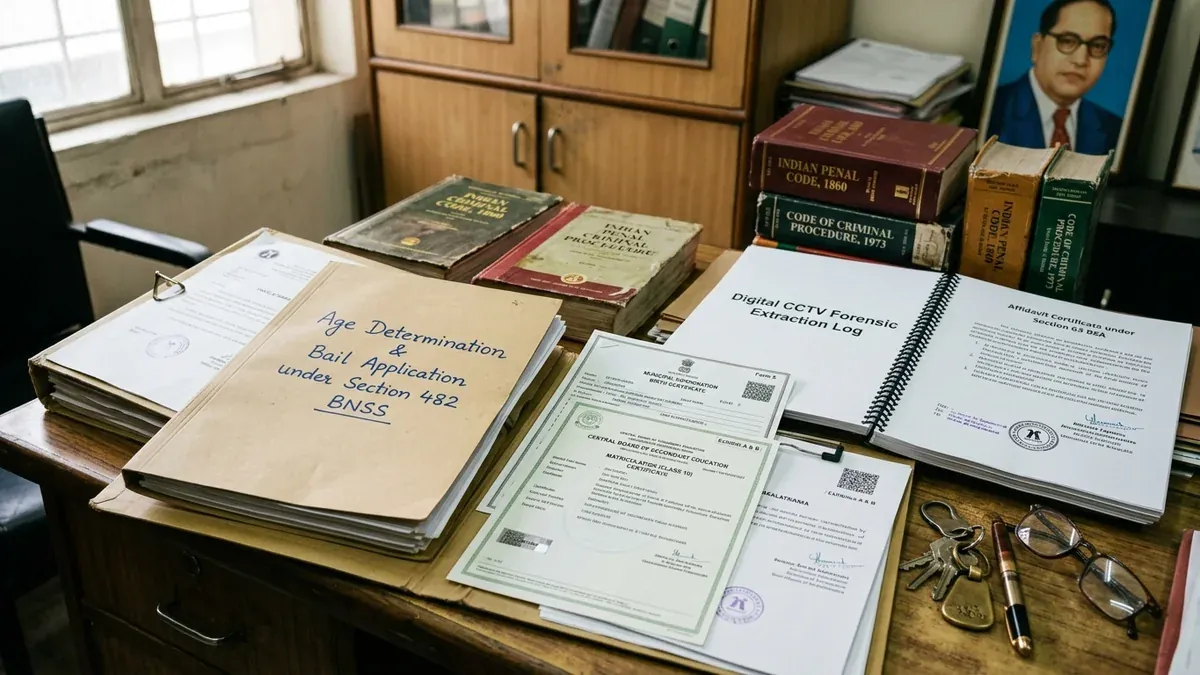
- Age Determination (Section 94 Juvenile Justice Act 2015): In false POCSO cases involving teenage relationships (Romeo-Juliet cases), the prosecution must prove minority strictly via Section 94 JJ Act: (1) Matriculation or equivalent certificate; (2) Municipal birth certificate; (3) In the absence of both, an Ossification Test with 2-year margin of error. Minorities asserted solely via unverified school admission registers can be demolished in trial.
- Medico-Legal Report (MLR) Discrepancies: Absence of hymenal tear, physical trauma, genital injuries, or foreign DNA/semen in medical examination conducted within 24 hours of the alleged incident directly contradicts allegations of penetrative sexual assault.
- Unexplained Delay in FIR Registration: While delay in reporting sexual offences is evaluated sympathetically, an unexplained delay of weeks or months coupled with ongoing property or matrimonial litigation strongly indicates fabrication.
- Forensic Call Record (CDR) Triangulation: Tower location data proving that the accused and complainant were in completely different geographic sectors at the alleged date and time.
5. Anticipatory Bail Strategy under Section 482 BNSS
Securing anticipatory bail in POCSO matters requires overcoming stringent judicial hesitation. Special Courts grant pre-arrest protection under Section 482 BNSS when the defence establishes:
- Adolescent Love Affair / Consensual Relationship: The victim and accused eloped voluntarily, with love letters, photographs, or train tickets demonstrating lack of force or predatory intent.
- Documentary Proof of False Enmity / Cross-FIRs: Pending civil suits, land partition disputes, or 498A/matrimonial complaints showing that the POCSO FIR was lodged as an afterthought for leverage.
- Absence of Custodial Interrogation Requirement: Full willingness to submit electronic devices for forensic imaging without needing physical remand.
6. High Court FIR Quashing under Section 528 BNSS
Where a POCSO or sexual harassment FIR is manifestly malicious, the accused can petition the High Court (e.g. Punjab & Haryana High Court at Chandigarh or Delhi High Court) under Section 528 BNSS (formerly Section 482 CrPC):
High Courts invoke inherent jurisdiction to quash POCSO complaints where: (1) The allegations in the FIR, even if taken at face value, do not disclose the ingredients of a sexual offence; (2) The proceeding is manifestly attended with mala fides or maliciously instituted with an ulterior motive for wreaking vengeance; (3) In romantic relationship cases where the parties have attained majority and married lawfully.
7. Prosecution of False Complainants (Section 22 POCSO Act & Section 248 BNS)
The law provides explicit punitive and civil remedies against individuals who lodge malicious, fabricated complaints:
- Section 22(1) POCSO Act: Imposes imprisonment up to six months or fine, or both, upon any person who makes a false complaint or provides false information knowing it to be false with intent to defame or blackmail.
- Section 248 BNS (Formerly IPC 211): False charge of offence made with intent to injure, punishable with up to 7 years imprisonment and fine where the false charge relates to an offence punishable with death or imprisonment for 7+ years.
- Civil Defamation Suit: Instituting a suit for damages in Civil Court claiming financial compensation for mental agony, legal expenses, and loss of business or corporate employment reputation.
8. Comparative Assessment Table: Bail & Quashing Remedies in POCSO
| Parameter | Anticipatory Bail (Sec 482 BNSS) | Regular Bail (Sec 483 BNSS) | High Court Quashing (Sec 528 BNSS) |
|---|---|---|---|
| Primary Forum | Special POCSO Court / High Court | Special POCSO Court / High Court | High Court (Inherent Powers) |
| Timing | Prior to arrest / pre-custody | Post-arrest / during trial | Any stage (FIR / Chargesheet) |
| Legal Objective | Protection from custodial arrest | Release from judicial jail custody | Complete annulment & dismissal of FIR |
| Core Benchmark | Prima facie fabrication / consensual affair | Completion of investigation & PW deposition | Absence of offence / proven malicious motive |
9. Practical Trial Strategy for Faridabad Special POCSO Courts
- Cross-Examination of Victim under Section 33 POCSO: Cross-examination in POCSO Special Courts is conducted via written questions routed through the Special Judge to prevent re-traumatization. Defence counsel must frame precise questions exposing contradictions with previous Section 183 BNSS (old 164 CrPC) magistrate statements.
- Examine Defense Witnesses & Alibi Exhibits: Formally introduce electronic call logs, CCTV DVR hard drives, and independent witnesses during Section 351 BNSS defence stage.
- Demand Strict Chain of Custody on Digital Exhibits: Object to uncertified printouts and challenge gaps in hash verification on seized mobile phones under Section 63 BSA 2023.
Statutory Authorities & Legal References
- Transfer of Property Act (Sections 53A, 54 Sale, Section 106 Tenancy)
- Registration Act, Indian Stamp Act & Haryana Stamp Rules
- Specific Relief Act (Section 16(c) Readiness and Willingness & Injunctions)
- Code of Civil Procedure (Order 39 Rules 1 & 2 Temporary Injunctions)
- Case precedents reported in Supreme Court Cases (SCC), All India Reporter (AIR), and Punjab Law Reporter (PLR).
- e-Courts Services & National Judicial Data Grid (NJDG) procedural tracking guidelines.
Disclaimer: This article is published for educational and informational purposes only under the Advocates Act, 1961. It does not constitute formal legal advice or create an attorney-client relationship. For case-specific legal strategy, consult a qualified advocate.
Actionable Next Steps & Critical Legal Checklist
If you are facing an active legal dilemma regarding Criminal Trial Defence & Evidence Checklist, execute these immediate procedural steps to protect your statutory rights:
- Establish Civil Nature of Dispute: Demonstrate through contracts, account ledgers, and bank trails that the matter involves commercial breach rather than penal fraud.
- Preserve Digital Communications: Archive all WhatsApp chats, SMS threads, emails, and audio recordings certified under Section 63 of Bharatiya Sakshya Adhiniyam 2023.
- Explore Section 359 BNSS Compounding: If parties resolve differences, prepare a formal Compromise Deed for compounding or mutual quashing before the High Court.
Frequently Asked Questions
Key statutory answers and procedural guidance curated by Senior Advocates in Faridabad & Delhi NCR.
Can anticipatory bail be granted in POCSO cases in India?
Yes. While courts exercise extreme caution, anticipatory bail under Section 482 BNSSis granted in POCSO cases where the accused demonstrates that the FIR is demonstrably false, motivated by prior property/matrimonial disputes, or involves a consensual teenage romantic relationship with no predatory intent.
What is the presumption of guilt under Section 29 of the POCSO Act?
Under Section 29 POCSO, the court presumes the accused committed the offence once the prosecution proves foundational facts. However, the Supreme Court in P. Yuvaprakash (2023) held that the accused needs only to rebut this presumption on a preponderance of probabilities using digital alibis and medical evidence.
Can the High Court quash a false POCSO FIR under Section 528 BNSS?
Yes. UnderSection 528 BNSS(formerly Section 482 CrPC), High Courts regularly quash POCSO FIRs where the complaint is manifestly malicious, filed due to family disputes, or where the parties were in a consensual relationship and have subsequently married upon attaining majority.
What action can be taken against a person who files a false POCSO complaint?
Under Section 22 of the POCSO Act, filing a false complaint carries imprisonment for up to 6 months and a fine. Additionally, the falsely accused can initiate prosecution under Section 248 BNS (up to 7 years imprisonment) and file a civil suit for damages.
How critical is electronic evidence in proving an alibi in sexual harassment cases?
Electronic evidence (CCTV footage, Call Detail Records, GPS logs, WhatsApp chats) certified under Section 63 BSA2023 is conclusive in proving that the accused was physically present elsewhere at the time of the alleged offence, securing early bail and discharge.