Grandparents' Custody & Visitation Rights in India
 Authored by: Advocate Kishan Kumar (Advocate & Legal Consultant)
Quick Legal Takeaways
- Core Statutory Base: Exhaustive legal coverage under the latest 2024–2026 statutes and landmark judicial precedents.
- Practical Procedure: Detailed step-by-step litigation roadmap before District Courts, High Courts, and specialized tribunals.
- Evidence & Remedies: How to build watertight documentary trails and protect civil and personal liberties.
1. Legal Standing of Grandparents under Indian Family Law
During acrimonious matrimonial disputes between spouses, or following the tragic, untimely demise of a parent, paternal and maternal grandparents frequently face complete, deliberate severance from their grandchildren. Under traditional personal laws, grandparents were often viewed as secondary guardians. However, modern Indian child jurisprudence—governed by the Guardians and Wards Act (GWA) and the Hindu Minority & Guardianship—places the psychological, emotional, and physical welfare of the child above the proprietary claims of biological parents.
While Section 6 of the HMGA designates the father and mother as natural guardians of a Hindu minor, Section 13 of the HMGA and Section 17 of the GWA categorically mandate that the Welfare of the Minor shall be the paramount consideration, empowering Family Courts to grant custody or independent visitation rights to grandparents.
2. The Paramount Welfare Doctrine (Section 17 Guardians & Wards Act)
When adjudicating child custody and visitation claims instituted by grandparents, Family Courts do not operate as dispute resolution forums between adult family members; they exercise parens patriae jurisdiction as legal protectors of the child.
Under Section 17 of the Guardians and Wards Act, the court evaluates:
- The age, sex, and religion of the minor child.
- The character, moral capacity, and financial stability of the proposed guardian.
- The existing emotional bond, continuity of schooling, and psychological comfort of the child.
- If the minor is old enough to form an intelligent preference (generally 9+ years), the court conducts an in-chamber personal interaction to ascertain the child's wishes.
3. When Can Grandparents Claim Primary Physical Custody?
Although natural parents hold statutory priority under Section 6 HMGA, Family Courts in India routinely grant exclusive physical custody to grandparents over surviving biological parents in specific circumstances:
- Demise of One Parent with Severe Neglect / Abuse by Surviving Parent: Where a mother dies (e.g. dowry death or illness) and the father faces criminal prosecution under Section 85/86 BNS (old 498A) or shows moral unfitness.
- De Facto Custody & Emotional Continuity: Where the grandchild has lived exclusively with the grandparents since infancy, and uprooting the child would cause severe psychological distress.
- Subsequent Remarriage & Hostile Step-Parent Environment: Where a surviving parent remarries and the child faces neglect, discrimination, or maltreatment in the new household.
- Abandonment or Substance Addiction: Where biological parents suffer from chronic drug/alcohol addiction, severe mental incapacitation, or have abandoned the child.
4. Landmark Supreme Court Judgments on Grandparental Custody
In a landmark judgment, the Supreme Court awarded primary custody of a minor child to the maternal grandmother over the biological father. The Apex Court held: "The welfare of the child is the paramount consideration. Where the child has grown up under the care and affection of the grandmother since birth, biological parentage alone cannot defeat the child's established emotional equilibrium."
The Supreme Court denied custody to a father facing criminal charges in connection with his wife's death, confirming that maternal grandparents were best suited to protect the moral, educational, and psychological well-being of the minor child.
5. Independent Visitation Rights of Grandparents (The Yashita Sahu Doctrine)
Even where physical custody remains with a fit biological parent, grandparents possess a judicially recognized right to maintain meaningful contact with their grandchildren. In the landmark decision of Yashita Sahu v. State of Rajasthan (2020) 3 SCC 67, the Supreme Court articulated the doctrine of Shared Parenting and Extended Family Access:
"A child has the fundamental right to the love, affection, and care of both parents as well as grandparents. Even if parents are separated, courts must ensure that the child is not deprived of contact with paternal and maternal grandparents through physical weekend access, festival visitations, and regular video calls."
6. Countering Parental Alienation Syndrome (PAS)
In bitter matrimonial breakdowns, the custodial parent frequently engages in Parental Alienation—poisoning the child's mind against the non-custodial parent and grandparents. Indian courts treat deliberate alienation as a form of psychological cruelty against the child.
Where grandparents are denied access, Family Courts can pass mandatory interim orders under Section 12 of the Guardians and Wards Act directing:
- Mediation & Child Counseling: Referring the family to court-appointed child psychologists to dismantle alienation.
- Children's Complex Physical Meetings: Scheduling supervised meetings on 1st and 3rd Saturdays inside the Family Court Children's Room (e.g. Sector-12 District Court Faridabad).
- Digital Visitation: Directing mandatory 30-minute WhatsApp/Zoom video calls on fixed weekdays.
7. Step-by-Step Roadmap: How to File for Custody / Visitation
Grandparents seeking legal custody or visitation should execute this systematic procedure before the Family Court:
- Drafting Guardianship Petition (GWA Sec 7, 10 & 12): File a petition under the Guardians and Wards Act before the Principal Judge, Family Court having territorial jurisdiction over where the minor ordinarily resides.
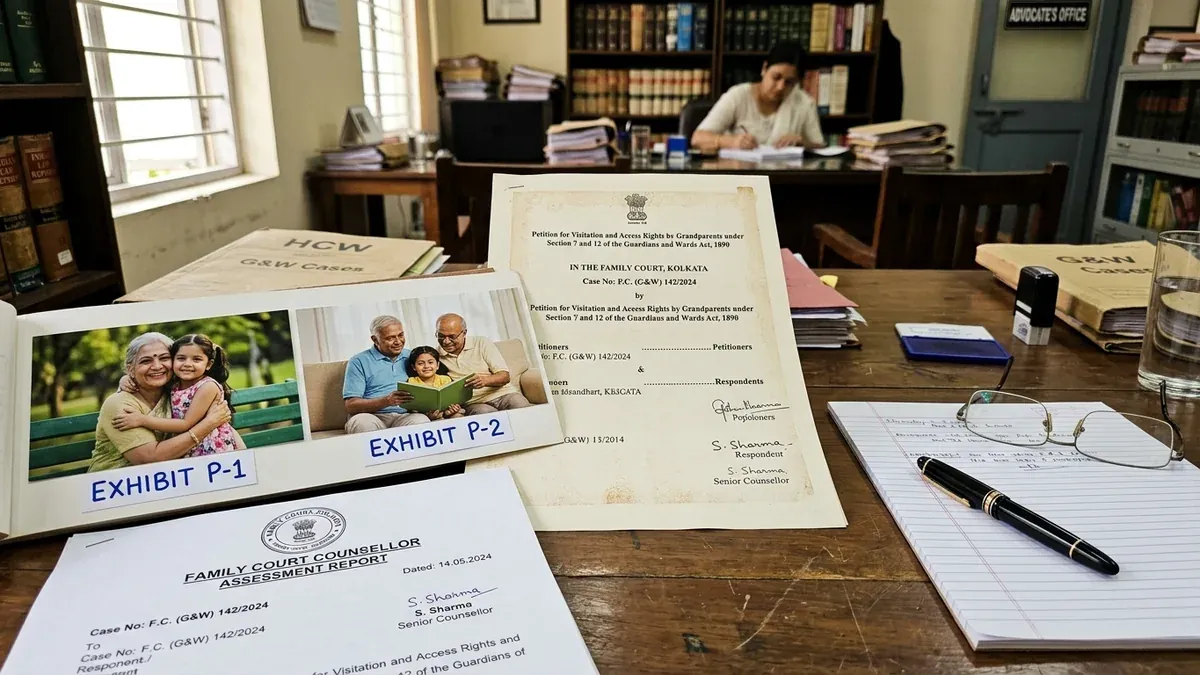
- Documentary Proof of Emotional & Financial Upbringing: Attach school report cards, medical expenditure bills, photographs of family milestones, and affidavits demonstrating past cohabitation.
- Interim Application for Immediate Visitation: Move an urgent interim application under Section 12 GWA seeking immediate weekend access to prevent total alienation during trial pendency.
- Interaction in Court Chambers: The Family Judge conducts an in-camera confidential interview with the minor to understand the child's comfort level.
- Final Custody Decree / Visitation Schedule: The court passes a binding decree defining permanent physical custody or structured vacation/festival parenting schedules.
8. Comparative Assessment: Biological Parents vs. Grandparents Custody
| Parameter | Natural Biological Parents | Grandparents |
|---|---|---|
| Statutory Priority | Primary natural guardians under Section 6 HMGA | Secondary guardians under Section 17 GWA |
| Burden of Proof | Presumed fit unless unfitness is proved | Must prove child's welfare is best served in their custody |
| Independent Visitation Access | Standard weekend & vacation rights | Recognized under Yashita Sahu & Section 12 GWA |
| Overriding Legal Test | Paramount Welfare of Minor (Sec 13 HMGA) | Paramount Welfare of Minor (Sec 13 HMGA) |
9. Practical Legal Advisory for Grandparents in Delhi NCR
- Never Engage in Self-Help / Forcible Restraint: Forcibly removing a child can trigger kidnapping allegations under Section 137 BNS. Always secure custody through lawful Family Court orders.
- Maintain Detailed Communication Records: Keep records of text messages, WhatsApp requests, and greeting cards sent to the child to prove continuous desire for affection.
- Leverage Senior Citizens Act Tribunals: If the child's parent is an abusive son/daughter occupying the grandparents' self-acquired home, grandparents can seek protection and eviction orders before the SDM Maintenance Tribunal under the Senior Citizens Act 2007.
Statutory Authorities & Legal References
- Hindu Marriage Act (Sections 13, 13B, 24, 25) & Special Marriage Act
- Domestic Violence Act, 2005 (PWDVA) & Section 144 BNSS
- Supreme Court Guidelines in Rajnesh v. Neha (2020) & Aditi alias Mithi v. Jitesh Sharma (2023)
- Case precedents reported in Supreme Court Cases (SCC), All India Reporter (AIR), and Punjab Law Reporter (PLR).
- e-Courts Services & National Judicial Data Grid (NJDG) procedural tracking guidelines.
Disclaimer: This article is published for educational and informational purposes only under the Advocates Act, 1961. It does not constitute formal legal advice or create an attorney-client relationship. For case-specific legal strategy, consult a qualified advocate.
Actionable Next Steps & Critical Legal Checklist
If you are facing an active legal dilemma regarding Child Welfare & Custody Litigation Checklist, execute these immediate procedural steps to protect your statutory rights:
- Document Primary Caregiver Role: Preserve daily routine logs, school performance records, medical consultations, and extracurricular involvement showing the child's best interest.
- Seek Structured Interim Visitation: Apply for urgent weekend physical access, festival visitation, and video conferencing rights under the Guardians and Wards Act.
- Avoid Parental Alienation: Maintain a child-centric approach in all court pleadings, prioritizing the psychological well-being and moral stability of the minor.
Frequently Asked Questions
Key statutory answers and procedural guidance curated by Senior Advocates in Faridabad & Delhi NCR.
Can grandparents get primary physical custody of a grandchild in India?
Yes. While natural parents are primary guardians under Section 6 HMGA, Family Courts grant primary physical custody to grandparents under Section 17 GWA if natural parents are unfit, abusive, or deceased, or if the child has lived with the grandparents since infancy as affirmed in Anjali Kapoor v. Rajiv Kapoor (2009).
How can grandparents secure visitation rights if the custodial parent refuses contact?
Grandparents can file an interim visitation petition under Section 12 of the Guardians and Wards Act before the Family Court. Under the Supreme Court's Yashita Sahu (2020) ruling, children have a right to the affection of grandparents, and courts routinely order weekend meetings and video calls.
What happens to child custody if the mother dies and the father is accused in an FIR?
Under the Supreme Court ruling in Nil Ratan Kundu (2008), if a father is facing criminal prosecution connected to the mother's demise, courts prioritize maternal grandparents for custody to protect the child's moral and psychological welfare over natural parentage.
Where should a grandparent file a child custody or visitation petition?
Under Section 9 of the Guardians and Wards Act, the petition must be filed before the Family Court or District Court within whose territorial jurisdiction the minor child ordinarily resides.
Can grandparents get overnight weekend custody of their grandchild?
Yes. Family Courts frequently grant overnight weekend custody, festival sharing (Diwali, Holi, birthdays), and vacation stays to grandparents once a healthy emotional bond is verified through initial supervised interactions.