 Authored by: Advocate Kishan Kumar (Advocate & Legal Consultant)
How to Read Court Summons: Immediate Legal Steps
Quick Legal Takeaways
- Summons Essentials: Issued under Order 5 CPC (Civil) or Sec 63-71 BNSS 2023 (Criminal). Check Court Name, Case Number, Parties, and Next Date of Hearing (NDOH).
- Ex-Parte Risk (Civil): Ignoring civil summons under Order 9 Rule 6 CPC allows courts to pass an adverse ex-parte decree in your absence.
- Warrant Risk (Criminal): Ignoring criminal summons triggers Bailable Warrants (BW) followed by Non-Bailable Warrants (NBW under Sec 72 BNSS).
- Immediate Action: Note receipt date, obtain complete copies of complaint/exhibits, and file a Written Statement (WS) within 30 days under Order 8 Rule 1 CPC.
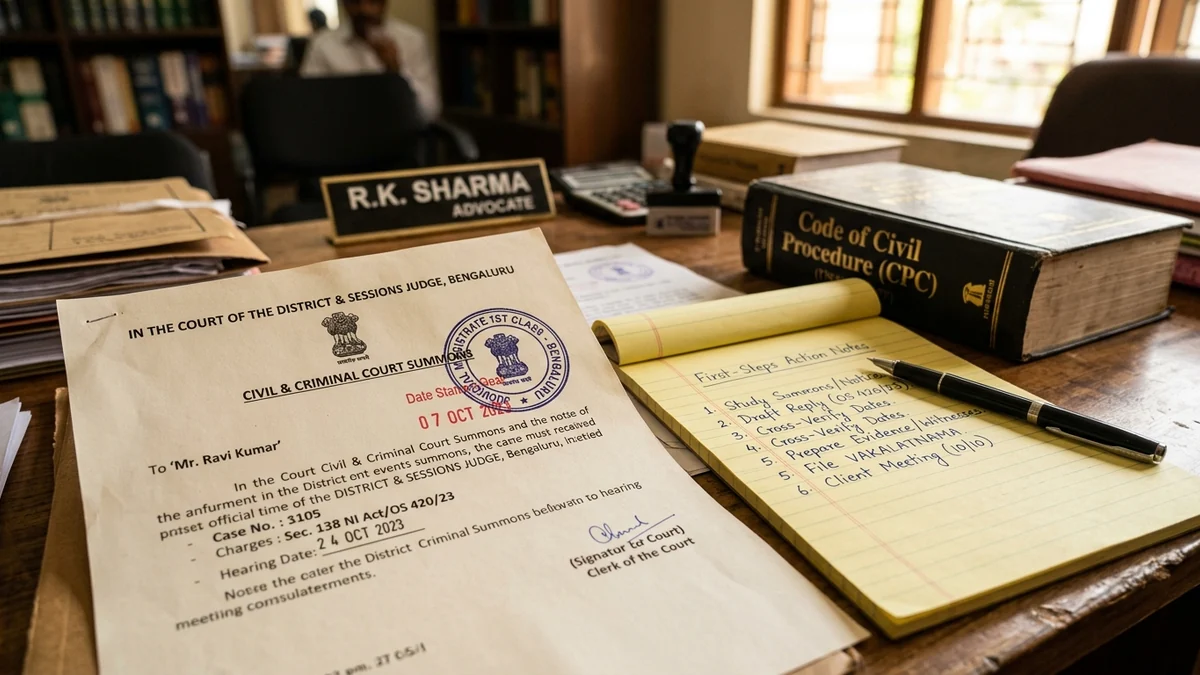
Receiving an official court summons or legal notice delivered by a process server or registered Speed Post can cause immediate concern. Understanding how to decode key details on the summons document ensures you take the right protective legal steps.
1. Key Information Included in a Court Summons
Every formal summons issued under Order 5 CPC (Civil) or Sections 63 – 71 BNSS 2023 (Criminal) contains essential information:
- Court Name & Forum Jurisdiction: e.g., In the Court of Civil Judge Senior Division, District Court Sector-12 Faridabad.
- Case / Suit Number & Category: e.g., Civil Suit No. 124 of 2026 or COMA 452 of 2026.
- Parties Name: Plaintiff / Complainant vs. Defendant / Respondent / Accused.
- Next Date of Hearing (NDOH): The exact date and time fixed for your mandatory appearance or filing reply.
- Court Seal & Presiding Officer Signature: Official judicial stamp validating the paper.
2. What Happens If You Ignore or Refuse a Summons?
- Civil Cases (Order 9 Rule 6 CPC): If you refuse or fail to appear after valid service, the Civil Court can declare you Ex-Parte and pass an adverse judgment in your absence.
- Criminal Cases (Section 72 BNSS): Ignoring a criminal summons leads to the issuance of a Bailable Warrant (BW), followed by a Non-Bailable Warrant (NBW).
3. First 4 Steps to Take Immediately Upon Receipt
- Note the exact date, time, and mode of receipt (Speed Post tracking number or process server signature).
- Obtain complete copies of the Plaint / Complaint and attached exhibits.
- Consult a trial Advocate immediately to draft a Written Statement (WS) within the mandatory 30-day window under Order 8 Rule 1 CPC.
- Appear in court through your Advocate on the Next Date of Hearing (NDOH) and file a formal Power of Attorney (Vakalatnama).
4. Comprehensive Legal Framework under Bharatiya Nagarik Suraksha Sanhita 2023
With the enactment of the Bharatiya Nagarik Suraksha Sanhita, 2023, replacing the Code of Criminal Procedure 1973 (CrPC), criminal investigation, arrest safeguards, trial procedures, and bail jurisprudence have undergone structural transformation across Indian courts. Navigating criminal defence in Delhi NCR and Haryana requires exact statutory compliance with newly codified timelines, mandatory electronic audio-video recording, and revamped bail provisions.
Key statutory pillars governing criminal proceedings under the new criminal laws include:
- Section 35 BNSS (Notice of Appearance): Replaces Section 41A CrPC. Police officers cannot effect arbitrary arrest for offences punishable with imprisonment up to 7 years without recording written reasons and serving a formal Section 35 notice. Non-compliance violates Supreme Court mandates in Arnesh Kumar.
- Anticipatory Bail (Section 482 BNSS / old Sec 438 CrPC): Empowers the Sessions Court and High Court to grant pre-arrest protection to persons with reasonable apprehension of arrest in non-bailable offences.
- Regular Bail (Section 480 & 483 BNSS / old Sec 437 & 439 CrPC): Governs post-arrest bail applications before the Magistrate, Sessions Court, and High Court upon consideration of the gravity of the offence, risk of tampering with evidence, flight risk, and roots in society.
- Mandatory Electronic Evidence Certification (Section 63 BSA 2023): All digital evidence, phone recordings, CCTV footage, and WhatsApp chats require an accompanying Certificate under Section 63 of the Bharatiya Sakshya Adhiniyam, 2023 (formerly Section 65B Indian Evidence Act).
5. Landmark Supreme Court Precedents in Criminal Jurisprudence
The Supreme Court mandated that arrest should be an exception, not the rule, in offences punishable with less than 7 years. Police officers must satisfy the Section 41 CrPC (now Section 35 BNSS) checklist, and Magistrates must not authorize mechanical remand.
Categorized offences into distinct categories (A, B, C, D) and laid down strict guidelines that non-custodial investigation in Category A offences warrants immediate bail without sending accused persons to judicial custody.
Established the foundational seven categories under which High Courts must exercise inherent powers (now Section 528 BNSS) to quash false, frivolous, and maliciously instituted FIRs to prevent abuse of the process of law.
6. Step-by-Step Criminal Trial & Defence Roadmap
The life cycle of criminal proceedings from FIR registration to final acquittal follows this rigid statutory timeline:
- FIR Registration & Preliminary Steps: Lodging of First Information Report under Section 173 BNSS. Accused evaluates whether to apply for immediate Anticipatory Bail (Section 482 BNSS) or challenge the FIR via High Court Quashing (Section 528 BNSS).
- Investigation & Notice Compliance: Compliance with Section 35 BNSS notice, submission of documentary alibi, and digital evidence before the Investigating Officer (IO).
- Filing of Police Report / Chargesheet (Section 193 BNSS): Police file chargesheet within 60 or 90 days. Accused receives full copy of police papers, witness statements (Section 180 BNSS), and relied documents.
- Cognizance & Framing of Charges (Section 251 / 263 BNSS): Arguments on Discharge. If no prima facie case exists, the defence moves for discharge. Otherwise, charges are formally framed.
- Prosecution Evidence (PW Examination): Prosecution witnesses depose on oath. Defence counsel conducts strategic cross-examination to dismantle prosecution narratives, establish contradictions, and expose improvements.
- Statement of Accused (Section 351 BNSS / old Sec 313 CrPC): Court puts all incriminating circumstances to the accused to explain their defence without oath.
- Defence Evidence (DWs): Accused introduces independent defence witnesses, certified electronic evidence under Section 63 BSA 2023, and expert opinions.
- Final Arguments & Judgment: Defence presents judicial precedents, legal contradictions, and reasonable doubts, culminating in an order of acquittal or sentence.
7. Comparative Assessment Table: Criminal Remedies & Bail Types
| Parameter | Anticipatory Bail (Sec 482 BNSS) | Regular Bail (Sec 483 BNSS) | Default / Statutory Bail (Sec 187 BNSS) |
|---|---|---|---|
| Timing | Prior to arrest / during investigation | Post-arrest / during judicial custody | Upon non-filing of chargesheet in 60/90 days |
| Forum | Sessions Court or High Court | Magistrate / Sessions / High Court | Court of jurisdictional Magistrate |
| Right vs Discretion | Judicial Discretion | Judicial Discretion | Indefeasible Absolute Right |
| Key Factor | Prima facie case, custodial necessity | Investigation status, charge severity | Statutory time lapse by police |
8. Strategic Legal Advice for Criminal Matters in Faridabad & Delhi NCR
When facing criminal investigations or court proceedings in District Courts Sector-12 Faridabad or Delhi Courts, implement these critical safeguards:
- Never Ignore Section 35 BNSS Notices: Failing to comply with a notice to appear allows police to seek non-bailable warrants (NBW) and effect lawful arrest. Always submit written representation through counsel.
- Preserve Digital Evidence Immediately: Timestamp and preserve CCTV footage, CDR (Call Detail Records), and WhatsApp chats before telcos delete data after 1 year.
- File for Discharge Promptly: Where allegations are civil in nature (e.g. breach of contract disguised as cheating), move discharge applications before charge framing to terminate frivolous prosecution early.
9. Frequently Asked Questions (FAQ)
Answer: Police can only arrest without a warrant in cognizable offences. For offences punishable with imprisonment of 7 years or less, Section 35 BNSS mandates serving a notice of appearance unless specific grounds justifying arrest (such as preventing evidence destruction or flight risk) are recorded in writing.
Answer: Once filed, anticipatory bail petitions are typically listed within 24 to 48 hours. Courts often grant interim protection on the first hearing while directing the applicant to join the investigation.
Answer: Immediate remedies include securing anticipatory bail, attending mediation, collecting documentary proof of separate residence, and filing a petition under Section 528 BNSS before the High Court to quash general, omnibus allegations lacking specific dates and overt acts.
Statutory Authorities & Legal References
- Bharatiya Nyaya Sanhita & Bharatiya Nagarik Suraksha Sanhita, 2023
- Bharatiya Sakshya Adhiniyam, 2023 (Section 63 Electronic Evidence Certificate)
- Landmark rulings of the Supreme Court of India and Punjab & Haryana High Court
- Case precedents reported in Supreme Court Cases (SCC), All India Reporter (AIR), and Punjab Law Reporter (PLR).
- e-Courts Services & National Judicial Data Grid (NJDG) procedural tracking guidelines.
Disclaimer: This article is published for educational and informational purposes only under the Advocates Act, 1961. It does not constitute formal legal advice or create an attorney-client relationship. For case-specific legal strategy, consult a qualified advocate.
Actionable Next Steps & Critical Legal Checklist
If you are facing an active legal dilemma regarding Regulatory & Statutory Remedy Action Checklist, execute these immediate procedural steps to protect your statutory rights:
- Calculate Ad Valorem Court Fees & Interest: Compute statutory interest under HRERA Rules or Section 7(iv) Court Fees Act before filing claims.
- Observe 2-Year Consumer Limitation Window: File consumer forum complaints within 2 years from the date of cause of action under Section 69 Consumer Protection Act.
- Execute Court Decrees Under Order 21 CPC: If opponent defaults on judicial orders, initiate execution proceedings or contempt under Order 39 Rule 2A CPC.