Injunction vs Damages for Breach of Contract
 Authored by: Advocate Kishan Kumar (Advocate & Legal Consultant)
Quick Legal Takeaways
- Injunction (Specific Relief Act 1963): Restrains a party from committing an unlawful breach or compels specific performance where monetary compensation is inadequate.
- Damages (Contract Act 1872): Awarded under Sec 73 & 74 to financially compensate actual quantifiable losses.
- Injunction 3-Prong Test (Gujarat Bottling): Requires proving: 1. Prima facie case, 2. Balance of convenience, 3. Irreparable injury that cannot be compensated in money.
- Applications: Seek Injunctions for real estate sale agreement breaches or trade secret theft; seek Damages for unpaid invoices or supply defaults.
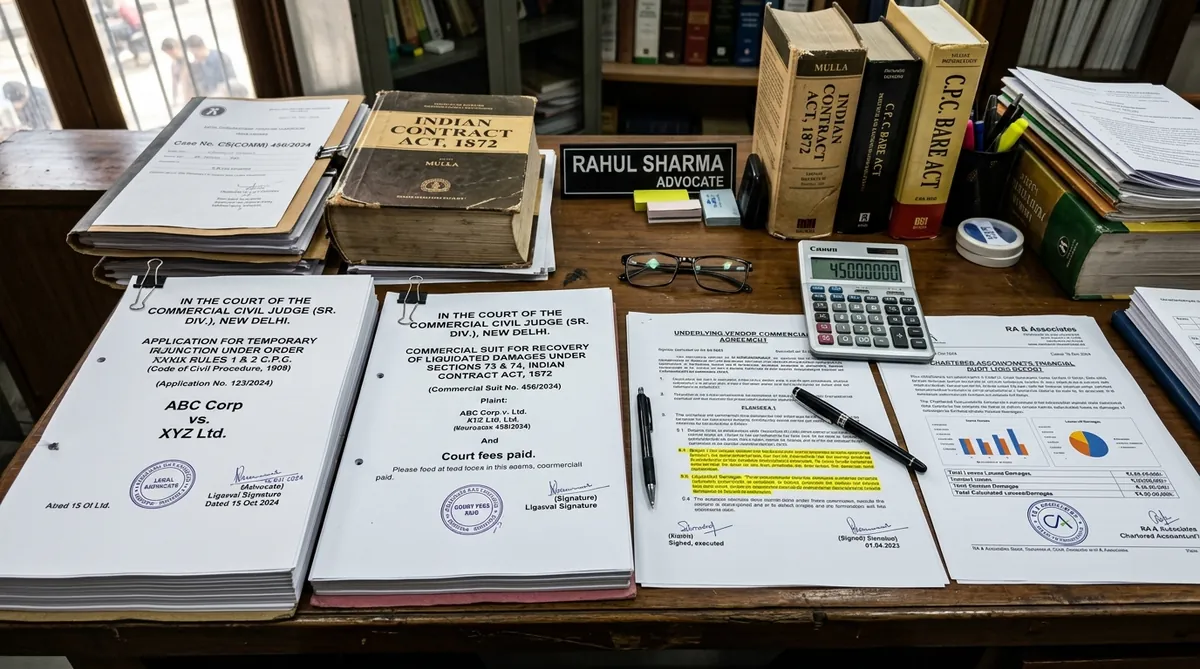
When a commercial contract, non-compete clause, real estate sale agreement, or vendor contract is breached, selecting the correct legal remedy is essential. Indian civil law offers two primary remedies: seeking a Court Injunction (Stay Order) or claiming Monetary Damages.
1. Comparison Overview Table
| Parameter | Injunction (Specific Relief Act) | Monetary Damages (Indian Contract Act) |
|---|---|---|
| Core Purpose | Court order restraining a party from doing an illegal act or enforcing performance. | Financial compensation awarded to cover actual financial loss suffered. |
| Governing Law | Sections 37 – 42 of Specific Relief Act. | Sections 73 & 74 of Indian Contract Act. |
| Primary Legal Test | Irreparable injury, prima facie case, balance of convenience. | Proof of actual, quantifiable financial loss or liquidated damages. |
| Best Suited For | Real estate sale agreements, non-compete covenants, intellectual property theft. | Unpaid invoice defaults, delayed supply deliveries, quantifiable money claims. |
The Supreme Court held that in deciding applications for temporary injunctions, courts must evaluate three mandatory parameters: 1. Prima facie case, 2. Balance of convenience, and 3. Irreparable injury that cannot be compensated in terms of money.
2. When Should You Seek an Injunction?
An injunction is appropriate when financial compensation alone cannot restore your position:
- Preventing a property owner from selling a plot to a third party after taking Earnest Money (Bayana) under an Agreement to Sell.
- Restraining a former business partner or employee from misusing proprietary trade secrets.
- Preventing illegal construction or land encroachment on private property.
3. When Should You Seek Monetary Damages?
Pursuing damages under Section 73 of the Contract Act is ideal when the financial loss can be precisely computed (e.g., unpaid business invoices, defaulted friendly loans, or supply chain delay losses).
4. Statutory Framework: Contract Act & Specific Relief Act
The choice between seeking an injunction or claiming damages is governed by specific statutory rules in India, primarily focusing on whether financial compensation is an adequate remedy.
- Section 73 & 74, Indian Contract Act: Section 73 deals with unliquidated damages (compensation for actual loss suffered), while Section 74 deals with liquidated damages (pre-estimated damages specified in the contract).
- Section 38 & 39, Specific Relief Act: Section 38 allows perpetual injunctions to prevent breach of an obligation. Section 39 allows mandatory injunctions to compel the performance of certain acts to prevent the breach.
- Section 41, Specific Relief Act: Specifies situations where an injunction cannot be granted, notably when "equally efficacious relief can certainly be obtained by any other usual mode of proceeding" (i.e., when damages are sufficient).
5. Landmark Precedents on Injunction vs. Damages
The Supreme Court laid down the principles for granting interlocutory injunctions, emphasizing the "balance of convenience" and "irreparable injury" tests. If the injury can be compensated in terms of money, an injunction should generally be refused.
The Court reiterated that an injunction cannot be granted if the plaintiff has not suffered any irreparable loss that cannot be adequately compensated by way of damages.
6. Comparative Assessment: Injunction vs. Damages vs. Specific Performance
| Parameter | Injunction | Monetary Damages | Specific Performance |
|---|---|---|---|
| Nature of Relief | Preventive (stopping an action). | Compensatory (financial payout). | Compulsory (forcing completion of a contract). |
| When Granted | When damages are inadequate or impossible to calculate. | When loss is quantifiable in monetary terms. | When the act agreed to be done is unique (e.g., real estate). |
| Speed of Relief | Temporary injunctions can be obtained within days. | Requires a full trial (years). | Requires a full trial (years). |
7. Strategic Advisory for Commercial Contract Breaches
In commercial contracts, always ensure you have a robustly drafted "Liquidated Damages" clause and a specific acknowledgment that a breach will cause "irreparable harm" justifying injunctive relief. While courts aren't bound by such clauses, they carry persuasive value. If a breach is imminent, moving swiftly for an ex-parte temporary injunction under Order 39 CPC gives you immense negotiating leverage, far more than waiting to file a long-drawn suit for damages.
Statutory Authorities & Legal References
- Transfer of Property Act (Sections 53A, 54 Sale, Section 106 Tenancy)
- Registration Act, Indian Stamp Act & Haryana Stamp Rules
- Specific Relief Act (Section 16(c) Readiness and Willingness & Injunctions)
- Code of Civil Procedure (Order 39 Rules 1 & 2 Temporary Injunctions)
- Case precedents reported in Supreme Court Cases (SCC), All India Reporter (AIR), and Punjab Law Reporter (PLR).
- e-Courts Services & National Judicial Data Grid (NJDG) procedural tracking guidelines.
Disclaimer: This article is published for educational and informational purposes only under the Advocates Act, 1961. It does not constitute formal legal advice or create an attorney-client relationship. For case-specific legal strategy, consult a qualified advocate.
Strategic Choice: Claiming Specific Relief Injunction vs Monetary Damages
In commercial and contract litigation, choosing between an injunction (Specific Relief Act) and damages (Section 73 Contract Act) depends on the nature of injury:
1. Irreparable Injury Test: An injunction is granted where monetary damages cannot afford adequate relief (such as alienation of unique real estate or disclosure of trade secrets).
2. Section 10 Specific Relief Act (2018 Amendment): Specific performance is now mandatory, eliminating court discretion to substitute monetary compensation in valid contracts.
3. Liquidated Damages under Section 74 Contract Act: Where the contract specifies a reasonable pre-estimate of loss, the aggrieved party is entitled to reasonable compensation not exceeding the penalty amount (Kailash Nath Associates).
The Supreme Court held that Section 74 of the Contract Act awards reasonable compensation for damage or loss caused by a breach, and earnest money or liquidated damages cannot be forfeited arbitrarily without proving actual loss.
Actionable Next Steps & Critical Legal Checklist
If you are facing an active legal dilemma regarding Commercial Contracts & Corporate Compliance Checklist, execute these immediate procedural steps to protect your statutory rights:
- Review Dispute Resolution & Notice Clauses: Examine contractual cure periods, limitation provisions, and mandatory pre-institution mediation requirements.
- Serve Detailed Advocate Legal Notice: Detail specific contractual breaches, calculation of liquidated damages, and compliance timelines before litigation.
- Adhere to POSH & Employment Directives: Ensure Internal Committee (IC) inquiry procedures strictly comply with natural justice and statutory 90-day inquiry timelines.
Frequently Asked Questions
Key statutory answers and procedural guidance curated by Senior Advocates in Faridabad & Delhi NCR.
When should a party seek specific performance instead of damages for breach of contract?
Specific performance is appropriate when monetary damages are inadequate to compensate the breach, such as in contracts involving unique property, rare goods, or where the subject matter has no market equivalent. Under Section 14 of the Specific Relief Act, courts will not order specific performance where monetary compensation is an adequate remedy.
Can a court grant both an injunction and damages simultaneously?
Yes. Under Section 40 of the Specific Relief Act, the plaintiff may claim damages in addition to or in substitution of injunctive relief. The court has discretion to award both where the injunction alone would not fully compensate the aggrieved party for the breach.
What is the limitation period for filing a suit for breach of contract?
Under Article 55 of the Limitation Act, a suit for compensation for breach of contract must be filed within3 yearsfrom the date the contract is broken. For specific performance, Article 54 prescribes the same 3-year period from the date fixed for performance.
Can a company director be prosecuted for a cheque issued by the company?
Yes, under Section 141 of the NI Act, every person who was in charge of and responsible to the company for the conduct of its business at the time the offence was committed is vicariously liable, provided specific averments regarding their active role are made in the complaint.
What happens if the drawer issues a 'Stop Payment' instruction to the bank?
As held in Modi Cements v. Kuchil Kumar Nandi, a cheque returned with 'Stop Payment' instructions is fully actionable under Section 138 NI Actunless the drawer proves there were sufficient funds in the account and payment was stopped for a valid extraneous reason.
Is an unsigned or undated security cheque actionable under Section 138?
Under Section 20 of the NI Act, when a person signs and delivers an incomplete negotiable instrument, they grant prima facie authority to the holder to fill in remaining particulars. The Supreme Court in Bir Singh v. Mukesh Kumar (2019) confirmed that a signed blank cheque given as security is fully actionable upon dishonour.
What is the statutory limitation period for filing proceedings related to injunction vs damages for breach of contract?
Under the Limitation Act, 1963, limitation varies depending on the specific cause of action (e.g. 3 years for civil suits/contracts, 30 days for Section 138 NI Act notices, 90 days for statutory appeals). You can verify exact limitation windows using our interactive Limitation Calculator.
How can I consult an experienced advocate in Delhi NCR or Haryana for injunction vs damages for breach of contract?
You can schedule a confidential legal consultation with Advocate Kishan Kumar at Urban Rights Legal Consultants (Chamber No. 343, District & Sessions Court Complex, Faridabad) by phone or WhatsApp at +91-92120-22119 to review case documents and structure an effective litigation strategy.