Landlord-Tenant Disputes & Eviction Rules under Haryana Rent Control Laws
 Authored by: Advocate Kishan Kumar (Advocate & Legal Consultant)
Quick Legal Takeaways
- Eviction Statute: Governed by Section 13 of the Haryana Urban (Control of Rent and Eviction) Act, 1973 before the Rent Controller.
- Statutory Eviction Grounds: Rent default, personal bona fide requirement, unauthorized subletting, or material structural impairment.
- Section 106 Notice to Quit: Mandatory pre-suit notice terminating tenancy under Transfer of Property Act 1882.
- Title Check Safeguard: Verify ownership deeds via 30-year property title search reports.
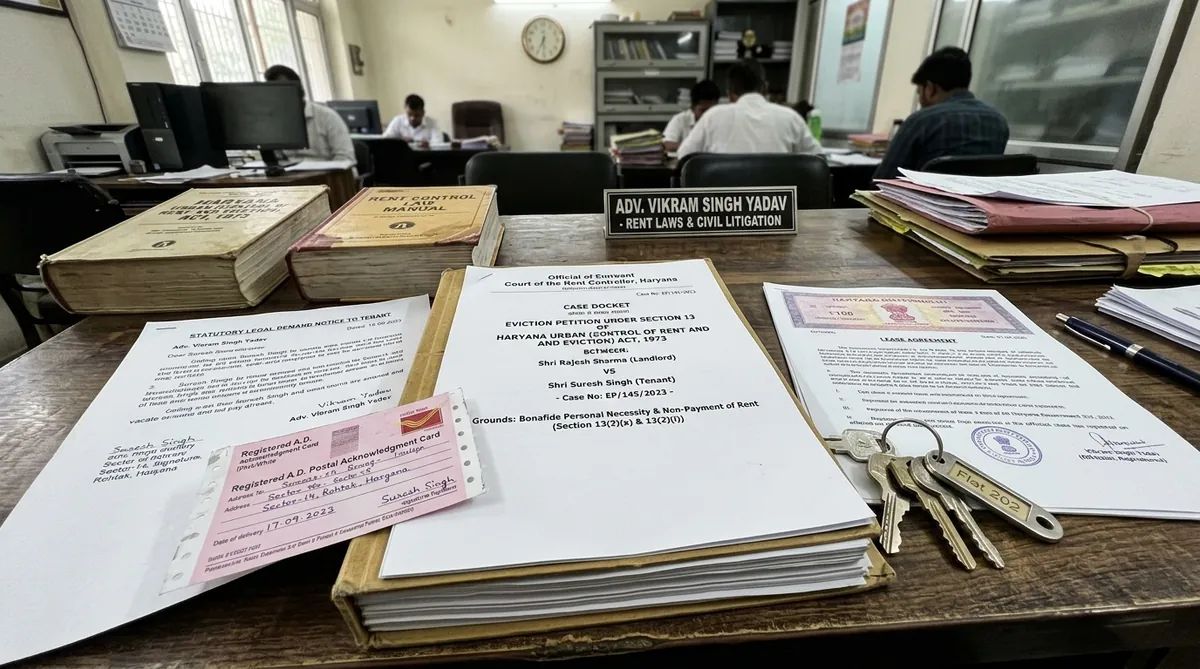
Commercial and residential tenancy disputes in urban Haryana areas (including Faridabad, Gurgaon, and NIT) are governed by the Haryana Urban (Control of Rent and Eviction) Act, 1973 alongside general provisions of the Transfer of Property Act. Where unauthorized occupants attempt to claim title, property owners must differentiate rent petitions from civil encroachment and injunction suits.
- Verify Title & Circle Rate Valuation: Conduct encumbrance searches across Book-1 records at the Sub-Registrar office and verify Section 47A circle rate valuations.
- Serve Statutory Eviction Notice: Issue a formal termination notice under the Haryana Urban Rent Control Act or Section 106 TPA detailing statutory eviction grounds.
- Seek Urgent Demolition / Encroachment Stay: File for an ad-interim injunction under Order 39 Rules 1 & 2 CPC with site photographs, demarcation reports, and title deeds.
1. Statutory Grounds for Tenant Eviction in Haryana
- Non-Payment of Rent (Section 13(2)(i)): Default in paying agreed rent within 15 days of due date.
- Bona Fide Personal Requirement (Section 13(3)(a)): Genuine necessity of the property by landlord for personal residential or commercial occupation.
- Material Impairment or Alteration: Tenant committing acts that materially impair property value or structural utility.
- Sub-letting without Consent: Unlawfully subletting premises to third parties without landlord's written consent.
- Nuisance: Tenant creating continuous public or neighborhood nuisance.
2. Section 106 Notice to Quit (Transfer of Property Act)
Prior to instituting eviction proceedings, serving a formal 15-day (residential) or 6-month (commercial) Notice to Quit under Section 106 TP Act terminating tenancy is mandatory. Ownership credentials must be verified via 30-year property title search reports.
3. Comprehensive Statutory Analysis & Procedural Safeguards
Tenancy disputes in urban Haryana (including Faridabad, Ballabhgarh, and Gurugram) operate under a dual legislative framework: the Haryana Urban (Control of Rent and Eviction) Act, 1973 for protected tenancies, and the Transfer of Property Act alongside the Specific Relief Act for contractual lease deeds and commercial licenses. Navigating these laws requires careful compliance with mandatory statutory pre-conditions before approaching the Rent Controller or Civil Judge (Senior Division).
Under Section 13(2) of the Haryana Rent Act, landlords must establish specific legal grounds with documentary proof:
- Non-Payment of Rent (Section 13(2)(i)): Where the tenant fails to pay or tender rent within 15 days of the agreed due date. The Rent Controller calculates statutory interest (8% per annum) and cost of application on the first date of hearing. If the tenant tenders this assessed amount, eviction on the ground of first default is averted.
- Bona Fide Requirement (Section 13(3)(a)): The landlord must demonstrate a genuine, pressing necessity for personal residential or commercial occupation. The landlord must plead and prove that they do not occupy any other reasonably suitable building in the same urban area and have not vacated such premises without sufficient cause.
- Material Impairment & Structural Changes (Section 13(2)(iii)): Any structural alteration made without the landlord's written consent that impairs the property's utility, stability, or valuation entitles the owner to seek immediate eviction.
- Unauthorized Subletting (Section 13(2)(ii)): The tenant cannot sublet, transfer, or assign their leasehold rights to any third party without express written permission. Sub-tenancies created informally are illegal and render both occupants liable to summary eviction.
4. Landmark Supreme Court & High Court Precedents
The Supreme Court established that upon passing of an eviction decree, the contractual tenancy terminates, and during the pendency of any appeal or stay, the tenant is liable to pay mesne profits / market rent rather than the nominal contractual rent.
The Apex Court held that discrimination between residential and commercial premises concerning bona fide personal requirement is unconstitutional. Landlords can seek eviction for commercial premises for their genuine business needs under equal footing.
The court clarified the mandatory operation of Section 106 Notice to Quit and statutory waiver rules where rent is accepted without prejudice post-termination.
5. Step-by-Step Eviction Trial Procedure in Haryana Courts
The standard procedural lifecycle of a tenancy eviction petition before the Rent Controller at Faridabad District Court follows this trajectory:
- Statutory Notice to Quit (Section 106 TPA): Formal legal notice served through registered post with acknowledgment due (RPAD) and speed post, providing 15 days (residential) or 6 months (manufacturing/commercial) for vacation.
- Institution of Eviction Petition: Drafted with certified title deeds, site plans, original rent agreement, and bank statements proving rent default or bona fide necessity.
- Summons & Service of Process: Court summons issued via process server, registered post, and dasti service. Substituted service by publication ordered upon willful avoidance.
- Written Statement & Replication: Tenant files defense within 30 days. Landlord files replication clarifying specific factual denials.
- Provisional Assessment of Rent: On the first date of hearing, the Rent Controller assesses arrears of rent, statutory interest, and court costs.
- Evidence Stage (PWs & DWs): Examination-in-Chief via sworn affidavits and rigorous cross-examination of landlord and tenant witnesses.
- Final Arguments & Eviction Order: Court delivers judgment granting statutory time (typically 1 to 3 months) to vacate the premises.
- Execution Petition (Order XXI CPC): If the tenant fails to vacate, warrants of possession are issued with police assistance and break-open orders.
6. Comparative Assessment Table: Tenancy Rights & Remedies
| Parameter | Haryana Urban Rent Act | Transfer of Property Act | Commercial License / Leave & License |
|---|---|---|---|
| Applicability | Urban areas notified under Rent Act | Registered leases over 11 months | Temporary occupancy licenses |
| Forum / Jurisdiction | Rent Controller (Civil Judge Senior Division) | Civil Court / Commercial Court | Civil Suit for Mandatory Injunction |
| Standard Eviction Time | 12 - 24 Months | 18 - 36 Months | 6 - 12 Months (Summary route) |
| Mesne Profits Entitlement | Applicable post-eviction decree | From date of tenancy determination | Damages as per license terms |
7. Practical Advocate Advisory for Landlords & Tenants in Faridabad
To safeguard investments and prevent protracted civil litigation in Haryana, adhere to these key legal practices:
- Mandatory Lease Registration: Any lease exceeding 11 months must be executed on requisite Haryana non-judicial stamp paper and registered before the Sub-Registrar under Section 17 of the Registration Act. Unregistered leases cannot be admitted in evidence to prove contractual terms.
- Clear Escalation & Forfeiture Clauses: Incorporate unambiguous 10% to 15% annual rent escalation, security deposit refund terms, and clear default forfeiture triggers.
- Avoid Cash Transactions: All rent payments must flow through RTGS/NEFT/UPI to maintain an indisputable digital audit trail.
9. Comprehensive Eviction Petition Filing Checklist for Haryana Courts
- Title Deeds & Record of Rights (Jamabandi) Records: Registered Sale Deed / Conveyance Deed proving absolute ownership of the premises.
- Original Rent / Lease Agreement: Duly stamped agreement specifying monthly rent, due date, and tenure terms.
- Section 106 Notice to Quit & India Post Tracking: Proof of dispatch and confirmed delivery of statutory termination notice.
- Bank Statements Showing Rent Default: Certified bank account ledgers demonstrating non-receipt of rent for the default period.
- Architect / Structural Expert Report: Required when eviction is sought on grounds of structural impairment or reconstruction.
Eviction proceedings before the Rent Controller require: (1) Registered Tenancy Agreement / Lease Deed; (2) Electricity/Water utility bills proving ownership; (3) Formal Notice to Quit under Section 106 TPA; and (4) Certified bank records proving non-payment of rent.
Statutory Authorities & Legal References
- Transfer of Property Act (Sections 53A, 54 Sale, Section 106 Tenancy)
- Registration Act, Indian Stamp Act & Haryana Stamp Rules
- Specific Relief Act (Section 16(c) Readiness and Willingness & Injunctions)
- Code of Civil Procedure (Order 39 Rules 1 & 2 Temporary Injunctions)
- Case precedents reported in Supreme Court Cases (SCC), All India Reporter (AIR), and Punjab Law Reporter (PLR).
- e-Courts Services & National Judicial Data Grid (NJDG) procedural tracking guidelines.
Disclaimer: This article is published for educational and informational purposes only under the Advocates Act, 1961. It does not constitute formal legal advice or create an attorney-client relationship. For case-specific legal strategy, consult a qualified advocate.
Actionable Next Steps & Critical Legal Checklist
If you are facing an active legal dilemma regarding Property Protection & Tenancy Eviction Checklist, execute these immediate procedural steps to protect your statutory rights:
- Verify Title & Circle Rate Valuation: Conduct encumbrance searches across Book-1 records at the Sub-Registrar office and verify Section 47A circle rate valuations.
- Serve Statutory Eviction Notice: Issue a formal termination notice under the Haryana Urban Rent Control Act or Section 106 TPA detailing statutory eviction grounds.
- Seek Urgent Demolition / Encroachment Stay: File for an ad-interim injunction under Order 39 Rules 1 & 2 CPC with site photographs, demarcation reports, and title deeds.
Frequently Asked Questions
Key statutory answers and procedural guidance curated by Senior Advocates in Faridabad & Delhi NCR.
Can a landlord cut electricity or water supply to force a tenant out?
Absolutely not. Section 10 of the Haryana Rent Act strictly prohibits landlords from severing essential amenities like water or electricity without just or sufficient cause. Tenants can file an urgent application before the Rent Controller for immediate restoration within 24 hours.
How is commercial tenant eviction handled differently from residential eviction?
Commercial tenancies governed by registered lease agreements allow landlords to enforce fixed-term expiry, lock-in breach penalties, and recovery of mesne profits through specialized Commercial Courts under the Commercial Courts Act, 2015.
What is the limitation period for recovering unpaid rent arrears?
Under Article 52 of the Limitation Act, the limitation period for recovering rent arrears is 3 years from the date the rent became due. Beyond 3 years, the debt becomes legally time-barred.
What is the statutory limitation period for filing proceedings related to landlord-tenant disputes & eviction rules under haryana rent control laws?
Under the Limitation Act, 1963, limitation varies depending on the specific cause of action (e.g. 3 years for civil suits/contracts, 30 days for Section 138 NI Act notices, 90 days for statutory appeals). You can verify exact limitation windows using our interactive Limitation Calculator.
How can I consult an experienced advocate in Delhi NCR or Haryana for landlord-tenant disputes & eviction rules under haryana rent control laws?
You can schedule a confidential legal consultation with Advocate Kishan Kumar at Urban Rights Legal Consultants (Chamber No. 343, District & Sessions Court Complex, Faridabad) by phone or WhatsApp at +91-92120-22119 to review case documents and structure an effective litigation strategy.