Legal Notice for Breach of Contract: Essentials
 Authored by: Advocate Kishan Kumar (Advocate & Legal Consultant)
Quick Legal Takeaways
- Mandatory Pre-Litigation Step: Issuing a formal legal demand notice is required prior to instituting civil recovery suits or arbitration.
- Statutory Cure Period: Grants the defaulting party 15 to 30 days to rectify the breach or clear monetary defaults.
- Damages Computation (Sec 73 & 74 Contract Act): Requires proof of actual financial loss under Kailash Nath Associates (2015).
- Response Mandate: Recipients must send a formal reply within the cure period to avoid court inferences of implied admission.
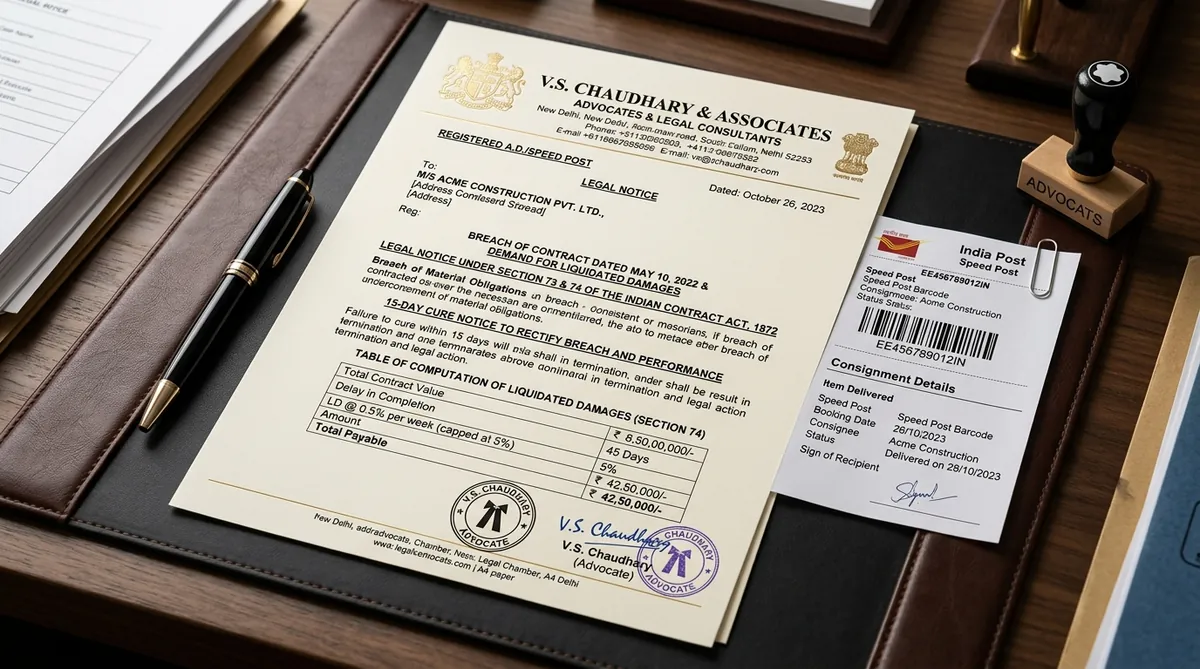
When a party to a commercial agreement, vendor contract, or service agreement fails to fulfill their obligations, issuing a formal Legal Notice for Breach of Contract is the mandatory first step before initiating civil litigation or arbitration.
1. Essential Elements of a Breach of Contract Legal Notice
- Recital of Agreement Terms: Specific details of the written agreement (contract date, execution location, consideration amount, and key performance clauses).
- Factual Matrix of Breach (Section 39 Contract Act): Precise description of how the defaulting party breached terms (e.g., non-payment, delayed delivery, or defective services).
- Statutory Cure Period: Granting a clear statutory cure window (typically 15 to 30 days) for the defaulting party to rectify the breach or make payment.
- Quantification of Loss & Damages (Section 73 & 74 Contract Act): Detailed computation of actual financial losses or liquidated damages suffered due to the breach.
- Reservation of Legal Rights: Reserving the right to file a civil recovery suit, arbitration petition, or Suit for Specific Performance upon non-compliance.
The Supreme Court held that under Section 74 of the Indian Contract Act, compensation for breach can be awarded only if the party claiming damages proves actual loss or damage suffered, unless proof of loss is impossible to establish.
2. How to Respond to a Breach of Contract Legal Notice
If you receive a legal notice alleging breach of contract:
- Review Dispute Resolution & Notice Clauses: Examine contractual cure periods, limitation provisions, and mandatory pre-institution mediation requirements.
- Serve Detailed Advocate Legal Notice: Detail specific contractual breaches, calculation of liquidated damages, and compliance timelines before litigation.
- Adhere to POSH & Employment Directives: Ensure Internal Committee (IC) inquiry procedures strictly comply with natural justice and statutory 90-day inquiry timelines.
3. Statutory Framework Governing Breach of Contract
The substantive law for claiming compensation or enforcing obligations upon a breach of contract is primarily found in the Indian Contract Act and the Specific Relief Act. Procedural requirements are governed by the Code of Civil Procedure and the Commercial Courts Act, 2015.
- Section 73 Contract Act (Unliquidated Damages): Provides for compensation for loss or damage caused by a breach of contract that naturally arose in the usual course of things.
- Section 74 Contract Act (Liquidated Damages): Applies when the contract stipulates a specific penalty or liquidated damages amount upon breach. The court grants reasonable compensation not exceeding the stipulated amount.
- Section 75 Contract Act: Entitles a person rightfully rescinding a contract to compensation for any damage sustained through the non-fulfillment of the contract.
- Specific Relief Act: Governs remedies like specific performance of the contract and injunctions to prevent the breach of negative covenants.
- Section 80 CPC (Notice to Government): Mandates a strict 60-day advance legal notice before instituting a civil suit against the Government or a public officer in respect of any act purporting to be done in official capacity.
4. Landmark Judicial Precedents on Breach & Legal Notices
The Supreme Court clarified the law on Section 74, holding that the jurisdiction of the court to award compensation in case of breach of contract is unqualified except as to the maximum stipulated; the court has to award "reasonable compensation".
Established that where actual loss or damage can be proved, such proof is required even if a liquidated damages clause exists. Earnest money forfeiture must be reasonable.
Held that in contracts where it is difficult or impossible to prove the exact loss caused by a breach, the pre-estimated liquidated damages stipulated in the contract will be awarded if they are a genuine pre-estimate.
5. Procedural Roadmap: Instituting a Breach of Contract Suit
Upon failure of the defaulting party to comply with the legal notice, the following civil litigation roadmap ensues:
- Drafting the Plaint: Instituting a civil suit under Order VII CPC, clearly pleading the terms of the contract, the specific breach, delivery of the legal notice, and the calculation of damages.
- Pre-Institution Mediation: For commercial disputes, mandatory pre-institution mediation under Section 12A of the Commercial Courts Act must be exhausted unless urgent interim relief is sought.
- Filing & Court Fees: Paying ad-valorem court fees on the quantum of damages claimed.
- Summons & Written Statement: The court issues summons to the defendant, who must file a Written Statement within 30 days (extendable up to 120 days in commercial suits).
- Framing of Issues & Evidence: The court frames issues under Order XIV CPC, followed by plaintiff and defendant leading documentary and oral evidence.
- Final Arguments & Decree: Adjudication of the dispute resulting in a decree for damages, specific performance, or injunction.
6. Comparative Assessment: Legal Notice vs Demand Notice vs Cease and Desist
| Parameter | Legal Notice for Breach | Demand Notice (Insolvency) | Cease and Desist Notice |
|---|---|---|---|
| Primary Objective | Claim damages or specific performance | Trigger corporate insolvency resolution | Halt infringing or unlawful activity |
| Governing Statute | Contract Act & CPC | Section 8 of IBC, 2016 | IP Laws & Tort Law |
| Statutory Timeline | Usually 15-30 days cure period | Strict 10 days to reply or pay | Immediate compliance expected |
| Consequence of Default | Civil Suit or Arbitration | NCLT Petition for Insolvency | Suit for Injunction & Damages |
7. Strategic Legal Advisory for Contract Drafting & Notices
To ensure a robust foundation for pursuing a breach of contract claim, adhere to these practical guidelines:
- Limitation Period Awareness: Under Articles 54 and 55 of the Limitation Act, a suit for specific performance or compensation for breach of contract must be filed within 3 years from the date fixed for performance, or when the breach occurs.
- Detailed Cause of Action: Ensure the legal notice precisely specifies the clauses breached and avoids vague allegations. A well-drafted notice sets the binding boundaries for your future court pleadings.
- Notice Service Protocol: Always serve notices via Registered Post with Acknowledgment Due (RPAD) to the registered office (for companies) or verified residential addresses, keeping original postal receipts and tracking reports.
Statutory Authorities & Legal References
- Transfer of Property Act (Sections 53A, 54 Sale, Section 106 Tenancy)
- Registration Act, Indian Stamp Act & Haryana Stamp Rules
- Specific Relief Act (Section 16(c) Readiness and Willingness & Injunctions)
- Code of Civil Procedure (Order 39 Rules 1 & 2 Temporary Injunctions)
- Case precedents reported in Supreme Court Cases (SCC), All India Reporter (AIR), and Punjab Law Reporter (PLR).
- e-Courts Services & National Judicial Data Grid (NJDG) procedural tracking guidelines.
Disclaimer: This article is published for educational and informational purposes only under the Advocates Act, 1961. It does not constitute formal legal advice or create an attorney-client relationship. For case-specific legal strategy, consult a qualified advocate.
Actionable Next Steps & Critical Legal Checklist
If you are facing an active legal dilemma regarding Commercial Contracts & Corporate Compliance Checklist, execute these immediate procedural steps to protect your statutory rights:
- Review Dispute Resolution & Notice Clauses: Examine contractual cure periods, limitation provisions, and mandatory pre-institution mediation requirements.
- Serve Detailed Advocate Legal Notice: Detail specific contractual breaches, calculation of liquidated damages, and compliance timelines before litigation.
- Adhere to POSH & Employment Directives: Ensure Internal Committee (IC) inquiry procedures strictly comply with natural justice and statutory 90-day inquiry timelines.
Frequently Asked Questions
Key statutory answers and procedural guidance curated by Senior Advocates in Faridabad & Delhi NCR.
What is the ideal timeframe for sending a legal notice after a breach of contract?
A legal notice should ideally be sent within30 daysof discovering the breach. While there is no statutory deadline for the notice itself, the underlying suit for breach of contract must be filed within3 yearsunder Article 55 of the Limitation Act. Prompt notice preserves evidence and demonstrates good faith.
Can a legal notice be sent via email or WhatsApp instead of registered post?
While there is no statutory prohibition,Registered Post AD (RPAD)remains the gold standard because it creates a legally recognized proof of delivery. Email and WhatsApp notices can supplement but should not replace RPAD. Some contracts may specify the agreed mode of communication, which should be followed.
What happens if the other party ignores the legal notice?
If the recipient fails to respond within the stipulated period (typically 15-30 days), the sender can proceed to file a civil suit for specific performance, damages, or injunction. The unanswered notice itself becomes evidence of the respondent's unwillingness to resolve the dispute amicably, which courts view unfavorably.
Can a company director be prosecuted for a cheque issued by the company?
Yes, under Section 141 of the NI Act, every person who was in charge of and responsible to the company for the conduct of its business at the time the offence was committed is vicariously liable, provided specific averments regarding their active role are made in the complaint.
What happens if the drawer issues a 'Stop Payment' instruction to the bank?
As held in Modi Cements v. Kuchil Kumar Nandi, a cheque returned with 'Stop Payment' instructions is fully actionable under Section 138 NI Actunless the drawer proves there were sufficient funds in the account and payment was stopped for a valid extraneous reason.
Is an unsigned or undated security cheque actionable under Section 138?
Under Section 20 of the NI Act, when a person signs and delivers an incomplete negotiable instrument, they grant prima facie authority to the holder to fill in remaining particulars. The Supreme Court in Bir Singh v. Mukesh Kumar (2019) confirmed that a signed blank cheque given as security is fully actionable upon dishonour.
What is the statutory limitation period for filing proceedings related to legal notice for breach of contract: essentials?
Under the Limitation Act, 1963, limitation varies depending on the specific cause of action (e.g. 3 years for civil suits/contracts, 30 days for Section 138 NI Act notices, 90 days for statutory appeals). You can verify exact limitation windows using our interactive Limitation Calculator.
How can I consult an experienced advocate in Delhi NCR or Haryana for legal notice for breach of contract: essentials?
You can schedule a confidential legal consultation with Advocate Kishan Kumar at Urban Rights Legal Consultants (Chamber No. 343, District & Sessions Court Complex, Faridabad) by phone or WhatsApp at +91-92120-22119 to review case documents and structure an effective litigation strategy.