Medical Negligence Claims & Doctor Protections in India
 Authored by: Advocate Kishan Kumar (Advocate & Legal Consultant)
Quick Legal Takeaways
- Civil Consumer Remedy: Patients paying treatment fees are "consumers" entitled to financial compensation for deficiency of medical service (IMA v. VP Shantha).
- Bolam Test: A doctor is NOT negligent if they acted in accordance with a standard practice accepted as proper by a skilled medical body.
- Criminal Negligence (Sec 106 BNS): Criminal prosecution requires proof of gross, reckless negligence.
- Doctor Protection Mandate (Jacob Mathew): Police CANNOT arrest or register an FIR against a doctor without an independent government medical panel opinion confirming gross negligence.
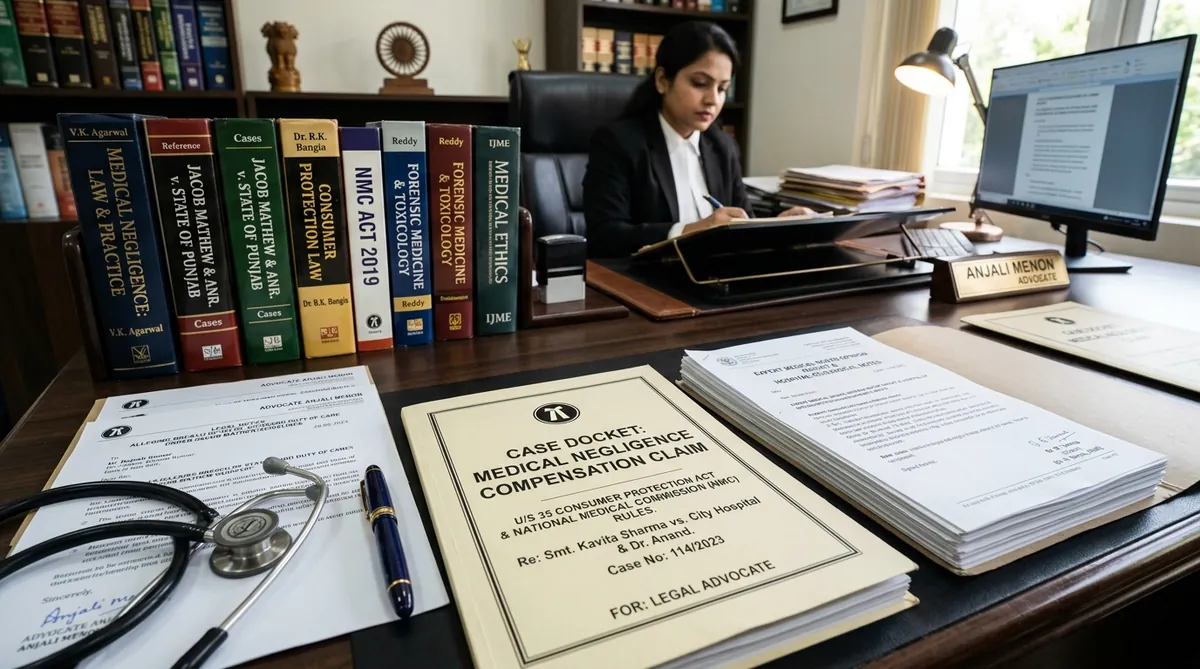
Medical treatment inherently involves professional judgment and risk. Under Indian law, a distinction is maintained between an unfortunate medical accident and actionable Medical Negligence. Victims can seek financial compensation under the Consumer Protection Act, while medical practitioners are granted specific safeguards against reckless criminal prosecution.
1. Civil Compensation in Consumer Courts
The Supreme Court brought medical services under the purview of consumer protection laws. Patients paying consultation or hospital fees are "consumers" entitled to claim compensation for deficiency of medical service resulting from professional negligence.
2. The "Bolam Test" for Evaluating Negligence
A doctor is not negligent merely because an alternative treatment method existed or a complication occurred. Under the Bolam Test, a medical practitioner is judged by whether they acted in accordance with a practice accepted as proper by a responsible body of medical men skilled in that particular art.
3. Safeguards Against Criminal Prosecution of Doctors
In criminal law, causing death by negligence is governed by Section 106 of Bharatiya Nyaya Sanhita (formerly Section 304A IPC).
A 3-Judge Bench of the Supreme Court laid down strict mandatory directions to protect medical professionals:
1. To prosecute a doctor criminally, the degree of negligence must be gross, reckless, or rash, not mere lack of care.
2. Police cannot arrest or register a criminal case against a doctor without first obtaining an independent medical opinion from a competent panel of government doctors confirming gross negligence.
4. Comprehensive Legal Framework & Statutory Safeguards
The liability for medical negligence and the corresponding protections for medical practitioners are governed by a combination of consumer law, criminal law, and specific regulatory guidelines.
- Consumer Protection Act: Allows patients to file complaints against hospitals and doctors for 'deficiency in service' to claim civil compensation.
- Section 106(1) Bharatiya Nyaya Sanhita: Replaces Section 304A IPC. It deals with causing death by negligence. It provides for a lesser punishment for registered medical practitioners compared to general negligence causing death.
- National Medical Commission Act, 2019: Regulates the professional conduct, etiquette, and ethics of registered medical practitioners, providing a mechanism for disciplinary action.
- Indian Medical Council (Professional Conduct, Etiquette and Ethics) Regulations, 2002: Outlines the duties and responsibilities of physicians, the breach of which can lead to professional misconduct charges.
5. Landmark Judicial Precedents
The Court reaffirmed the governing statutory principles in 1. Jacob Mathew v. State of Punjab (Supreme Court), establishing binding precedent for trial courts and authorities across Haryana and Delhi NCR.
The Court reaffirmed the governing statutory principles in 2. Martin F. D'Souza v. Mohd. Ishfaq (Supreme Court), establishing binding precedent for trial courts and authorities across Haryana and Delhi NCR.
The Court reaffirmed the governing statutory principles in 3. Kusum Sharma & Ors. v. Batra Hospital (Supreme Court), establishing binding precedent for trial courts and authorities across Haryana and Delhi NCR.
6. Complete Procedural Roadmap & Litigation Strategy
- Notice and Documentation: The aggrieved patient typically sends a legal notice. The hospital/doctor must secure all medical records, consent forms, and treatment logs immediately.
- Expert Opinion: Before filing a criminal complaint, the complainant must obtain an opinion from a competent doctor/medical board indicating gross negligence.
- Filing the Complaint: A civil complaint may be filed in the appropriate Consumer Disputes Redressal Commission based on the pecuniary value of the compensation claimed.
- Medical Board Constitution: In criminal investigations, the police must consult an independent medical board before proceeding with the arrest or prosecution of the doctor.
- Defense Strategy: The defense should focus on establishing that the treatment protocol followed the accepted standard of care (Bolam test) and that informed consent was obtained.
- Disciplinary Proceedings: Parallel complaints may be filed with the State Medical Council; doctors must respond with comprehensive medical justifications to avoid license suspension.
7. Comparative Assessment Table: Civil vs. Criminal Liability
| Parameter | Civil Liability (Consumer Courts) | Criminal Liability (Under BNS 2023) |
|---|---|---|
| Degree of Negligence Required | Preponderance of probabilities; simple lack of care or deficiency in service. | Beyond reasonable doubt; gross negligence or recklessness. |
| Outcome / Relief | Monetary compensation awarded to the patient or family. | Imprisonment and/or fine for the medical practitioner. |
| Forum | District, State, or National Consumer Disputes Redressal Commission. | Criminal Courts (Magistrate Courts). |
| Arrest Mechanism | No arrest involved in civil proceedings. | Arrest is possible, but subject to Jacob Mathew guidelines. |
8. Strategic Legal Advisory for Medical Professionals
Medical practitioners and hospitals must prioritize rigorous documentation, particularly obtaining informed written consent for all procedures, outlining potential risks and complications. Implementing robust standard operating procedures (SOPs) and maintaining comprehensive medical records are the strongest defenses against negligence claims. In the event of an adverse incident, immediate consultation with legal experts and maintaining transparent communication with the patient's family can mitigate the risk of escalating criminal or civil litigation.
10. Mandatory Pre-Filing Checklist for Medical Negligence Claims
- Complete Hospital Case Sheets: Certified copies of admission notes, treatment charts, surgical logs, and discharge summaries under MCI/NMC regulations.
- Independent Medical Board Opinion: Expert medical opinion detailing deviation from the standard degree of professional skill and care.
- All Diagnostic Reports & Bills: Original MRI, CT scans, pathology reports, pharmacy bills, and surgical invoices.
- Loss of Income Records: Proof of earnings and disability certificates quantifying financial and personal damages.
- Formal Notice to Hospital: Statutory notice setting out the exact negligence, lack of informed consent, and compensation claim.
Statutory Authorities & Legal References
- Transfer of Property Act (Sections 53A, 54 Sale, Section 106 Tenancy)
- Registration Act, Indian Stamp Act & Haryana Stamp Rules
- Specific Relief Act (Section 16(c) Readiness and Willingness & Injunctions)
- Code of Civil Procedure (Order 39 Rules 1 & 2 Temporary Injunctions)
- Case precedents reported in Supreme Court Cases (SCC), All India Reporter (AIR), and Punjab Law Reporter (PLR).
- e-Courts Services & National Judicial Data Grid (NJDG) procedural tracking guidelines.
Disclaimer: This article is published for educational and informational purposes only under the Advocates Act, 1961. It does not constitute formal legal advice or create an attorney-client relationship. For case-specific legal strategy, consult a qualified advocate.
Actionable Next Steps & Critical Legal Checklist
If you are facing an active legal dilemma regarding Regulatory & Statutory Remedy Action Checklist, execute these immediate procedural steps to protect your statutory rights:
- Calculate Ad Valorem Court Fees & Interest: Compute statutory interest under HRERA Rules or Section 7(iv) Court Fees Act before filing claims.
- Observe 2-Year Consumer Limitation Window: File consumer forum complaints within 2 years from the date of cause of action under Section 69 Consumer Protection Act.
- Execute Court Decrees Under Order 21 CPC: If opponent defaults on judicial orders, initiate execution proceedings or contempt under Order 39 Rule 2A CPC.
Frequently Asked Questions
Key statutory answers and procedural guidance curated by Senior Advocates in Faridabad & Delhi NCR.
What is the time limit for filing a medical negligence complaint in India?
Under the Consumer Protection Act, complaints must be filed within2 yearsfrom the date the cause of action arises (typically when the patient discovers the injury or negligence). The limitation can be condoned if sufficient cause for delay is shown to the Consumer Commission.
Can a doctor be criminally prosecuted for medical negligence?
Criminal prosecution under Section 106 BNS (replacing Section 304A IPC) requires proof ofgross negligenceamounting to recklessness, not merely a deviation from standard practice. The Supreme Court in Jacob Mathew v. State of Punjab (2005)mandated that a prima facie opinion from an independent medical board is required before criminal charges can be framed against doctors.
What compensation can be claimed in medical negligence cases?
Compensation covers actual medical expenses incurred for corrective treatment, loss of income during recovery, permanent disability or disfigurement, pain and suffering (non-pecuniary damages), and cost of future medical care. Consumer Commissions have awarded compensation ranging from Rs. 5 lakhs to several crores depending on the severity of negligence.
What is the statutory limitation period for filing proceedings related to medical negligence claims & doctor protections in india?
Under the Limitation Act, 1963, limitation varies depending on the specific cause of action (e.g. 3 years for civil suits/contracts, 30 days for Section 138 NI Act notices, 90 days for statutory appeals). You can verify exact limitation windows using our interactive Limitation Calculator.
How can I consult an experienced advocate in Delhi NCR or Haryana for medical negligence claims & doctor protections in india?
You can schedule a confidential legal consultation with Advocate Kishan Kumar at Urban Rights Legal Consultants (Chamber No. 343, District & Sessions Court Complex, Faridabad) by phone or WhatsApp at +91-92120-22119 to review case documents and structure an effective litigation strategy.
What documents are required to initiate legal action regarding medical negligence claims & doctor protections in india?
Essential documentation includes: (1) Primary agreement, notice, or FIR records; (2) Certified communication logs (WhatsApp, emails, speed post receipts); (3) Government/revenue identity documents; and (4) Chronological statement of facts signed by the client.
Can proceedings regarding medical negligence claims & doctor protections in india be settled out of court through mediation?
Yes. Under Section 89 CPC and statutory dispute resolution mechanisms, parties can resolve civil, matrimonial, and compoundable criminal disputes through court-annexed mediation, Lok Adalats, or private settlement agreements.