Morphed Photos & Cyber Stalking: Immediate Legal Action under IT Act & BNS
 Authored by: Advocate Kishan Kumar (Advocate & Legal Consultant)
Quick Legal Takeaways
- Core Statutory Base: Exhaustive legal coverage under the latest 2024–2026 statutes and landmark judicial precedents.
- Practical Procedure: Detailed step-by-step litigation roadmap before District Courts, High Courts, and specialized tribunals.
- Evidence & Remedies: How to build watertight documentary trails and protect civil and personal liberties.
1. The Growing Threat of Deepfakes, Morphed Photos & Digital Blackmail
With the rapid proliferation of artificial intelligence, deepfake generators, and social media misuse, online harassment via morphed photos, non-consensual image distribution, and cyber extortion has escalated rapidly across India. Victims—predominantly women, students, and corporate professionals—often experience intense emotional distress and reputational injury. However, Indian criminal and cyber jurisprudence provides fast-acting legal mechanisms to mandate immediate content removal, freeze blackmailer accounts, and prosecute offenders under non-bailable penal provisions.
Digital extortion typically unfolds through identifiable patterns:
- Social Media Impersonation: Creating duplicate accounts using stolen profile pictures to harass friends and family.
- AI Deepfake & Image Morphing: Superimposing facial images onto explicit photographs or video clips.
- Financial Extortion (Sextortion): Demanding instant UPI transfers, bank deposits, or cryptocurrency under threat of publishing compromised media.
2. Role of IT Intermediary Rules 2021: 24-Hour Mandatory Content Removal
Under Rule 3(2)(b) of the Information Technology (Intermediary Guidelines and Digital Media Ethics Code) Rules, 2021, major social media platforms (Meta/Instagram, Facebook, X/Twitter, WhatsApp, Telegram, Google) are legally mandated to disable access or remove non-consensual intimate imagery, morphed photos, or impersonating profiles within 24 hours of receiving a formal complaint from the victim or authorized legal counsel.
Intermediaries that fail to comply with takedown notices risk losing their statutory safe-harbour immunity under Section 79 of the IT Act, 2000, rendering platform executives directly liable for abetment of obscenity and defamation.
3. Comprehensive Statutory Framework under IT Act & BNS 2023
Prosecution of digital harassment, morphing, and extortion in India is anchored across specialized central penal statutes:
- Section 66E IT Act (Violation of Privacy): Intentionally capturing, publishing, or transmitting images of private areas without consent, carrying imprisonment up to 3 years and fine up to Rs. 2 Lakhs.
- Section 66D IT Act (Cheating by Personation): Cheating using computer resources or fake digital profiles, punishable with up to 3 years imprisonment.
- Section 67 & 67A IT Act (Obscene & Sexually Explicit Content): Transmitting sexually explicit material electronically carries up to 5 years imprisonment for first conviction and up to 7 years for repeat offences.
- Section 78 BNS (Cyber Stalking): Monitoring a person's internet, email, or digital communications, or persistently contacting them despite clear disinterest, carrying up to 3 years imprisonment (formerly Section 354D IPC).
- Section 75 BNS (Sexual Harassment): Unwelcome sexually coloured remarks or demanding sexual favors via digital messaging, carrying up to 3 years imprisonment.
- Section 308 BNS (Extortion & Blackmail): Demanding money or valuable security under threat of releasing morphed images, carrying rigorous imprisonment up to 7 years.
- Section 63 BSA 2023 (Electronic Evidence): Mandates signed electronic evidence certificates for digital admissibility of screenshots, device logs, and chat exports.
4. Landmark Judicial Precedents in Cyber Crime & Digital Privacy
The High Court established landmark sentencing guidelines for non-consensual image distribution under Section 66E IT Act, ruling that stealing or morphing private photographs without consent violates fundamental privacy under Article 21, warranting severe deterrent penal sentences.
The Supreme Court clarified intermediary liability under Section 79 IT Act, establishing that social platforms must act swiftly upon receiving court orders or government notifications to disable access to unlawful content.
A 9-Judge Constitution Bench recognized the Right to Privacy as a fundamental right under Article 21, providing the constitutional foundation for protecting personal dignity against digital morphing and surveillance.
5. Complete Procedural Roadmap: Emergency Action Plan for Victims
When subjected to digital stalking or blackmail, victims should execute this systematic 5-step action plan:
- Never Pay the Blackmailer: Paying extortion money never deletes the photos; it confirms financial vulnerability and leads to repeated escalated demands.
- Preserve Contemporaneous Digital Evidence: Take full-page timestamped screenshots showing complete URLs, profile handles, and system time. Export unedited WhatsApp/Telegram chat threads before blocking accounts.
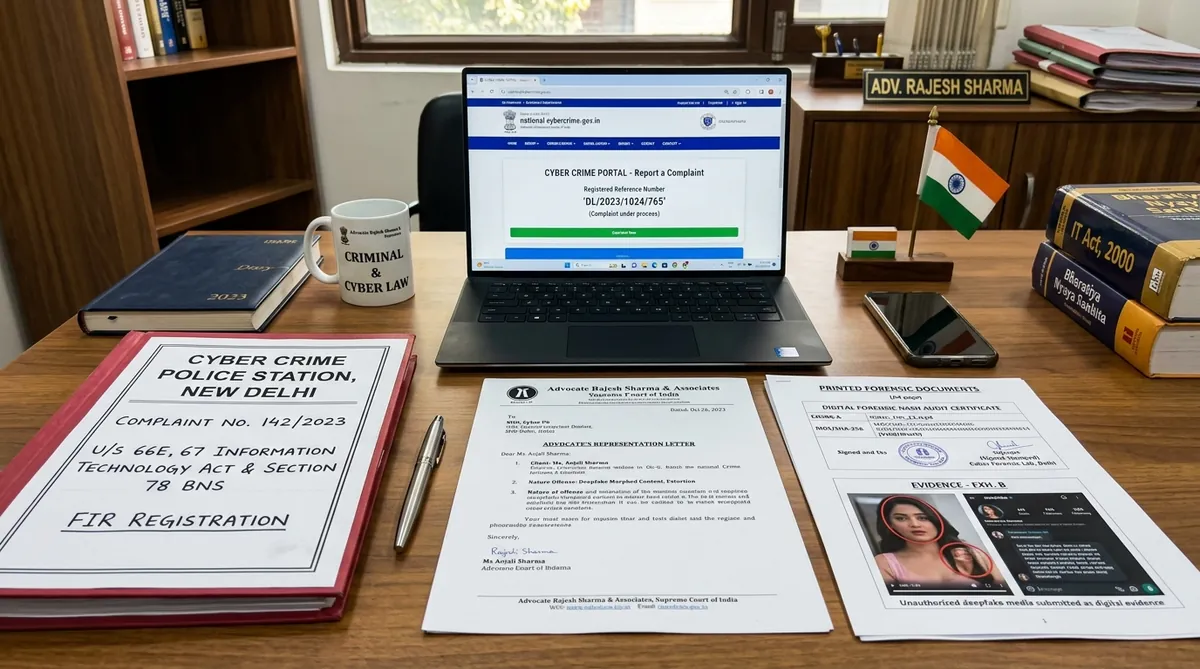
- File Emergency Report on Cybercrime.gov.in (Helpline 1930): Submit an immediate complaint on the National Cyber Crime Reporting Portal under the 'Report Women/Child Related Crime' category to initiate account freeze and police tracking.
- Dispatch 24-Hour Intermediary Takedown Notices: Serve formal statutory takedown notices to platform Grievance Officers under Rule 3(2)(b) of IT Rules 2021 for immediate media deletion.
- Lodge FIR at Cyber Police Station / Move Section 223 BNSS Petition: File an FIR at the jurisdictional Cyber Police Station (e.g., Cyber Crime Police Station NIT Faridabad) or approach the Judicial Magistrate under Section 223 BNSS for court-monitored investigation.
6. Comparative Assessment Table: Cyber Crime Legal Forums & Remedies
| Parameter | National Cyber Portal (1930) | Cyber Police Station (FIR) | High Court Writ / Injunction |
|---|---|---|---|
| Primary Objective | Immediate account freeze & tracking | Criminal arrest & penal prosecution | Urgent global takedown & damages |
| Timeframe for Action | Immediate (2–24 hours) | FIR within 24–48 hours | Interim order within 1–3 days |
| Forum Authority | MHA Cyber Division / State Police | Judicial Magistrate First Class | High Court (Writ Jurisdiction) |
| Statutory Base | Sec 106 BNSS / MHA Portal | Sec 66E IT Act & Sec 78 BNS | Article 226 / Order 39 CPC |
7. Practical Advisory for Cyber Crime Victims in Faridabad & Delhi NCR
- Do Not Delete Compromised Chats: Preserve the complete electronic trail. Deleting chats destroys primary forensic evidence required under Section 63 BSA 2023.
- Obtain Hash Verification on Digital Exhibits: Ensure computer forensic logs record SHA-256 hash values to prevent defence claims of photo manipulation.
- Pursue Civil Damages for Reputational Injury: In addition to criminal FIRs, victims can institute civil suits for damages against perpetrators under common law torts for intentional infliction of emotional distress.
Statutory Authorities & Legal References
- Bharatiya Nyaya Sanhita & Bharatiya Nagarik Suraksha Sanhita, 2023
- Bharatiya Sakshya Adhiniyam, 2023 (Section 63 Electronic Evidence Certificate)
- Landmark rulings of the Supreme Court of India and Punjab & Haryana High Court
- Case precedents reported in Supreme Court Cases (SCC), All India Reporter (AIR), and Punjab Law Reporter (PLR).
- e-Courts Services & National Judicial Data Grid (NJDG) procedural tracking guidelines.
Disclaimer: This article is published for educational and informational purposes only under the Advocates Act, 1961. It does not constitute formal legal advice or create an attorney-client relationship. For case-specific legal strategy, consult a qualified advocate.
Actionable Next Steps & Critical Legal Checklist
If you are facing an active legal dilemma regarding Digital Evidence Admissibility & Cyber Law Checklist, execute these immediate procedural steps to protect your statutory rights:
- Preserve Hash Values & Source Metadata: Keep the original mobile device, memory card, and cloud backup intact to prevent spoliation of electronic evidence.
- Mandatory Section 63 BSA 2023 Certificate: Draft and submit an electronic record certificate signed by the device custodian detailing hardware and software provenance.
- Report to National Cyber Crime Portal: File an immediate complaint on cybercrime.gov.in and petition the Cyber Police Station for urgent takedown notices under the IT Act.
Frequently Asked Questions
Key statutory answers and procedural guidance curated by Senior Advocates in Faridabad & Delhi NCR.
Can I file an FIR for morphed photos if the perpetrator is in another state?
Yes. UnderSection 173 BNSS(Zero FIR), you can lodge an FIR at any police station in India regardless of where the offence originated. The FIR will be transferred to the jurisdictional police station within 24 hours. Additionally, cybercrime.gov.in accepts complaints from any location.
How quickly must social media platforms remove morphed photos after a complaint?
Under Rule 3(2)(b) of the Information Technology (Intermediary Guidelines and Digital Media Ethics Code) Rules, 2021, social media intermediaries must remove or disable access to non-consensual intimate imagery within 24 hours of receiving a complaint.
Can I claim monetary compensation from the perpetrator in cyber morphing cases?
Yes. In addition to criminal prosecution under the IT Act and BNS, victims can file a civil suit for damages for mental agony, loss of reputation, and emotional distress following the K.S. Puttaswamy fundamental right to privacy framework.
What is the punishment for cyber stalking under Section 78 of Bharatiya Nyaya Sanhita?
Under Section 78 BNS 2023, cyber stalking is punishable with imprisonment for up to 3 years and a fine on first conviction, and imprisonment for up to 5 years with a fine on subsequent convictions.
What electronic certificate is required to submit screenshots as evidence in court?
Under Section 63 of Bharatiya Sakshya Adhiniyam 2023, electronic records such as screenshots, call logs, and WhatsApp chats must be accompanied by a signed Certificate identifying the electronic device and affirming its lawful operation.