POSH Act Compliance: Internal Committee Rules
 Authored by: Advocate Kishan Kumar (Advocate & Legal Consultant)
Quick Legal Takeaways
- Section 4 POSH Act Mandate: Every company/establishment with 10+ employees MUST constitute an Internal Committee (IC) in writing.
- IC Composition Rules: Senior Woman Presiding Officer, at least 2 employee members, 1 independent NGO/Legal External Member, and minimum 50% women representation.
- Strict Inquiry Timelines: 3-month filing limit, 90-day inquiry completion window, and 60-day employer implementation mandate.
- Aureliano Fernandes Ruling (2023): Supreme Court directed strict nationwide audit of POSH compliance and functional ICs across public and private sectors.
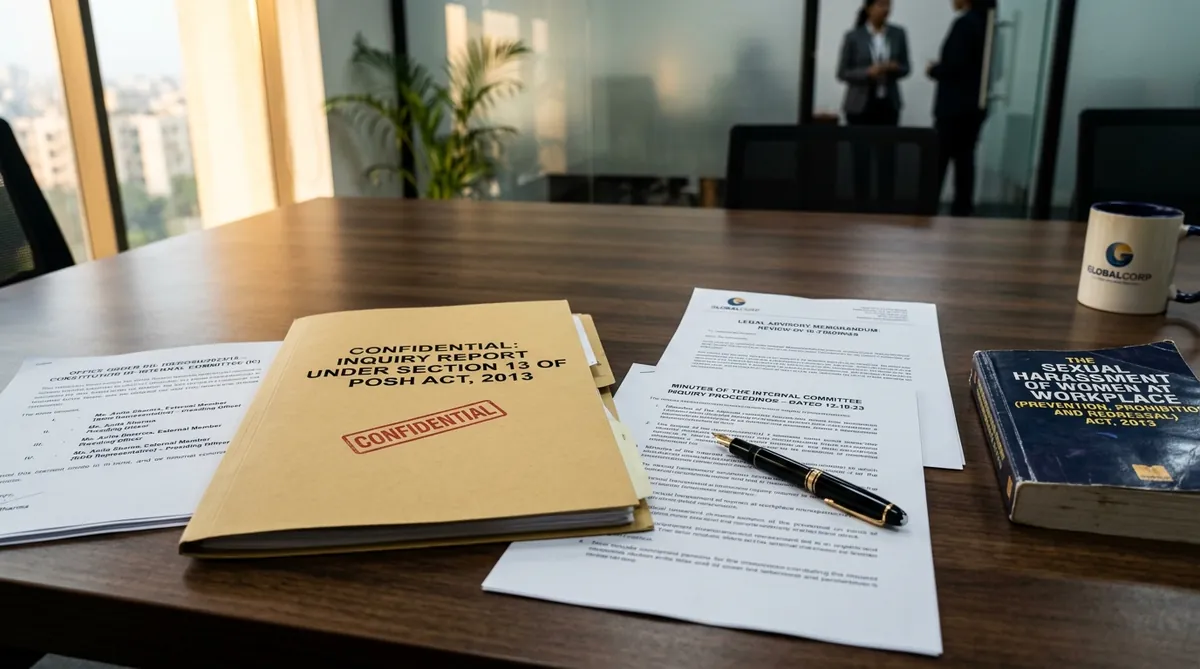
Under the Sexual Harassment of Women at Workplace (Prevention, Prohibition and Redressal) Act, 2013, every employer in India operating a business, IT firm, factory, or corporate office employing 10 or more employees is statutorily bound to constitute an Internal Committee (IC) and enforce strict anti-harassment policies.
- Review Dispute Resolution & Notice Clauses: Examine contractual cure periods, limitation provisions, and mandatory pre-institution mediation requirements.
- Serve Detailed Advocate Legal Notice: Detail specific contractual breaches, calculation of liquidated damages, and compliance timelines before litigation.
- Adhere to POSH & Employment Directives: Ensure Internal Committee (IC) inquiry procedures strictly comply with natural justice and statutory 90-day inquiry timelines.
1. Mandatory Composition of the Internal Committee (IC)
Under Section 4(2) POSH Act, the IC must consist of the following members nominated by the employer:
- Presiding Officer: A woman employed at a senior level at the workplace.
- Employee Members: At least two employees committed to the cause of women or having legal knowledge/experience in social work.
- External Member: One member from an NGO, association committed to the cause of women, or a person familiar with sexual harassment laws.
- Women Representation: At least 50% of the total members nominated to the IC MUST be women.
2. Statutory Inquiry Procedure & Timelines
- Complaint Filing (Section 9): Written complaint filed by aggrieved woman within 3 months of the incident.
- 90-Day Inquiry Window (Section 11): The IC must complete its formal inquiry within 90 days following natural justice principles.
- Inquiry Report & Employer Action (Section 13): IC submits findings within 10 days of inquiry completion. The employer MUST implement IC recommendations within 60 days.
The Supreme Court directed all government and private sector bodies, professional boards, and corporate institutions to strictly audit POSH compliance, observe mandatory IC constitution, and conduct regular awareness workshops for employees.
3. Penalties for Employer Non-Compliance
Under Section 26 POSH Act, failure to constitute an IC or non-implementation of recommendations carries a monetary fine up to Rs. 50,000, with repeated non-compliance risking cancellation of business operating licenses.
4. Comprehensive Legal Framework of the POSH Act 2013
The Prevention of Sexual Harassment (POSH) Act, 2013, creates a strict, employer-driven mechanism to address workplace sexual harassment, moving away from relying solely on traditional criminal justice systems.
- The POSH Act: Mandates any workplace with 10 or more employees to constitute an Internal Committee (IC). It outlines the definition of sexual harassment, the constitution of the IC, and the inquiry process.
- Section 26 (Penalties): Employers failing to constitute an IC or comply with the Act face a penalty of up to Rs. 50,000 for the first offense. Repeat offenses can lead to cancellation of business licenses.
- BNS 2023 (formerly IPC Section 354A): The POSH Act operates parallel to criminal laws. Section 74 of the Bharatiya Nyaya Sanhita 2023 criminalizes sexual harassment, allowing the complainant to pursue an IC inquiry and a criminal FIR simultaneously.
5. Landmark Precedents Shaping POSH Compliance
The foundational Supreme Court judgment that laid down the "Vishaka Guidelines," which served as the law for preventing workplace sexual harassment until the POSH Act was enacted in 2013.
The Supreme Court directed the Union and State governments, along with all public and private professional bodies, to strictly ensure the constitution of Internal Committees, noting severe lapses in compliance across the country.
6. Comparative Assessment: IC vs. Local Committee vs. Criminal FIR
| Parameter | Internal Committee (IC) | Local Committee (LC) | Police / Criminal FIR |
|---|---|---|---|
| Jurisdiction | Workplaces with 10+ employees. | Workplaces with <10 employees, or if the complaint is against the employer. | Any criminal act of sexual harassment under BNS 2023. |
| Nature of Proceedings | Civil/Disciplinary inquiry. | Civil/Disciplinary inquiry. | Criminal investigation and trial. |
| Standard of Proof | Preponderance of probabilities. | Preponderance of probabilities. | Beyond reasonable doubt. |
| Potential Outcome | Termination, deduction of wages, apology. | Recommendation of action to the employer/district officer. | Imprisonment and criminal fines. |
7. Strategic Legal Advisory for Employers
POSH compliance is not a one-time paper exercise. Ensure your IC has a qualified external member—often the point where companies fail during audits. Conduct mandatory annual sensitization training for all employees and separate capacity-building training for IC members. When an inquiry starts, maintain absolute confidentiality as mandated by Section 16; leaking details of the complaint or the identities of parties can invite separate penalties on the employer.
10. Complete Internal Committee (IC) Inquiry Checklist under POSH Act
- Formal Written Complaint: Lodged within 3 months of the incident (extendable by 3 months with recorded reasons).
- Notice to Respondent: Copy of complaint forwarded to the respondent within 7 working days for written reply.
- Conciliation Option (Section 10 POSH): Exploring settlement at complainant's request (no monetary settlement allowed).
- Inquiry Completion within 90 Days: Strict adherence to principles of natural justice and cross-examination.
- Submission of Inquiry Report: Detailed report submitted to District Officer and Employer within 10 days of inquiry closure.
Statutory Authorities & Legal References
- Transfer of Property Act (Sections 53A, 54 Sale, Section 106 Tenancy)
- Registration Act, Indian Stamp Act & Haryana Stamp Rules
- Specific Relief Act (Section 16(c) Readiness and Willingness & Injunctions)
- Code of Civil Procedure (Order 39 Rules 1 & 2 Temporary Injunctions)
- Case precedents reported in Supreme Court Cases (SCC), All India Reporter (AIR), and Punjab Law Reporter (PLR).
- e-Courts Services & National Judicial Data Grid (NJDG) procedural tracking guidelines.
Disclaimer: This article is published for educational and informational purposes only under the Advocates Act, 1961. It does not constitute formal legal advice or create an attorney-client relationship. For case-specific legal strategy, consult a qualified advocate.
Actionable Next Steps & Critical Legal Checklist
If you are facing an active legal dilemma regarding Commercial Contracts & Corporate Compliance Checklist, execute these immediate procedural steps to protect your statutory rights:
- Review Dispute Resolution & Notice Clauses: Examine contractual cure periods, limitation provisions, and mandatory pre-institution mediation requirements.
- Serve Detailed Advocate Legal Notice: Detail specific contractual breaches, calculation of liquidated damages, and compliance timelines before litigation.
- Adhere to POSH & Employment Directives: Ensure Internal Committee (IC) inquiry procedures strictly comply with natural justice and statutory 90-day inquiry timelines.
Frequently Asked Questions
Key statutory answers and procedural guidance curated by Senior Advocates in Faridabad & Delhi NCR.
What are the penalties for employers who fail to constitute an Internal Committee?
UnderSection 26 of the POSH Act, failure to constitute an IC attracts a fine of up toRs. 50,000for the first offence. Repeated non-compliance can lead tocancellation of the business licenseor registration by the licensing authority.
Can a male employee file a sexual harassment complaint under the POSH Act?
The POSH Act specifically protectsaggrieved womenand does not cover complaints by male employees. However, male employees can seek redressal through the company's internal grievance mechanism, general employment policies, or by filing a criminal complaint under Section 75 BNS (Sexual Harassment).
What is the time limit for filing a complaint with the Internal Committee?
The aggrieved woman must file a written complaint with the IC within3 monthsfrom the date of the last incident of sexual harassment. The IC may extend this period by an additional 3 months if satisfied that circumstances prevented timely filing.
What is the statutory limitation period for filing proceedings related to posh act compliance: internal committee rules?
Under the Limitation Act, 1963, limitation varies depending on the specific cause of action (e.g. 3 years for civil suits/contracts, 30 days for Section 138 NI Act notices, 90 days for statutory appeals). You can verify exact limitation windows using our interactive Limitation Calculator.
How can I consult an experienced advocate in Delhi NCR or Haryana for posh act compliance: internal committee rules?
You can schedule a confidential legal consultation with Advocate Kishan Kumar at Urban Rights Legal Consultants (Chamber No. 343, District & Sessions Court Complex, Faridabad) by phone or WhatsApp at +91-92120-22119 to review case documents and structure an effective litigation strategy.
What documents are required to initiate legal action regarding posh act compliance: internal committee rules?
Essential documentation includes: (1) Primary agreement, notice, or FIR records; (2) Certified communication logs (WhatsApp, emails, speed post receipts); (3) Government/revenue identity documents; and (4) Chronological statement of facts signed by the client.
Can proceedings regarding posh act compliance: internal committee rules be settled out of court through mediation?
Yes. Under Section 89 CPC and statutory dispute resolution mechanisms, parties can resolve civil, matrimonial, and compoundable criminal disputes through court-annexed mediation, Lok Adalats, or private settlement agreements.