Real Estate Title Search & Due Diligence Checklist for Haryana & NCR Buyers
 Authored by: Advocate Kishan Kumar (Advocate & Legal Consultant)
Quick Legal Takeaways
- 30-Year Chain Search: Mandatory verification of registered title deeds for an unbroken 30-year period before paying token money.
- Suraj Lamp Rule: GPA, Agreement to Sell, or Will transfers carry NO legal title in immovable property.
- Tehsil Revenue Records: Check current Jamabandi & Intakhab Mutation (Intiqal) mutation entries under Punjab Land Revenue Act to avoid boundary disputes.
- Encumbrance Certificate (EC): Sub-Registrar search verifying no active bank mortgages or court stay orders.
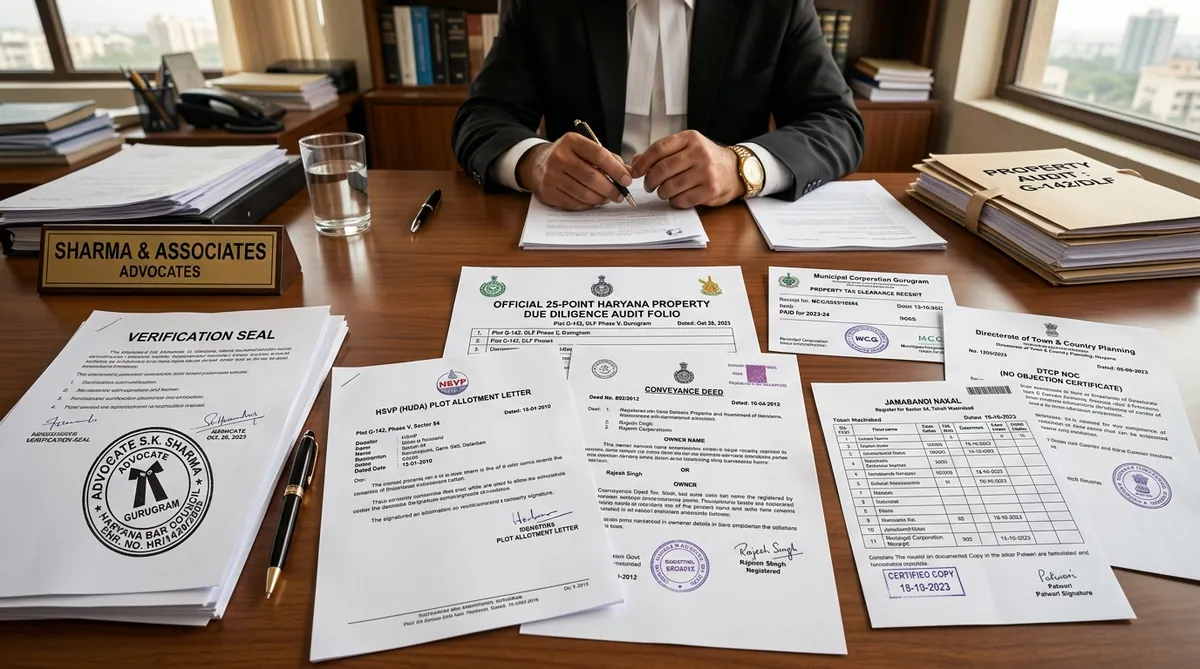
Purchasing real estate in Haryana, Gurgaon, or Faridabad involves substantial capital investments. Verifying legal ownership, encumbrance records, and municipal sanctions before paying earnest money protects buyers against title fraud and court litigation under the doctrine of Caveat Emptor (Buyer Beware). For a complete comparative analysis of conveyance instruments, read our guide on Gift Deeds vs Sale Deeds vs Wills.
The Supreme Court unequivocally held that property transfers via General Power of Attorney (GPA), Agreement to Sell, or Will do NOT convey valid legal title. An immovable property exceeding Rs. 100 value can lawfully be transferred ONLY via a duly registered Conveyance/Sale Deed under Section 17 of the Registration Act. Inherited assets must also comply with strict attestation under Indian Succession Act Will rules.
1. Statutory Checklist for Property Legal Verification
- 30-Year Chain Title Search: Verification of registered sale deeds, gift deeds, or partition decrees for an unbroken 30-year period.
- Revenue Records (Jamabandi & Intakhab Intiqal): Checking current Tehsil revenue mutation registers to confirm the seller's name in revenue logs under Punjab Land Revenue Act, helping avoid land encroachment and adverse possession disputes.
- Sub-Registrar Encumbrance Certificate (EC): Official search report confirming no existing bank mortgage, court injunction, or attachment order.
- Building Plan Sanction & Occupation Certificate (OC): Approval plans issued by Town & Country Planning Department (DTCP), HSVP, or Municipal Corporation.
- RERA Project Verification: Verifying builder project registration status and litigation history on the HRERA portal.
2. Key Precautions for Authority / HSVP Plots
- Verify Allotment Letter, Re-allotment Letter, and Registered Conveyance Deed.
- Obtain official No Dues Certificate (NDC) and NOC from HSVP / Authority.
- Verify court litigation search across Faridabad District Courts and High Court.
3. Comprehensive Legal Framework for Real Estate & Property Titles in Haryana
Property acquisition, title verification, partition litigation, and builder disputes in Haryana (including HUDA / HSVP sectors, builder floors, commercial plots, and agricultural land in Faridabad and Gurugram) operate under a rigorous mesh of state and central statutes: the Transfer of Property Act, the Haryana Land Revenue Act, 1887, the Real Estate (Regulation and Development) Act, 2016 (RERA / HRERA), the Code of Civil Procedure, and the Specific Relief Act.
Key statutory safeguards in real estate transactions and civil property disputes include:
- Section 54 TPA (Sale Deeds vs Agreement to Sell): A contract for sale (Agreement to Sell / Earnest Money (Bayana)) does not create any proprietary title or interest in immovable property. Title passes solely upon execution and registration of a conveyance deed under Section 17 of the Registration Act.
- Order 39 Rules 1 & 2 CPC (Temporary Injunctions): In property encroachment, boundary disputes, or unauthorized construction, plaintiffs must immediately move an application for temporary stay/injunction establishing a prima facie case, balance of convenience, and irreparable loss.
- Section 18 HRERA Haryana (Delayed Possession & Refund): If an allottee fails to receive possession of an apartment/plot in accordance with the Builder-Buyer Agreement (BBA), HRERA grants statutory right to claim full refund with prescribed interest (SBI MCLR + 2%) or monthly delay compensation.
- Partition Suits (Section 4 Partition Act, 1893): Co-owners holding joint undivided shares can file partition suits before the Civil Court to obtain preliminary decree determining shares, followed by local commissioner appointment and final metes-and-bounds division decree.
4. Landmark Supreme Court Precedents in Real Estate & Title Law
The Supreme Court authoritatively held that property transfer via General Power of Attorney (GPA), Special Power of Attorney (SPA), Agreement to Sell (ATS), and Will transfers is illegal and creates no title. Immovable property can only be lawfully transferred via registered Sale Deeds.
The Apex Court struck down one-sided, unfair clauses in builder-buyer agreements, holding that builders cannot compel homebuyers to accept inordinate construction delays while imposing exorbitant penalties on buyer defaults.
Settled that a person who has perfected title over immovable property by continuous, uninterrupted, and hostile adverse possession for 12+ years can maintain an affirmative suit as plaintiff for declaration of title and permanent injunction under Article 65 Limitation Act.
5. Complete Procedural Roadmap: Real Estate Due Diligence & Civil Suits
The procedural roadmap for executing safe property transactions and prosecuting title suits in Faridabad courts follows this pathway:
- 30-Year Chain of Title Verification: Procuring certified copies of all mother deeds, conveyance deeds, allotment letters, and conveyance records from the Sub-Registrar office for 30 uninterrupted years.
- Revenue Record Inspection (Jamabandi & Intiqal): Verifying ownership records with the Halqa Patwari to inspect Jamabandi (Record of Rights), Khasra Girdawari (crop/possession register), and mutation entries.
- Non-Encumbrance Certificate (NEC): Applying for Search Reports (Form 15/16) confirming zero registered mortgages, court attachments, or bank liens.
- Filing Civil Suit for Specific Performance (Section 10 Specific Relief Act): If a seller breaches an Agreement to Sell, buyer files suit depositing balance consideration, seeking court decree compelling execution of registered deed.
- Filing Partition Suit & Local Commissioner Appointment: Co-owners seek preliminary decree for share declaration, followed by court appointing a Local Commissioner (Advocate/Tehsildar) to physically demarcate portions.
- Execution & Possession Delivery: Final decree executed via warrants of possession under Order XXI CPC with demarcation assistance from Kanungo/Patwari.
6. Comparative Assessment Table: Real Estate Legal Remedies
| Parameter | Civil Suit for Injunction | Specific Performance (SRA 1963) | HRERA Haryana Complaint |
|---|---|---|---|
| Applicability | Encroachment, possession threat | Breach of Agreement to Sell | Delayed possession, builder fraud |
| Forum | Civil Judge (Senior Division) | Civil Court / Commercial Court | HRERA Authority Panchkula/Gurugram |
| Key Relief | Restraining illegal interference | Court-directed Sale Deed transfer | Refund with interest / delay penalty |
| Limitation Period | Continuous cause of action | 3 years from date fixed for deed | During project registration / delay |
7. Strategic Legal Advisory for Property Buyers & Owners in Faridabad
To insulate high-value real estate investments in Haryana from encroachment and fraudulent double-sales, our senior civil property advocates advise:
- Execute Registered Agreements to Sell: Under Section 17(1A) of the Registration Act (amended in Haryana), an Agreement to Sell involving delivery of possession must be registered on 90% stamp duty to claim protection under Section 53A TPA (Part Performance).
- Physical Boundary Fencing & Display Boards: Erect concrete boundary walls and prominent metal boards reading "Private Property - Trespassers Will Be Prosecuted" to establish clear, exclusive physical possession.
- Monitor Revenue Mutations Immediately: Post-registry, apply for mutation (Dakhil-Kharij) before the Tehsildar within 30 days to update the municipal and revenue register.
Statutory Authorities & Legal References
- Transfer of Property Act (Sections 53A, 54 Sale, Section 106 Tenancy)
- Registration Act, Indian Stamp Act & Haryana Stamp Rules
- Specific Relief Act (Section 16(c) Readiness and Willingness & Injunctions)
- Code of Civil Procedure (Order 39 Rules 1 & 2 Temporary Injunctions)
- Case precedents reported in Supreme Court Cases (SCC), All India Reporter (AIR), and Punjab Law Reporter (PLR).
- e-Courts Services & National Judicial Data Grid (NJDG) procedural tracking guidelines.
Disclaimer: This article is published for educational and informational purposes only under the Advocates Act, 1961. It does not constitute formal legal advice or create an attorney-client relationship. For case-specific legal strategy, consult a qualified advocate.
Actionable Next Steps & Critical Legal Checklist
If you are facing an active legal dilemma regarding Property Protection & Tenancy Eviction Checklist, execute these immediate procedural steps to protect your statutory rights:
- Verify Title & Circle Rate Valuation: Conduct encumbrance searches across Book-1 records at the Sub-Registrar office and verify Section 47A circle rate valuations.
- Serve Statutory Eviction Notice: Issue a formal termination notice under the Haryana Urban Rent Control Act or Section 106 TPA detailing statutory eviction grounds.
- Seek Urgent Demolition / Encroachment Stay: File for an ad-interim injunction under Order 39 Rules 1 & 2 CPC with site photographs, demarcation reports, and title deeds.
Frequently Asked Questions
Key statutory answers and procedural guidance curated by Senior Advocates in Faridabad & Delhi NCR.
Can a GPA holder sell the property to himself or his family members?
Under the law of agency (Section 215 Indian Contract Act) and Supreme Court rulings, a power of attorney holder cannot sell the principal's property to themselves or execute deeds without full disclosure and explicit authorization from the principal owner.
How is delay compensation calculated under HRERA Haryana?
Under Rule 15 of Haryana Real Estate (Regulation and Development) Rules, 2017, the promoter is liable to pay interest to the buyer at the State Bank of India Marginal Cost of Funds Based Lending Rate (SBI MCLR) + 2% per annum from the promised possession date until actual offer of lawful possession.
What should a co-owner do if another co-sharer starts unauthorized construction on joint land?
In joint undivided property, every co-owner has an undivided interest in every inch. A co-sharer cannot raise construction without mutual partition. The aggrieved co-owner should immediately file a Civil Suit for Permanent Injunction along with an urgent Order 39 Rule 1 & 2 application seeking stay on construction.
What is the statutory limitation period for filing proceedings related to real estate title search & due diligence checklist for haryana & ncr buyers?
Under the Limitation Act, 1963, limitation varies depending on the specific cause of action (e.g. 3 years for civil suits/contracts, 30 days for Section 138 NI Act notices, 90 days for statutory appeals). You can verify exact limitation windows using our interactive Limitation Calculator.
How can I consult an experienced advocate in Delhi NCR or Haryana for real estate title search & due diligence checklist for haryana & ncr buyers?
You can schedule a confidential legal consultation with Advocate Kishan Kumar at Urban Rights Legal Consultants (Chamber No. 343, District & Sessions Court Complex, Faridabad) by phone or WhatsApp at +91-92120-22119 to review case documents and structure an effective litigation strategy.