Recovering Security Deposits from Commercial Landlords
 Authored by: Advocate Kishan Kumar (Advocate & Legal Consultant)
Quick Legal Takeaways
- Section 108 TP Act Mandate: Landlords are legally bound to refund security deposits upon vacant possession handover, excluding natural wear and tear.
- Handover Protocol: Always document vacant premises handover with a signed inspection note and utility bill receipts.
- Fast-Track Civil Remedy: File a Summary Suit under Order 37 CPC for admitted security deposit debts.
- Cheque Bounce Remedy: If a refund cheque is issued and bounces, file a Section 138 NI Act criminal complaint.
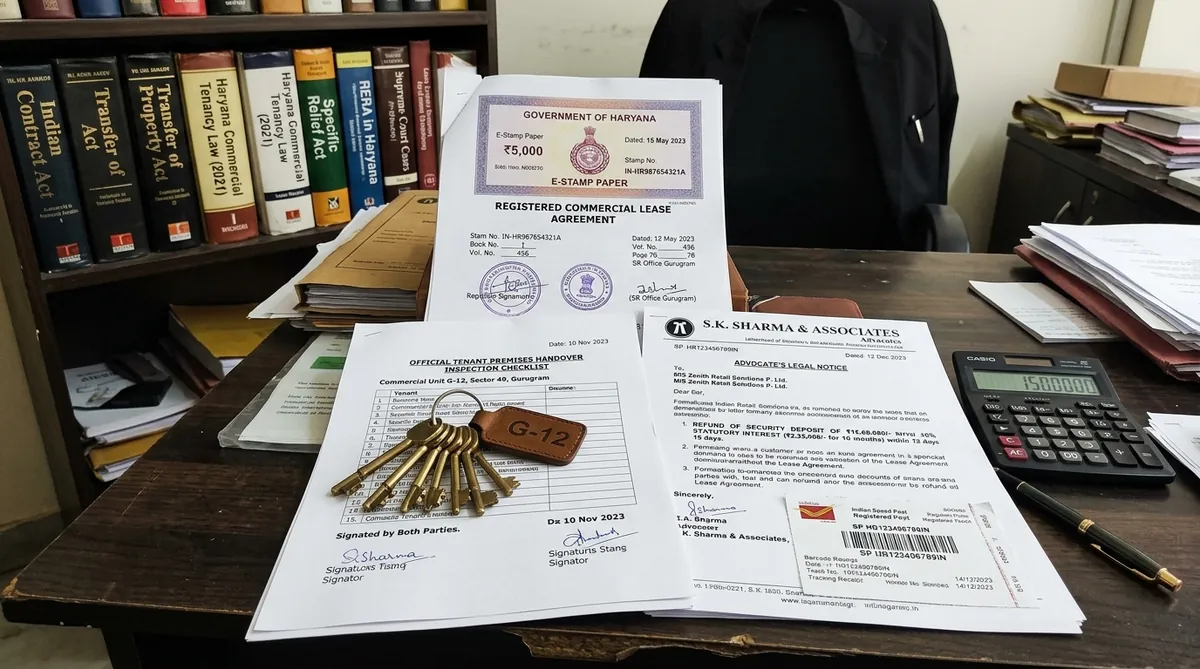
Commercial IT firms, office lessees, and residential tenants frequently encounter situations where landlords refuse to refund security deposits after peaceful vacant possession of premises is handed back. Unjustified deductions for routine wear and tear violate tenancy contract principles.
- Verify Title & Circle Rate Valuation: Conduct encumbrance searches across Book-1 records at the Sub-Registrar office and verify Section 47A circle rate valuations.
- Serve Statutory Eviction Notice: Issue a formal termination notice under the Haryana Urban Rent Control Act or Section 106 TPA detailing statutory eviction grounds.
- Seek Urgent Demolition / Encroachment Stay: File for an ad-interim injunction under Order 39 Rules 1 & 2 CPC with site photographs, demarcation reports, and title deeds.
1. Step-by-Step Procedure to Recover Security Deposit
- Document Vacant Possession Handover: Prepare a formal Handover Takeover Protocol / Inspection Note signed by both parties recording electricity/water meter readings and confirming no structural damage.
- Serve 15-Day Legal Demand Notice: Issue a formal legal demand notice detailing lease agreement terms, handover date, and demanding immediate refund with commercial interest (12% to 18% p.a.) under Section 73 Contract Act rules.
- File Summary Suit (Order 37 CPC): If the landlord fails to refund within 15 days, file a fast-track Summary Suit under Order 37 CPC before the Civil Court, as the security deposit is a liquidated debt admitted in the registered Lease Deed.
- Section 138 NI Act Prosecution: If the landlord issued a refund cheque that bounced, file a Section 138 NI Act complaint.
2. Can Landlords Deduct Money for Painting and Wear & Tear?
Unless expressly agreed in the registered Lease Deed, landlords cannot deduct security deposit amounts for routine painting, minor scuffs, or natural aging of the property. Deductions are valid ONLY for documented physical destruction or unpaid utility bills.
3. Statutory Framework Governing Security Deposit Disputes
Security deposit recovery disputes in Haryana and Delhi NCR are adjudicated under a combination of civil legislation and tenant protection statutes:
- Transfer of Property Act (Section 108): The lessor has a statutory obligation to return the security deposit upon lawful termination of the lease, after adjusting only documented damages, unpaid rent, or utility arrears with proper notice.
- Indian Contract Act (Sections 73 & 74): Unlawful forfeiture of a security deposit constitutes breach of contract, entitling the tenant to recover the deposit amount along with reasonable damages and interest.
- Consumer Protection Act: Commercial tenants and corporate lessees may file complaints before the District Consumer Disputes Redressal Forum if the landlord engages in unfair trade practices by withholding deposits arbitrarily.
- Haryana Urban (Control of Rent and Eviction) Act, 1973 (Section 10): Landlords cannot sever essential services (water, electricity) as coercion to forfeit deposits. Such actions invite immediate relief from the Rent Controller.
4. Landmark Precedents on Security Deposit Recovery
The High Court held that a landlord who withholds a security deposit beyond 30 days of lawful termination is liable to pay interest at 9% per annum from the date of demand until actual refund.
The Supreme Court established that in the absence of specific written terms, the burden of proof lies on the landlord to substantiate any deductions from the security deposit with documentary evidence of actual damage.
5. Step-by-Step Deposit Recovery Procedure
- Send Legal Notice under Section 80 CPC: Formal demand notice via registered post with acknowledgment due (RPAD), specifying the exact deposit amount, lease termination date, and 15-day deadline for refund.
- File Civil Suit for Recovery: If the landlord fails to comply, institute a civil suit for recovery of money (Order IV CPC) before the Civil Judge, along with an application for interim relief under Order 39 Rules 1 & 2 CPC.
- Consumer Complaint (Alternative): For commercial tenancies where the landlord operates as a service provider, file a complaint under the Consumer Protection Act 2019 before the District Consumer Forum for faster relief.
- Execution of Decree: Upon obtaining a recovery decree, proceed with execution under Order 21 CPC including attachment of the landlord's bank accounts and immovable property.
6. Comparative Table: Deposit Recovery Remedies
| Parameter | Civil Suit for Recovery | Consumer Forum Complaint | Section 138 NI Act (Bounced Refund Cheque) |
|---|---|---|---|
| Forum | Civil Judge / Commercial Court | District Consumer Forum | Judicial Magistrate First Class |
| Timeline | 12 - 24 Months | 3 - 6 Months | 6 - 12 Months |
| Court Fee | Ad-valorem on claim amount | Nominal (Rs. 200 - 5,000) | Nil (Criminal Complaint) |
| Interest Awarded | 6% - 12% per annum | 9% - 12% per annum | 20% interim compensation (Sec 143A) |
7. Practical Advisory for Tenants Recovering Deposits in Faridabad
- Document Everything: Photograph the premises at move-in and move-out. Maintain a digital record of all rent payment receipts and deposit transfer proofs.
- Insist on Written Acknowledgment: Upon vacating, obtain a signed handover receipt from the landlord confirming the condition of the premises and the date of vacation.
- Avoid Cash Deposits: All security deposit payments must flow through RTGS/NEFT/UPI to maintain an indisputable digital audit trail.
9. Complete Roadmap for Recovering Unlawfully Withheld Security Deposits
- Joint Handover & Inspection Report: Signed handover checklist confirming zero structural damage or unpaid utilities.
- Original Lease Deed & Security Receipts: Proof of security deposit transfer via RTGS/Cheque at lease inception.
- Formal Demand Notice (Section 106 / Contract Act): 15-day legal notice demanding deposit refund with 18% p.a. interest.
- Order 37 CPC Summary Suit: Filing fast-track commercial suit for liquidated debt recovery in District Court.
- Bank Account Attachment: Moving application under Order 38 Rule 5 CPC for attachment of landlord's rental income.
Statutory Authorities & Legal References
- Transfer of Property Act (Sections 53A, 54 Sale, Section 106 Tenancy)
- Registration Act, Indian Stamp Act & Haryana Stamp Rules
- Specific Relief Act (Section 16(c) Readiness and Willingness & Injunctions)
- Code of Civil Procedure (Order 39 Rules 1 & 2 Temporary Injunctions)
- Case precedents reported in Supreme Court Cases (SCC), All India Reporter (AIR), and Punjab Law Reporter (PLR).
- e-Courts Services & National Judicial Data Grid (NJDG) procedural tracking guidelines.
Disclaimer: This article is published for educational and informational purposes only under the Advocates Act, 1961. It does not constitute formal legal advice or create an attorney-client relationship. For case-specific legal strategy, consult a qualified advocate.
Actionable Next Steps & Critical Legal Checklist
If you are facing an active legal dilemma regarding Property Protection & Tenancy Eviction Checklist, execute these immediate procedural steps to protect your statutory rights:
- Verify Title & Circle Rate Valuation: Conduct encumbrance searches across Book-1 records at the Sub-Registrar office and verify Section 47A circle rate valuations.
- Serve Statutory Eviction Notice: Issue a formal termination notice under the Haryana Urban Rent Control Act or Section 106 TPA detailing statutory eviction grounds.
- Seek Urgent Demolition / Encroachment Stay: File for an ad-interim injunction under Order 39 Rules 1 & 2 CPC with site photographs, demarcation reports, and title deeds.
Frequently Asked Questions
Key statutory answers and procedural guidance curated by Senior Advocates in Faridabad & Delhi NCR.
Can a landlord cut electricity or water supply to force a tenant out?
Absolutely not. Section 10 of the Haryana Rent Act strictly prohibits landlords from severing essential amenities like water or electricity without just or sufficient cause. Tenants can file an urgent application before the Rent Controller for immediate restoration within 24 hours.
How is commercial tenant eviction handled differently from residential eviction?
Commercial tenancies governed by registered lease agreements allow landlords to enforce fixed-term expiry, lock-in breach penalties, and recovery of mesne profits through specialized Commercial Courts under the Commercial Courts Act, 2015.
What is the limitation period for recovering unpaid rent arrears?
Under Article 52 of the Limitation Act, the limitation period for recovering rent arrears is 3 years from the date the rent became due. Beyond 3 years, the debt becomes legally time-barred.
What is the statutory limitation period for filing proceedings related to recovering security deposits from commercial landlords?
Under the Limitation Act, 1963, limitation varies depending on the specific cause of action (e.g. 3 years for civil suits/contracts, 30 days for Section 138 NI Act notices, 90 days for statutory appeals). You can verify exact limitation windows using our interactive Limitation Calculator.
How can I consult an experienced advocate in Delhi NCR or Haryana for recovering security deposits from commercial landlords?
You can schedule a confidential legal consultation with Advocate Kishan Kumar at Urban Rights Legal Consultants (Chamber No. 343, District & Sessions Court Complex, Faridabad) by phone or WhatsApp at +91-92120-22119 to review case documents and structure an effective litigation strategy.