 Authored by: Advocate Kishan Kumar (Advocate & Legal Consultant)
Relinquishment Deed vs Release Deed Explained
Quick Legal Takeaways
- Relinquishment Deed (Tyag Patra): Executed ONLY between legal co-heirs surrendering inherited joint property shares without monetary consideration.
- Release Deed: Executed between co-owners or partners with or without monetary consideration.
- Mandatory Registration: Under Section 17 Registration Act (Yellapu Uma Maheswari), unregistered relinquishment deeds carry NO legal standing.
- Haryana Stamp Concession: Attracts nominal, concessionary stamp duty for immediate blood relatives in Haryana.
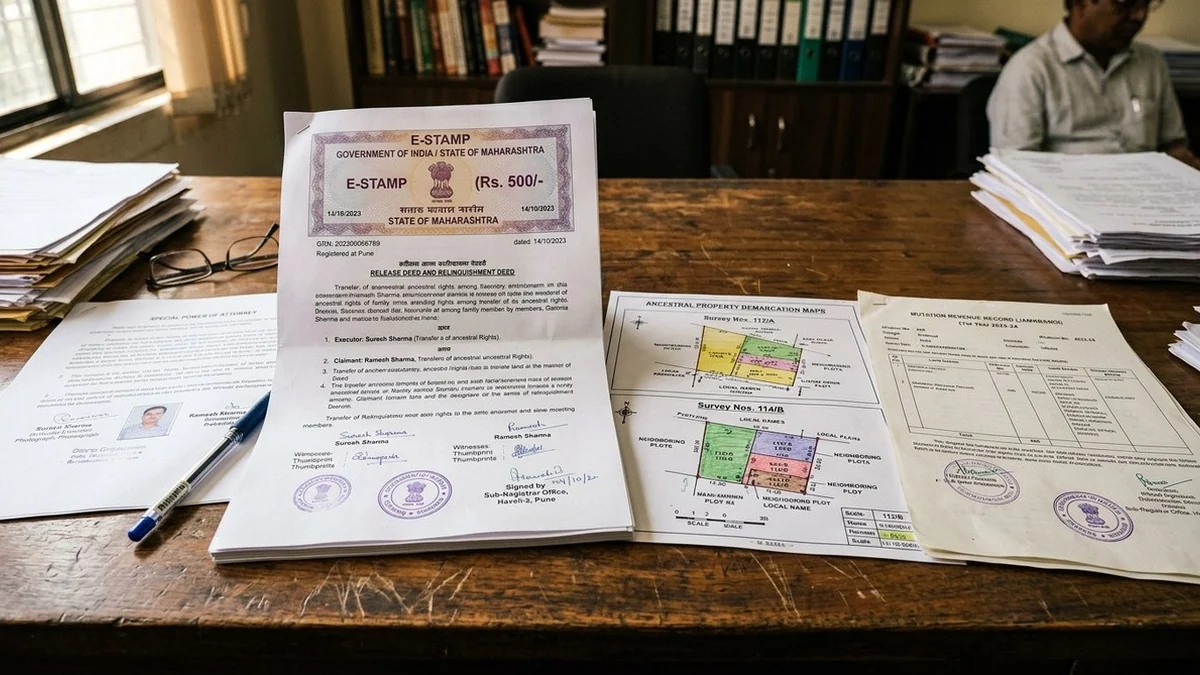
When a property owner dies intestate, their estate devolves jointly upon all Class I legal heirs (mother, widow, sons, daughters). Often, family members agree that certain heirs (e.g., married daughters or siblings) will surrender their inherited share in favour of another family member. This is accomplished legally via a Relinquishment Deed (Tyag Patra) or a Release Deed.
1. Comparison Overview Table
| Parameter | Relinquishment Deed (Tyag Patra) | Release Deed |
|---|---|---|
| Eligible Parties | Executed ONLY between legal co-heirs who inherited joint ancestral/intestate property. | Can be executed between co-owners, partners, or interested property claim holders. |
| Consideration | Voluntary, executed without monetary payment. | Can be executed with or without monetary consideration. |
| Stamp Duty Advantage | Attracts concessionary, nominal stamp duty in Haryana for immediate blood relatives. | Attracts standard stamp duty based on property valuation if consideration is paid. |
| Registration Mandate | Mandatory under Section 17(1)(b) Registration Act. | Mandatory under Section 17(1)(b) Registration Act. |
- Distinguish Ancestral vs Self-Acquired: Verify whether property was inherited across 4 generations unpartitioned to protect coparcenary birthrights under Hindu Succession Act.
- Procure Certified Revenue Records: Obtain 30-year Jamabandi (Record of Rights), Mutation (Intiqal), and Aks Shajra maps from the local Tehsil office.
- Apply for Interim Injunction under Order 39: Move an urgent civil application to restrain co-owners from selling, constructing, or altering the property during partition litigation.
The Supreme Court held that an unregistered relinquishment deed or release deed that purports to extinguish right, title, or interest in immovable property cannot be received in evidence for any transaction affecting the property under Section 49 of the Registration Act.
2. Stamp Duty Benefits in Haryana
In Haryana, executing a registered Relinquishment Deed among immediate blood relatives (father, mother, son, daughter, brother, sister) carries significant stamp duty savings compared to a Gift Deed or Sale Deed.
3. Comprehensive Legal Framework under Indian Succession Act & Hindu Succession Act
Estate planning, testamentary conveyancing, and inheritance in India are governed by the Indian Succession Act, the Hindu Succession Act (amended 2005), the Transfer of Property Act, and the Registration Act. Successfully protecting family wealth and preventing partition disputes requires understanding the critical legal differences between self-acquired and ancestral coparcenary properties.
Fundamental statutory principles governing succession and wills include:
- Testamentary Capacity (Section 59 Indian Succession Act): Every person of sound mind not being a minor may dispose of their self-acquired property by Will. Testator must possess testamentary disposing capacity at the precise moment of execution.
- Mandatory Attestation (Section 63(c) Indian Succession Act): A Will must be signed by the testator in the presence of at least two attesting witnesses, each of whom must have seen the testator sign and must sign the Will in the testator's presence. Beneficiaries should not act as attesting witnesses.
- Ancestral vs Self-Acquired Property: A Hindu father/ancestor cannot Will away ancestral coparcenary property to the exclusion of other coparceners. However, self-acquired property can be bequeathed to anyone, completely disinheriting legal heirs.
- Daughters' Equal Coparcenary Rights: Under the landmark 2020 Supreme Court ruling in Vineeta Sharma, daughters have equal birthright in ancestral coparcenary property with status identical to sons, irrespective of whether the father was alive on the date of the 2005 amendment.
4. Landmark Supreme Court Precedents in Succession Law
The Supreme Court definitively settled that the 2005 Amendment to Section 6 of the Hindu Succession Act confers coparcenary status on daughters by birth, operating retroactively regardless of whether the father passed away before 9th September 2005.
The foundational ruling establishing that the propounder of a Will must prove due execution, attestation, and sound disposing mind, while dispelling all 'suspicious circumstances' surrounding the execution of the instrument.
The Supreme Court established that a 'Nominee' in a bank account, insurance policy, or housing society is merely a trustee/custodian authorized to receive funds, which must ultimately be distributed among legal heirs in accordance with succession laws or Will.
5. Complete Procedural Roadmap: Will Execution, Probate & Succession Petitions
The lifecycle of testamentary and intestate estate transfer before Civil Courts and Sub-Registrars in Haryana follows this structured path:
- Drafting & Execution of Watertight Will: Drafting comprehensive Will identifying all movable/immovable assets, appointing Executors, defining specific bequests, and obtaining medical fitness certificate from a registered physician.
- Registration before Sub-Registrar: Though optional under Section 18 of Registration Act, registering the Will before the Sub-Registrar creates strong presumption of genuineness and negates coercion claims.
- Safekeeping & Codicils: Depositing sealed Will under Section 42 of Registration Act. Executing supplementary Codicils for asset additions or beneficiary changes.
- Probate Petition (Indian Succession Act): In presidential cities (or where properties are situated in Mumbai/Kolkata/Chennai), executors file Probate Petition before District Judge. Citation published in national newspapers.
- Succession Certificate / Letter of Administration: In intestate succession (no Will), legal heirs apply for Succession Certificate for movable securities (debts, shares, bank balances) under Section 372 Indian Succession Act.
- Mutation of Revenue Records: Certified copy of Will/Succession Certificate submitted to Municipal Corporation (MCF Faridabad) and Tehsil for sanction of mutation (Dakhil Kharij) in Record of Rights (Jamabandi) records.
6. Comparative Assessment Table: Estate Transfer Instruments
| Parameter | Registered Will | Gift Deed (Hibanama) | Family Settlement Deed (FSD) |
|---|---|---|---|
| Operative Effect | Only post-death of testator | Immediate inter-vivos transfer | Immediate family partition |
| Revocability | 100% revocable anytime during life | Irrevocable once accepted | Binding on all signatories |
| Stamp Duty | Nominal (₹100 - ₹500) | Full state stamp duty (~2% to 7%) | Nominal if recording past partition |
| Vulnerability to Challenge | Can be contested on mental fitness/fraud | Extremely difficult to challenge | Courts strongly favor family peace |
7. Strategic Legal Advisory for Asset Protection in Faridabad & Delhi NCR
To ensure smooth wealth transmission and insulate real estate assets from future litigation, our senior succession lawyers recommend:
- Always Attach a Doctor's Mental Fitness Certificate: Have a qualified MBBS physician examine the testator on the day of Will signing, attesting sound disposing mind on the document itself.
- Video Record the Execution Process: High-definition video recording of the testator reading and signing the Will in the presence of attesting witnesses provides irrefutable digital evidence under Section 63 BSA 2023.
- Execute Registered Relinquishment Deeds: When family members agree to surrender rights in favor of one sibling or mother, always register a formal Relinquishment Deed with clear consideration clauses.
8. Frequently Asked Questions (FAQ)
Answer: Yes. An individual has absolute testamentary freedom over self-acquired property under Section 30 of the Hindu Succession Act. The parent can legally execute a Will bequeathing 100% of self-acquired property to anyone, completely excluding any child.
Answer: No. Section 18 of the Registration Act classifies Wills as optionally registrable documents. An unregistered Will is 100% legally valid if executed in accordance with Section 63 of the Indian Succession Act. However, registration before the Sub-Registrar makes it far harder for disgruntled relatives to challenge.
Answer: Under Section 23 of the Maintenance and Welfare of Parents and Senior Citizens Act, 2007, if a senior citizen transfers property by gift subject to the condition that the child provide basic amenities, and the child neglects them, the Senior Citizens Tribunal can declare the Gift Deed null and void.
9. Complete Checklist for Executing Registered Relinquishment Deeds
- Original Parent Title Deed / Will: Establishing that all parties are bona fide legal co-heirs.
- Family Tree (Shajra Nasab / Legal Heir Certificate): Issued by Tehsildar or Sub-Divisional Magistrate (SDM).
- NOC from Relinquishing Co-Sharers: Express statement releasing undivided shares in favor of specific co-owners.
- Haryana E-Stamp Paper & Registration Fee: Requisite state stamp duty and registration fee receipt.
- Two Independent Identifiers: Witnesses with local Aadhar cards present before the Sub-Registrar.
Statutory Authorities & Legal References
- Transfer of Property Act (Sections 53A, 54 Sale, Section 106 Tenancy)
- Registration Act, Indian Stamp Act & Haryana Stamp Rules
- Specific Relief Act (Section 16(c) Readiness and Willingness & Injunctions)
- Code of Civil Procedure (Order 39 Rules 1 & 2 Temporary Injunctions)
- Case precedents reported in Supreme Court Cases (SCC), All India Reporter (AIR), and Punjab Law Reporter (PLR).
- e-Courts Services & National Judicial Data Grid (NJDG) procedural tracking guidelines.
Disclaimer: This article is published for educational and informational purposes only under the Advocates Act, 1961. It does not constitute formal legal advice or create an attorney-client relationship. For case-specific legal strategy, consult a qualified advocate.
Actionable Next Steps & Critical Legal Checklist
If you are facing an active legal dilemma regarding Ancestral Property & Partition Action Checklist, execute these immediate procedural steps to protect your statutory rights:
- Distinguish Ancestral vs Self-Acquired: Verify whether property was inherited across 4 generations unpartitioned to protect coparcenary birthrights under Hindu Succession Act.
- Procure Certified Revenue Records: Obtain 30-year Jamabandi (Record of Rights), Mutation (Intiqal), and Aks Shajra maps from the local Tehsil office.
- Apply for Interim Injunction under Order 39: Move an urgent civil application to restrain co-owners from selling, constructing, or altering the property during partition litigation.