Restitution of Conjugal Rights: Section 9 HMA
 Authored by: Advocate Kishan Kumar (Advocate & Legal Consultant)
Quick Legal Takeaways
- Section 9 HMA Remedy: Filed by an aggrieved spouse when the other spouse withdraws from marital cohabitation without reasonable excuse.
- Reasonable Excuse Defence: Physical/mental cruelty or dowry harassment (Section 85/86 BNS) serves as a valid defence to dismiss Section 9.
- Stepping Stone to Divorce (Sec 13(1A)(ii)): Non-restitution for 1+ year after a Section 9 decree entitles either spouse to file for Contested Divorce.
- Constitutional Validity: Upheld by the Supreme Court in Saroj Rani v. Sudarshan Kumar (1984).
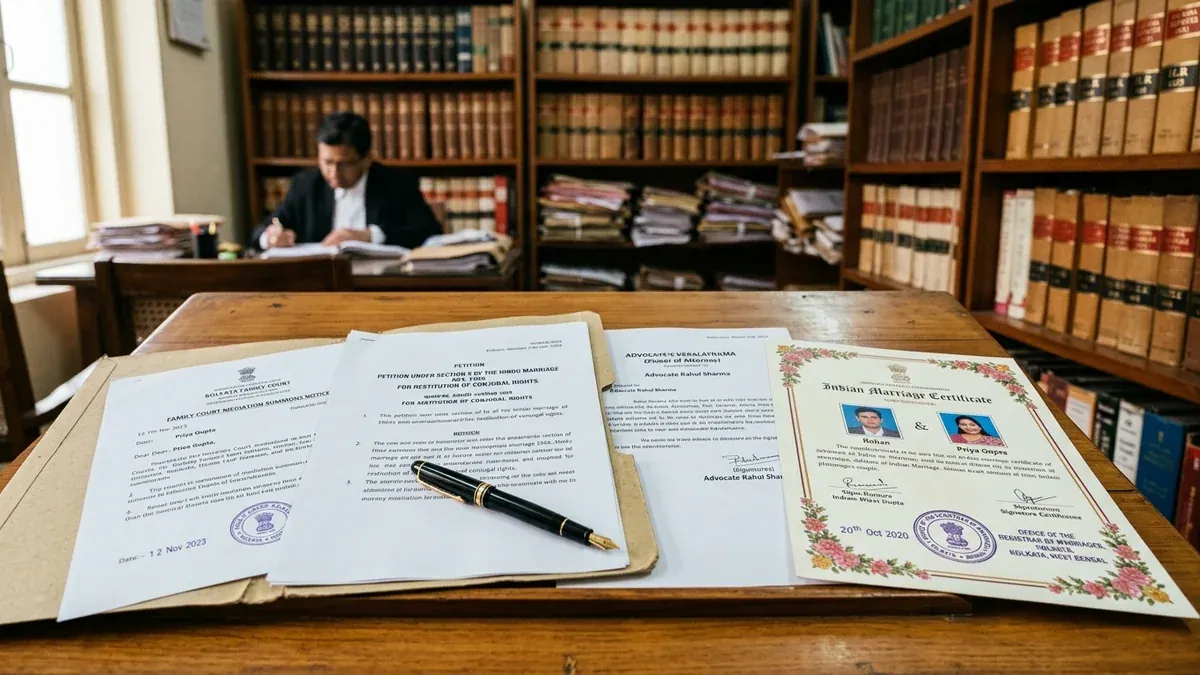
When a spouse leaves the matrimonial home without justifiable cause, the aggrieved spouse can file a petition for Restitution of Conjugal Rights under Section 9 of the Hindu Marriage Act. This remedy aims to preserve the institution of marriage by inviting the court to direct the deserting spouse to return and resume cohabitation.
- Establish Specific Statutory Grounds: Provide concrete dates, contemporaneous communications, and witness testimonies substantiating mental cruelty or desertion under Section 13(1) HMA.
- Apply for Interim Protective Orders: Under Section 12 PWDVA, seek urgent ex-parte protection orders, residence rights, and monetary maintenance to prevent matrimonial eviction.
- Protect Joint Bank Accounts & Assets: Audit joint lockers, mutual funds, and immovable property titles to restrain unilateral disposal or unauthorized withdrawals.
1. Three Mandatory Conditions for Granting Section 9 Decree
- The respondent spouse has withdrawn from the society of the petitioner.
- Such withdrawal was made without any reasonable excuse.
- The Family Court is satisfied regarding the truth of statements made in the petition and there is no legal bar to granting relief.
2. What Constitutes a "Reasonable Excuse" to Refuse Cohabitation?
If the respondent spouse proves that living together is unviable due to legal grounds, the court will dismiss the Section 9 petition. Valid defences include:
- Acts of physical or severe mental cruelty by the petitioner.
- Demand for unlawful dowry or harassment by in-laws (related to Section 85/86 BNS cruelty charges).
- Petitioner indulging in an extramarital relationship.
The Supreme Court upheld the constitutional validity of Section 9 HMA, observing that the purpose of the decree is to offer an opportunity for reconciliation between estranged spouses and prevent hasty breakdown of marriage.
3. Strategic Link Between Section 9 and Contested Divorce
Section 9 serves as a strategic stepping stone toward divorce under Section 13(1A)(ii) HMA:
- Establish Specific Statutory Grounds: Provide concrete dates, contemporaneous communications, and witness testimonies substantiating mental cruelty or desertion under Section 13(1) HMA.
- Apply for Interim Protective Orders: Under Section 12 PWDVA, seek urgent ex-parte protection orders, residence rights, and monetary maintenance to prevent matrimonial eviction.
- Protect Joint Bank Accounts & Assets: Audit joint lockers, mutual funds, and immovable property titles to restrain unilateral disposal or unauthorized withdrawals.
4. Comprehensive Statutory Analysis under Indian Matrimonial Law
Family and matrimonial disputes in India operate across intertwined statutory frameworks: the Hindu Marriage Act, the Special Marriage Act, the Domestic Violence Act, 2005 (PWDVA), and maintenance regimes under Section 144 of the Bharatiya Nagarik Suraksha Sanhita, 2023 / Section 125 CrPC. Handling matrimonial disputes requires balanced legal strategy combining court litigation, asset protection, child welfare priorities, and structured mediation.
The major legal avenues available to spouses before Family Courts include:
- Mutual Consent Divorce (Section 13B HMA): Spouses living separately for 1 year can jointly petition for divorce by mutual consent. First Motion (joint statement) is followed by a 6-month statutory waiting period (which can be waived by moving an application under Supreme Court guidelines in Amardeep Singh), culminating in the Second Motion and final decree of dissolution.
- Contested Divorce (Section 13(1) HMA): Grounds include Cruelty (physical/mental), Desertion (uninterrupted 2+ years), Adultery, Conversion, Incurable Mental Disorder, and Venereal Disease.
- Maintenance & Alimony (Section 24 & 25 HMA, Sec 144 BNSS): Interim maintenance during litigation pendency (Section 24 HMA) and permanent alimony upon decree (Section 25 HMA), assessed according to comprehensive income affidavits mandated in Rajnesh v. Neha .
- Child Custody & Guardianship (Guardians and Wards Act): Custody determinations are strictly governed by the paramount doctrine of the 'Welfare of the Child' rather than parental proprietary claims.
5. Landmark Supreme Court Judgments in Matrimonial Jurisprudence
The Supreme Court established uniform national guidelines for maintenance calculation, making it mandatory for both spouses to file comprehensive Affidavits of Assets and Liabilities covering income, properties, bank accounts, and lifestyle expenses.
Held that the 6-month cooling-off period under Section 13B(2) HMA is directory, not mandatory. Family Courts can waive the waiting period where parties have genuinely settled all alimony, child custody, and property issues.
Affirmed that the Supreme Court can grant direct divorce under Article 142 on the ground of 'Irretrievable Breakdown of Marriage' without waiting for statutory periods where the marriage is emotionally dead and beyond repair.
6. Complete Procedural Roadmap of Family Court Litigation
The procedural journey of matrimonial litigation before Family Courts in Haryana (Faridabad Sector-12) proceeds through these key stages:
- Filing Petition & Service of Summons: Matrimonial petition drafted with marriage certificate, wedding photographs, address proofs, and verified pleadings. Summons issued to respondent spouse.
- Mandatory Court-Annexed Mediation: Section 9 of the Family Courts Act, 1984 mandates referring spouses to trained mediators to explore reconciliation or amicable settlement.
- Filing Income & Asset Affidavits (Rajnesh v. Neha): Both parties submit comprehensive disclosure affidavits along with 3 years of ITRs, bank statements, and salary slips.
- Interim Maintenance Orders (Section 24 HMA / Sec 144 BNSS): Court determines monthly interim maintenance for spouse and minor children alongside litigation expenses.
- Written Statement & Framing of Issues: Respondent files defense; court frames substantive legal issues regarding cruelty, desertion, or entitlement to divorce.
- Evidence & Cross-Examination: Parties lead oral testimony, call bank/employer witnesses, and cross-examine on allegations of cruelty or financial suppression.
- Final Arguments & Judgment / Decree: Court adjudicates the petition, orders permanent alimony, custody/visitation rights, and dissolves the marriage.
7. Comparative Assessment Table: Matrimonial Remedies & Legal Routes
| Parameter | Mutual Consent Divorce (13B HMA) | Contested Divorce (13(1) HMA) | Domestic Violence (Sec 12 PWDVA) |
|---|---|---|---|
| Duration | 1 to 6 Months (with waiver) | 2 to 4 Years | 6 to 18 Months |
| Key Requirement | Consensus on alimony, custody, assets | Proving statutory grounds (cruelty/desertion) | Domestic relationship & domestic violence |
| Remedies Granted | Divorce dissolution & clean break | Divorce decree + permanent alimony | Residence, protection, interim maintenance |
| Appeal Forum | Non-appealable by consent | High Court (First Appeal under Sec 19 FCA) | Sessions Court / High Court Revision |
8. Strategic Legal Advisory for Matrimonial Cases in Delhi NCR
To protect legal rights, emotional well-being, and financial security during matrimonial disputes, our senior family advocates advise:
- Comprehensive Memorandum of Understanding (MOU): In mutual consent divorce, ensure the MOU explicitly details the mode and schedule of alimony payments, Stridhan return, joint property division, and irreversible withdrawal of all cross-complaints (Section 125, DV Act, 498A/85 BNS).
- Maintain Complete Financial Disclosure: Never suppress income, as perjury applications under Section 340 CrPC / Section 379 BNSS can be initiated for false asset affidavits.
- Prioritize Structured Child Visitation: Draft unambiguous parenting plans specifying holiday schedules, school fee sharing, medical decision rights, and international travel consent protocols.
Statutory Authorities & Legal References
- Hindu Marriage Act (Sections 13, 13B, 24, 25) & Special Marriage Act
- Domestic Violence Act, 2005 (PWDVA) & Section 144 BNSS
- Supreme Court Guidelines in Rajnesh v. Neha (2020) & Aditi alias Mithi v. Jitesh Sharma (2023)
- Case precedents reported in Supreme Court Cases (SCC), All India Reporter (AIR), and Punjab Law Reporter (PLR).
- e-Courts Services & National Judicial Data Grid (NJDG) procedural tracking guidelines.
Disclaimer: This article is published for educational and informational purposes only under the Advocates Act, 1961. It does not constitute formal legal advice or create an attorney-client relationship. For case-specific legal strategy, consult a qualified advocate.
Actionable Next Steps & Critical Legal Checklist
If you are facing an active legal dilemma regarding Matrimonial Litigation & Asset Protection Checklist, execute these immediate procedural steps to protect your statutory rights:
- Establish Specific Statutory Grounds: Provide concrete dates, contemporaneous communications, and witness testimonies substantiating mental cruelty or desertion under Section 13(1) HMA.
- Apply for Interim Protective Orders: Under Section 12 PWDVA, seek urgent ex-parte protection orders, residence rights, and monetary maintenance to prevent matrimonial eviction.
- Protect Joint Bank Accounts & Assets: Audit joint lockers, mutual funds, and immovable property titles to restrain unilateral disposal or unauthorized withdrawals.
Frequently Asked Questions
Key statutory answers and procedural guidance curated by Senior Advocates in Faridabad & Delhi NCR.
Can an NRI spouse file for mutual consent divorce without traveling to India?
Yes. Under modern Family Court rules and Supreme Court directives, NRI spouses residing abroad can execute a Special Power of Attorney (SPA) attested by the Indian Embassy, and participate in First and Second Motion statements via video conferencing.
How is child custody decided if both parents are working and financially capable?
Financial capacity is secondary to the child's emotional stability, educational continuity, and day-to-day welfare. For children under 5 years, custody is generally with the mother under Section 6(a) of the Hindu Minority & Guardianship, while granting extensive weekend and holiday visitation to the father.
What is the statutory limitation period for filing proceedings related to restitution of conjugal rights: section 9 hma?
Under the Limitation Act, 1963, limitation varies depending on the specific cause of action (e.g. 3 years for civil suits/contracts, 30 days for Section 138 NI Act notices, 90 days for statutory appeals). You can verify exact limitation windows using our interactive Limitation Calculator.
How can I consult an experienced advocate in Delhi NCR or Haryana for restitution of conjugal rights: section 9 hma?
You can schedule a confidential legal consultation with Advocate Kishan Kumar at Urban Rights Legal Consultants (Chamber No. 343, District & Sessions Court Complex, Faridabad) by phone or WhatsApp at +91-92120-22119 to review case documents and structure an effective litigation strategy.