 Authored by: Advocate Kishan Kumar (Advocate & Legal Consultant)
Superdari Vehicle Release: Section 503 BNSS Guide
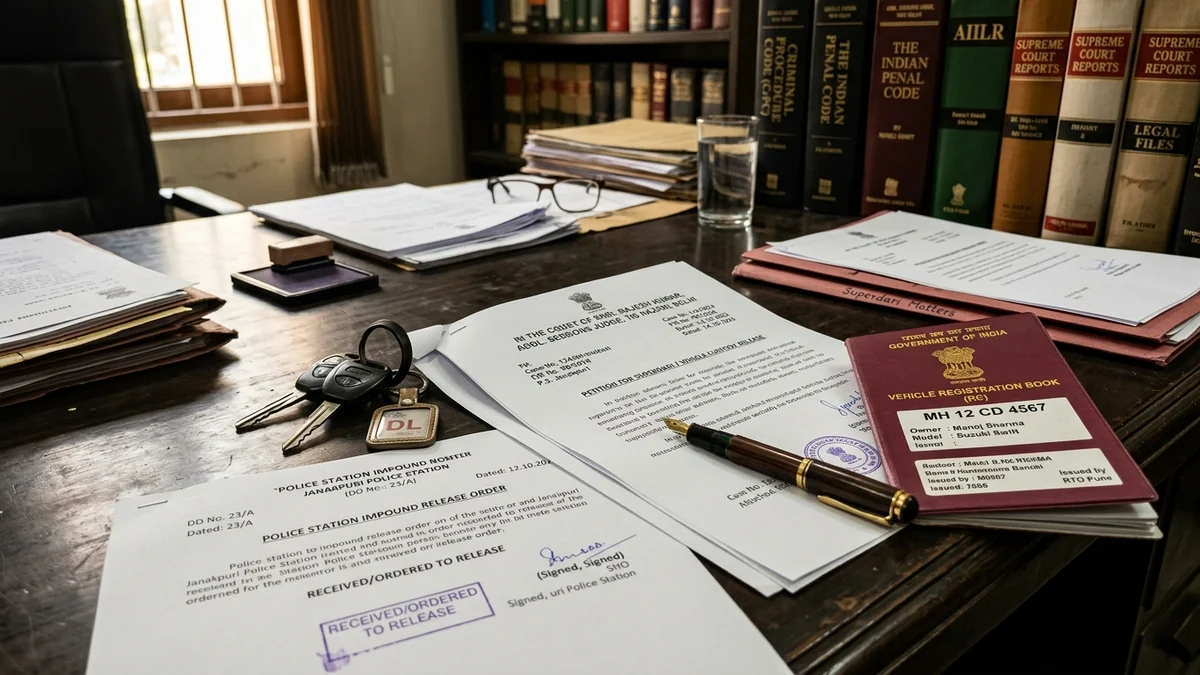
Quick Legal Takeaways
- Core Statutory Base: Exhaustive legal coverage under the latest 2024–2026 statutes and landmark judicial precedents.
- Practical Procedure: Detailed step-by-step litigation roadmap before District Courts, High Courts, and specialized tribunals.
- Evidence & Remedies: How to build watertight documentary trails and protect civil and personal liberties.
1. When and Why Do Police Seize Vehicles in Criminal Matters?
Vehicles (cars, commercial trucks, two-wheelers, and construction machinery) are frequently seized by police authorities during the course of criminal investigations and motor vehicle accident inquiries. Under the Bharatiya Nagarik Suraksha Sanhita, 2023, vehicles are impounded in several common legal scenarios:
- Motor Accident Claims & FIRs (Sections 106 / 281 BNS): Seized for mechanical inspection following road accidents.
- Transportation of Contraband / Criminal Acts: Vehicles alleged to have been used in carrying smuggled goods, illicit liquor, or commission of offences.
- Drunk Driving & Seizure under Motor Vehicles Act (Section 207 MV Act): Vehicles impounded for driving without valid papers, dangerous driving, or unpaid compounding challans.
- Recovery of Stolen Vehicles: Vehicles recovered by police after theft or fraudulent transfer.
2. The Sunderbhai Ambalal Desai Mandate: Vehicles Must Not Rust in Thanas
A historic problem in Indian police stations was the indefinite detention of seized vehicles in open-air yards (Malkhanas), resulting in scrap degradation, mechanical rot, and parts theft. The Supreme Court of India stepped in to create an unambiguous legal mandate governing interim custody.
In the landmark judgment of Sunderbhai Ambalal Desai v. State of Gujarat (2002) 10 SCC 283, the Supreme Court mandated: "It is of no use to keep-seized vehicles at the police stations for a long period. It is for the Magistrate to pass appropriate orders immediately by taking appropriate bond and guarantee as well as security for return of the said vehicles, if required at any point of time. The power under Section 451 CrPC (now Section 503 BNSS) should be exercised expeditiously and within a period of not more than 15 to 30 days."
3. Comprehensive Statutory Analysis under Sections 502, 503 & 504 BNSS
The disposal and interim custody of seized property under BNSS 2023 is governed by a streamlined statutory mechanism:
- Section 503 BNSS (Order for Custody & Disposal of Property Pending Trial): Empowers the Judicial Magistrate to pass interim custody orders (Superdari) for property produced before court during inquiry or trial (formerly Section 451 CrPC).
- Section 503(2) BNSS (Photographic & Panchnama Record): Mandates that before releasing the vehicle, the court shall prepare a detailed inventory (Panchnama), take certified photographs, and record engine/chassis numbers so the actual vehicle does not need to be produced physically on every hearing date.
- Section 504 BNSS (Disposal of Property at Conclusion of Trial): Governs the final permanent disposal, confiscation, or return of property upon conclusion of the criminal trial (formerly Section 452 CrPC).
- Section 505 BNSS (Procedure upon Police Seizure without Trial): Covers release of property seized by police where no formal inquiry or trial is pending in court (formerly Section 457 CrPC).
4. Landmark Judicial Precedents on Vehicle Superdari
Established universal guidelines for criminal courts across India: commercial and private vehicles must be released promptly to the registered owner on superdari bonds after photographic inventory, ensuring vehicles remain roadworthy and useful.
The Supreme Court directed all state police forces and High Courts to implement the Sunderbhai Desai guidelines strictly, mandating that insurance companies and registered owners should obtain vehicle release within a strict timeline without bureaucratic delays.
Clarified that where specialized state statutes (such as Forest Acts or Excise Acts) provide for independent administrative confiscation proceedings by an Authorized Officer, magistrate courts cannot override statutory confiscation unless permitted by special law.
5. Step-by-Step Procedural Roadmap for Superdari Vehicle Release
The step-by-step procedure to release a seized vehicle from police custody through the Faridabad or Delhi NCR District Courts follows this sequence:
- Obtain Mechanical Inspection & Seizure Memo: Collect the official Seizure Memo (Fard Zabti) and verify that the Motor Vehicle Inspector (MVI) has conducted physical inspection of the car/bike.
- Drafting Superdari Application under Section 503 BNSS: Prepare a formal application before the Jurisdictional Judicial Magistrate First Class (JMFC) containing vehicle description, registration number, engine number, chassis number, and proof of ownership.
- Filing Supporting Ownership Documents: Attach original/certified copies of Registration Certificate (RC), valid insurance policy, pollution certificate (PUC), driving license, and Aadhaar card of the registered owner.
- Police Verification & Status Report: The Magistrate calls for a report from the Investigating Officer (IO) verifying title ownership and confirming that the vehicle is no longer needed for physical custody.
- Execution of Superdarinama (Indemnity Bond): The owner or surety executes a Superdarinama bond (typically equal to the market value of the car). The Magistrate issues a Release Warrant (Robkar) addressed to the SHO/Malkhana Incharge to hand over physical possession.
6. Comparative Table: Interim Custody (Superdari) vs. Final Disposal
| Parameter | Interim Release on Superdari (Section 503 BNSS) | Final Disposal / Release (Section 504 BNSS) |
|---|---|---|
| Stage of Proceeding | During investigation or pending criminal trial | After final judgment and conclusion of trial |
| Ownership Conditions | Conditional custody (cannot sell/alter without court permission) | Absolute unconditional ownership restored |
| Security Requirement | Superdari bond + solvent surety required | No surety required (final decree) |
| Production in Court | Must produce vehicle if ordered (rare with photo inventory) | No further production requirement |
7. Practical Advisory for Car & Commercial Fleet Owners in NCR
- Only Registered Owner (RC Holder) Can Claim Superdari: If the vehicle was purchased on GPA or without name transfer on RC, obtain a Special Power of Attorney (SPA) from the registered owner or join them as co-applicant.
- Do Not Alter Vehicle Color or Structure: While the vehicle is on interim superdari custody, do not change its color, chassis structure, or sell it to third parties without prior permission of the trial court.
- Keep Insurance Active: Ensure comprehensive vehicle insurance is immediately renewed upon release to avoid compounding liability in pending motor accident claim proceedings.
8. Frequently Asked Questions (FAQ)
Answer: A Superdari application (under Section 503 BNSS 2023 / formerly Section 451 CrPC) is a formal court petition moved by the registered owner of a seized vehicle or property requesting the Judicial Magistrate to release the property into their interim custody pending the criminal trial.
Answer: Under standard procedure in Faridabad and Delhi NCR District Courts, a Superdari application is typically decided within 3 to 7 working days once the court receives the verification report from the investigating police officer.
Answer: No. When property is released on Superdari, the owner executes an indemnity bond promising not to sell, transfer, dismantle, or alter the vehicle without prior written permission of the trial court until the criminal case is conclusively decided.
Answer: Yes. If the vehicle is subject to a valid hypothecation / hire-purchase agreement and the borrower defaults or is unable to maintain the asset, the financing bank or NBFC can move a Superdari application as a lawful interested party under Section 503 BNSS.
Answer: Mandatory documents include: (a) Original or certified copy of Registration Certificate (RC), (b) Valid vehicle insurance policy, (c) Pollution Under Control (PUC) certificate, (d) Aadhaar card of the owner, (e) Copy of police FIR / Seizure Memo, and (f) Solvent surety documents for executing the Superdarinama bond.
Statutory Authorities & Legal References
- Bharatiya Nyaya Sanhita & Bharatiya Nagarik Suraksha Sanhita, 2023
- Bharatiya Sakshya Adhiniyam, 2023 (Section 63 Electronic Evidence Certificate)
- Landmark rulings of the Supreme Court of India and Punjab & Haryana High Court
- Case precedents reported in Supreme Court Cases (SCC), All India Reporter (AIR), and Punjab Law Reporter (PLR).
- e-Courts Services & National Judicial Data Grid (NJDG) procedural tracking guidelines.
Disclaimer: This article is published for educational and informational purposes only under the Advocates Act, 1961. It does not constitute formal legal advice or create an attorney-client relationship. For case-specific legal strategy, consult a qualified advocate.
Actionable Next Steps & Critical Legal Checklist
If you are facing an active legal dilemma regarding Criminal Trial Defence & Evidence Checklist, execute these immediate procedural steps to protect your statutory rights:
- Establish Civil Nature of Dispute: Demonstrate through contracts, account ledgers, and bank trails that the matter involves commercial breach rather than penal fraud.
- Preserve Digital Communications: Archive all WhatsApp chats, SMS threads, emails, and audio recordings certified under Section 63 of Bharatiya Sakshya Adhiniyam 2023.
- Explore Section 359 BNSS Compounding: If parties resolve differences, prepare a formal Compromise Deed for compounding or mutual quashing before the High Court.