Is Stop Payment Instruction to Bank an Offence under Section 138 NI Act?
 Authored by: Advocate Kishan Kumar (Advocate & Legal Consultant)
Quick Legal Takeaways
- Sec 138 Applicability: Issuing "Stop Payment" instructions does NOT escape Section 138 criminal liability if the cheque was issued for a legally enforceable debt.
- MMTC & Goaplast Rulings: Supreme Court confirmed that stop payment memo carries identical statutory presumption under Section 139 NI Act.
- Valid Defence Conditions: To defend a stop-payment charge, the drawer must prove sufficient account funds on presentation date AND genuine cause (e.g. cheque lost or total failure of contract).
- Notice Timeline: Payees must dispatch a 30-day legal demand notice following the stop payment memo.
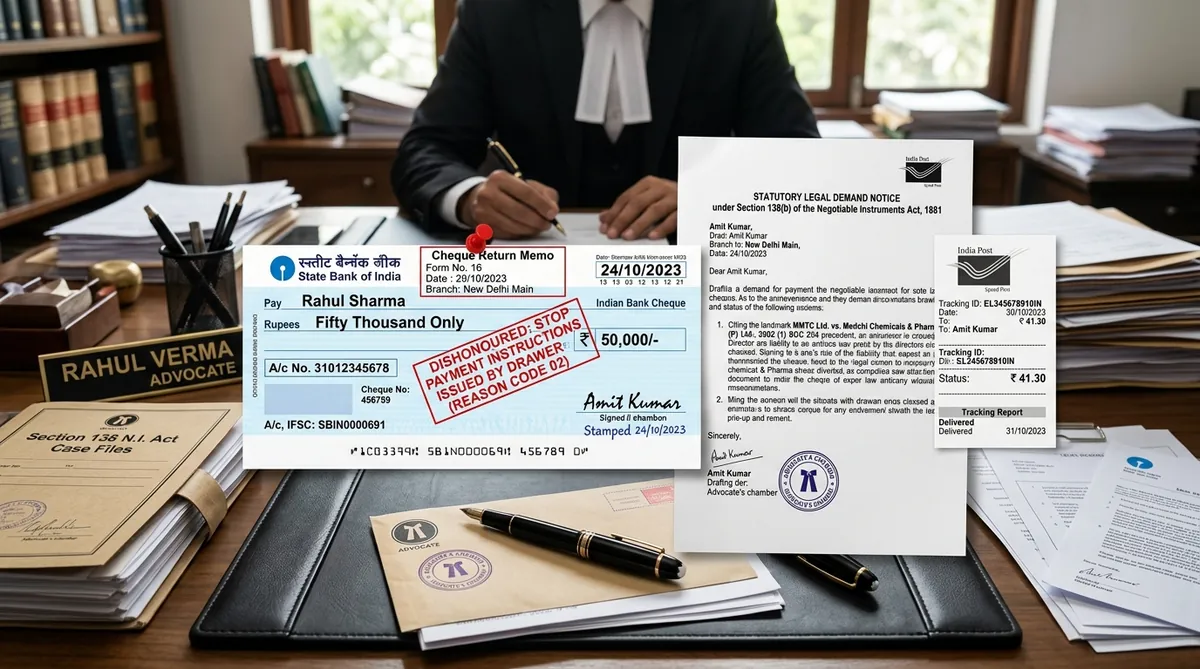
A common misconception among business owners and individual drawers is that issuing a "Stop Payment" instruction to their bank prevents criminal prosecution under Section 138 of the Negotiable Instruments Act (NI Act). The Supreme Court of India has repeatedly held that "Stop Payment" instructions do not escape Section 138 liability if the cheque was issued for a legally enforceable debt.
The Supreme Court held that a complaint under Section 138 NI Act is 100% maintainable even if the cheque is returned with the endorsement "Payment Stopped by Drawer". The statutory presumption under Section 139 NI Act applies equally to stop-payment cases.
The Apex Court affirmed that if stop payment instructions were allowed as an automatic defence, the sanctity and commercial utility of negotiable instruments would be destroyed. Section 138 applies whether the cheque is returned due to "insufficient funds" or "stop payment".
1. When Can "Stop Payment" Act as a Valid Defence?
To successfully defend a Section 138 prosecution involving stop-payment instructions, the accused drawer must prove two specific conditions in court:
- That there were sufficient funds available in the bank account on the date the cheque was presented.
- That "Stop Payment" was issued due to a valid, lawful reason (e.g., cheque stolen, lost, or total failure of contract performance by the payee).
2. Statutory Timelines Still Apply to Stop Payment Cases
Payees holding a stop-payment dishonoured cheque must strictly observe statutory limits:
- Dispatch a statutory legal demand notice within 30 days of receiving the bank return memo (as detailed in our Section 138 legal notice checklist).
- Grant a 15-day cure period before filing a complaint before the Judicial Magistrate.
- Claim up to 20% interim compensation under Section 143A NI Act.
3. In-Depth Statutory Framework under Negotiable Instruments Act & Civil Law
Commercial recovery and cheque dishonour litigation in India are anchored primarily in Section 138 to Section 148 of the Negotiable Instruments Act (NI Act) alongside civil recovery mechanisms under Order XXXVII of the Code of Civil Procedure (Summary Suits) and the Commercial Courts Act, 2015. Establishing criminal culpability and securing financial recovery require strict adherence to statutory limitation periods and mandatory notice formalities.
The essential ingredients to sustain a Section 138 NI Act criminal prosecution include:
- Legally Enforceable Debt or Liability: The cheque must have been issued in discharge, in whole or in part, of a legally enforceable debt or liability. Cheques issued as pure gifts, donations, or for time-barred debts require specific acknowledgment to remain enforceable.
- Presentation within Validity Period: The cheque must be presented to the bank within its validity period (3 months from the date of issuance).
- Dishonour Memo: The cheque must be returned unpaid by the bank due to 'Insufficient Funds', 'Account Closed', 'Exceeds Arrangement', or 'Payment Stopped by Drawer'.
- Mandatory 30-Day Statutory Legal Notice: The payee must demand payment in writing within 30 days of receiving the bank's memo of dishonour.
- 15-Day Grace Period & Cause of Action: If the drawer fails to make the full payment within 15 days of receiving the legal notice, the cause of action arises on the 16th day, and a criminal complaint must be filed within 30 days thereafter before the Judicial Magistrate.
4. Landmark Judicial Precedents in Commercial & Cheque Litigation
The Supreme Court held that the statutory presumption under Section 139 of the NI Act includes the existence of a legally enforceable debt. The burden shifts to the accused drawer to rebut this presumption on a preponderance of probabilities.
The Apex Court held that Section 138 offences are primarily civil wrongs with criminal overtones, and the trial court possesses inherent power to compound the offence and discharge the accused upon deposit of cheque amount with reasonable compensation.
Affirmed the mandatory nature of Section 148 NI Act, requiring appellate courts to direct the appellant-convict to deposit a minimum of 20% of the fine or compensation amount awarded by the trial court during appeal.
5. Complete Procedural Roadmap of Section 138 NI Act Trials
The structured lifecycle of a cheque bounce trial before the Judicial Magistrate First Class (JMFC) at Faridabad District Court proceeds as follows:
- Pre-Litigation Demand Notice: Drafting and serving statutory notice through Registered Post AD and Speed Post with tracking reports within 30 days of dishonour.
- Filing Criminal Complaint: Institution of complaint under Section 138/142 NI Act accompanied by original cheque, return memo, postal receipts, tracking report, and pre-summoning evidence affidavit.
- Pre-Summoning Evidence & Cognizance: Complainant deposes via Section 145 NI Act affidavit. Magistrate takes cognizance and issues summons under Section 204 CrPC (Section 227 BNSS).
- Notice of Accusation & Plea: Accused appears, secures bail, and court frames Notice under Section 251 CrPC (Section 274 BNSS). Accused states defense under Section 143A for interim compensation.
- Complainant Cross-Examination: Accused cross-examines complainant on financial capacity, income tax returns (ITRs), and source of funds to rebut statutory presumption.
- Statement of Accused & Defence Evidence: Accused records statement and introduces bank ledgers, handwriting expert reports, or counter-receipts.
- Final Arguments & Judgment: Court evaluates evidence and pronounces sentence (up to 2 years imprisonment, double the cheque amount as fine, or both).
6. Comparative Assessment Table: Cheque Bounce vs Civil Recovery Suit
| Parameter | Section 138 NI Act Complaint | Order 37 CPC Summary Suit | Ordinary Civil Money Suit |
|---|---|---|---|
| Nature of Remedy | Criminal prosecution with financial penalty | Fast-track civil decree | Regular civil decree |
| Court Fees | Nominal court fee (e.g. ₹50 - ₹1000) | Ad-valorem court fee based on amount | Full ad-valorem court fee (~5% - 7.5%) |
| Limitation Period | 30 days post 15-day notice period | 3 years from cause of action | 3 years from loan date / breach |
| Interim Compensation | Up to 20% under Section 143A NI Act | Conditional leave to defend deposit | Attachment before judgment (Order 38) |
7. Strategic Legal Advisory for Businesses & Lenders in Faridabad
To maximize recovery chances and safeguard financial interests in commercial contracts and loans, adhere to these guidelines:
- Always Document Friendly Loans: Never advance unsecured loans in cash exceeding ₹20,000 (violating Section 269SS Income Tax Act). Execute a Promissory Note and Loan Agreement on stamp paper with two independent witnesses.
- Maintain Proof of Notice Delivery: Download and notarize India Post consignment tracking reports confirming 'Item Delivered' or 'Refused' (deemed service under Section 27 General Clauses Act).
- Leverage Section 143A Interim Compensation: Move an early application after notice framing requesting the court to order 20% interim deposit within 60 days.
Statutory Authorities & Legal References
- Negotiable Instruments Act (Sections 138, 139, 141, 142 & 143A)
- Bharatiya Nagarik Suraksha Sanhita, 2023 (Summary Trial Procedure)
- Supreme Court precedents reported in Supreme Court Cases (SCC) and All India Reporter (AIR)
- Case precedents reported in Supreme Court Cases (SCC), All India Reporter (AIR), and Punjab Law Reporter (PLR).
- e-Courts Services & National Judicial Data Grid (NJDG) procedural tracking guidelines.
Disclaimer: This article is published for educational and informational purposes only under the Advocates Act, 1961. It does not constitute formal legal advice or create an attorney-client relationship. For case-specific legal strategy, consult a qualified advocate.
Actionable Next Steps & Critical Legal Checklist
If you are facing an active legal dilemma regarding Cheque Dishonour Statutory Action Checklist, execute these immediate procedural steps to protect your statutory rights:
- Adhere to 30-Day Notice Window: Issue a formal advocate legal demand notice under Section 138 Proviso (b) within exactly 30 days of receiving the bank memo.
- Preserve Original Records: Safeguard the original cheque, return memo with bank seal, postal speed post receipts, and online tracking delivery reports.
- Calculate 15-Day Cure Period: Allow exactly 15 days for payment after notice delivery before filing the complaint within 30 days under Section 142 NI Act.
Frequently Asked Questions
Key statutory answers and procedural guidance curated by Senior Advocates in Faridabad & Delhi NCR.
Can a company director be prosecuted for a cheque issued by the company?
Yes, under Section 141 of the NI Act, every person who was in charge of and responsible to the company for the conduct of its business at the time the offence was committed is vicariously liable, provided specific averments regarding their active role are made in the complaint.
What happens if the drawer issues a 'Stop Payment' instruction to the bank?
As held in Modi Cements v. Kuchil Kumar Nandi, a cheque returned with 'Stop Payment' instructions is fully actionable under Section 138 NI Actunless the drawer proves there were sufficient funds in the account and payment was stopped for a valid extraneous reason.
Is an unsigned or undated security cheque actionable under Section 138?
Under Section 20 of the NI Act, when a person signs and delivers an incomplete negotiable instrument, they grant prima facie authority to the holder to fill in remaining particulars. The Supreme Court in Bir Singh v. Mukesh Kumar (2019)confirmed that a signed blank cheque given as security is fully actionable upon dishonour.
What is the statutory limitation period for filing proceedings related to is stop payment instruction to bank an offence under section 138 ni act??
Under the Limitation Act, 1963, limitation varies depending on the specific cause of action (e.g. 3 years for civil suits/contracts, 30 days for Section 138 NI Act notices, 90 days for statutory appeals). You can verify exact limitation windows using our interactive Limitation Calculator.
How can I consult an experienced advocate in Delhi NCR or Haryana for is stop payment instruction to bank an offence under section 138 ni act??
You can schedule a confidential legal consultation with Advocate Kishan Kumar at Urban Rights Legal Consultants (Chamber No. 343, District & Sessions Court Complex, Faridabad) by phone or WhatsApp at +91-92120-22119 to review case documents and structure an effective litigation strategy.